

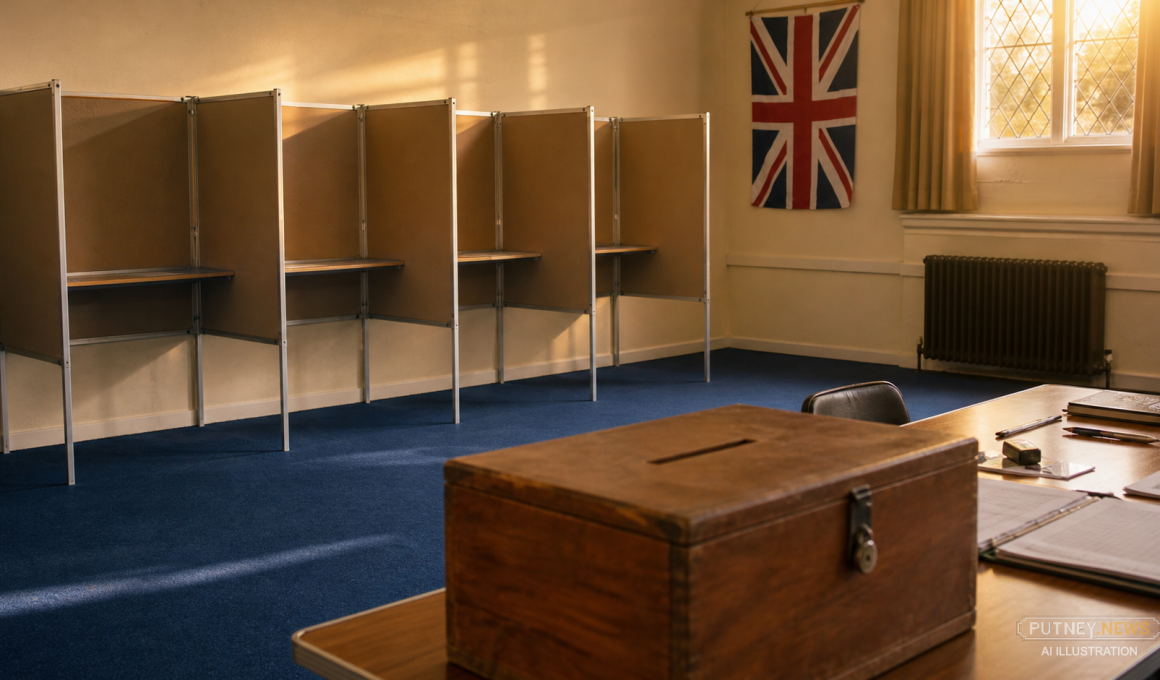
Pick your ward. Push the dials. See what it would take for Wandsworth to swing, then ask yourself how many of your neighbours need to vote the way you do for it to actually happen.
Four days from now, the borough will vote again on the longest ballot paper in living memory. There are 295 candidates standing across 22 wards. Three independent forecasting models (the YouGov MRP published in early April, the PollCheck projection and the Cavendish forecast) agree on one outcome. Nobody is winning a majority.
Wandsworth is more genuinely uncertain than at any point in decades. A few hundred votes per ward will decide which combination of choices on the Alton Estate, Putney Bridge Junction, Wimbledon Park, the council’s finances, the riverside and Hammersmith Bridge actually gets made for the next four years. The widget above is not a prediction. It is a way of seeing how thin the margins are.
Find your Wandsworth ward
Enter your postcode to see the candidates standing in your ward and our coverage of your local area.
Couldn’t find that postcode
Please check the postcode and try again.
Three models. One answer.
The YouGov MRP put the national vote share at Labour 31, Conservative 20, Reform 11. That is the headline anyone watching this election from outside Wandsworth will have seen. What matters more, locally, is what Patrick English at YouGov pointed out alongside it: Reform’s national vote share is roughly equal to the gap between Labour and the Conservatives. Whichever party Reform takes votes from, the result on Friday morning runs through how that compression plays out ward by ward.
PollCheck and Cavendish, working from different methodologies, arrive at the same place. No party is on track for a majority. Both project No Overall Control as the most likely outcome.
This is unusual. Wandsworth has not had a genuinely uncertain council election in twenty-four years. From 1978 the borough was Conservative without interruption. In 2022 it flipped clean to Labour, who took 35 seats to the Conservatives’ 22. Now, in 2026, three independent models converge on a hung council. Read coldly, that is the fact: nobody, looking at the same data, can tell you who will form the next administration.
By Friday morning the question will not be how big the swing was. It will be who can put together enough councillors to run the place.
Three things being said that the evidence does not support
There are three claims circulating about this election that the evidence doesn’t support.
The first is the Conservative comeback framing. Tony Travers at LSE projected a Conservative recovery in October last year, and ConservativeHome has run with it ever since. The forecasting picture has moved a long way in seven months. A Conservative comeback large enough to retake Wandsworth would require a uniform local swing – but that’s not how voters have been behaving nationally. At hustings events over the past month, both Labour and the Conservative have been talking in traditional terms about how it is a choice between them; audiences have consistently pushed back. We are currently living in a multi-party system, with seats dependent on which way voters looking for an alternative decide to move. The Conservatives may well finish ahead of where they were last summer. They are not finishing ahead of Labour on any current model.
The second is the Reform won’t matter at council level framing, associated with commentary from Lord Hayward, picked up by Politics UK. The arithmetic does not survive contact with the YouGov finding. If Reform takes 8 to 12% from Conservative-leaning voters in marginal wards, the structural effect is to compress whatever Conservative recovery is happening. Whether Reform wins seats or not is the wrong question – it will be hard to breakthrough in Wandsworth. The right question is whether Reform voters reshape the result through vote-splitting. The forecasting models suggest they do.
The third is the Wandsworth doesn’t move model, the longest-running of the three. Forty-four years of Conservative control, the assumption goes, made this a borough that resists change. The historical record now contradicts the framing. Wandsworth went Labour in 2022 by a margin nobody had predicted. Three independent models now project No Overall Control in 2026. That is a borough that has moved twice in five years. The assumption that it doesn’t move is itself the claim that needs evidence.
The public conversation about Wandsworth in this election is running on three confident assertions that the evidence does not support. The truth is that Wandsworth surprised national observers by shifting to Labour in 2022; it is likely to surprise them again this week and may well reflect where our national politics are headed.
Why the ballot paper itself has changed
Set the polling aside for a moment and look at the ballot paper.
In 2022, 86 candidates stood against Labour or the Conservatives across the borough. In 2026, that figure is 179. It has more than doubled. Reform UK is contesting all 22 wards from a 2022 baseline of zero. The Greens are contesting every ward. The Liberal Democrats are running a full slate. Independent and TUSC candidates fill in the rest.
This matters, because in wards where the Conservative vote share typically sits between 23 and 29%, three-way and four-way splits do not behave neutrally. A 9% Reform showing in a ward where the Conservative-Labour margin is 4 points is not a curiosity. It is the result.
Push the third-party dials and watch what happens to the swing. The maths is not opinion. It is the reality of the 2026 ballot paper. It’s not just about Reform either. The Green Party has seen a resurgence of energy in recent months and could well take a seat as well as make several others highly unpredictable; and the Liberal Democrats have been focused on a small number of target wards that may tip orange, but just as likely will decide whether the end result is red or blue.
The wards that will decide it
The result will be settled in five or six wards, most of them inside or adjacent to Putney. Let’s walk them west to east along the river, then south.
Thamesfield. Three Conservative seats in 2022 with a 9.8-point cushion. Comfortably held on paper, but Thamesfield is the ward that lives most directly with the Putney Bridge Junction failure and watched the council push the redesign works to 2027. Transport failure does not stay party-political when the buses are 41% worse than the rest of the borough. If Thamesfield slips, it slips on issues that cross the aisle.
East Putney. The 2022 margin was below one point. There is no more marginal ward in Wandsworth, or across London. The first hustings of the season was reported here, and the claims that did not survive the evidence were reported with the candidates in the room. The structural question is whether the local Conservative recovery, if there is one, can pick up enough Reform-curious voters back from the Reform candidate without losing its Lib Dem-curious voters to the Lib Dem candidate. That is the calculation that will decide the seat.
West Putney. A split ward but one that appears to be turning back to the Conservatives in part due to the current administration’s housing decisions. The result is tight and likely to depend on how people split their vote between the Liberal Democrats and Green parties and where those votes come from.
Southfields. The Liberal Democrats made their strongest visible push of the campaign here. The Southfields hustings illustrated a strong field of candidates. The All England Lawn Tennis Club planning row, with its cross-borough embarrassment for Wandsworth and Merton, sits inside Southfields. A 3.5-point Conservative margin in 2022 is the kind of margin a third-party campaign can close.
Wandsworth Town. The boundary redraw makes Wandsworth Town the most read-across ward of the night. If a borough-wide swing is happening, this is the ward that records it cleanly. It is the bellwether people will be watching.
Roehampton. Structurally Labour. But the Roehampton hustings produced the most uncomfortable assessment of any in the season: a sitting member who appeared not to recognise the issues residents were raising. And one of the Conservative candidates was expelled by the party on Friday after a Hitler post surfaced, although their name remains on the ballot. Roehampton is a Labour stress test, not a competitive contest. What matters here is the size of the structural vote that holds.
In terms of who sits in Wandsworth Town Hall, central-borough wards will decide it – Balham, Battersea Park, Tooting Broadway, Wandle. The 2022 Labour majorities are defendable on paper, but the third-seat reach is plausible in several.
Find your Wandsworth ward
Enter your postcode to see the candidates standing in your ward and our coverage of your local area.
Couldn’t find that postcode
Please check the postcode and try again.
The themes underneath the votes
Walk the wards together and patterns emerge that no manifesto names directly.
The first is estate green-space building as a borough-wide flashpoint. It runs through Alton, through the Lennox sites, through the Roehampton hustings, and through the Wimbledon Park amendment campaign. The detail varies. The dispute is the same one: who decides what gets built on land residents thought was theirs to look at.
The second is transport failure as a cross-party problem. The Putney Bridge Junction is a Conservative-era design that became a Labour-era responsibility. The Albert Bridge closure, the Hammersmith Bridge stalemate and the District Line reliability issues span both administrations. No party in this election has a transport plan that matches the scale of what residents are actually living with.
The third is the councillor disconnect the hustings season has surfaced repeatedly. In several wards, the candidates standing, and in some cases the candidates who already represent residents, appear not to know the local issues. That is a finding that does not break down along party lines either.
The fourth, and the structural one, is third-party momentum. The 2022 ballot paper had 86 challengers to the two main parties. The 2026 ballot paper has 179. Whatever the result on Friday morning, the conversation about this borough is no longer a two-party one. The widget at the top of this piece is built around that fact.
What the next administration will actually have to decide
Here is what the next administration will actually have to decide, and what the manifesto scorecards say about each party’s account of how they will decide it.
Council finances
The UK Statistics Authority told the council leader in March that the “frozen council tax for four years” claim had “potential to mislead”. The 2027/28 budget gap stands at £62m, rising to £92.4m by 2028/29 in the council’s own Paper 26-63.
The Fair Funding Review reclassifies Wandsworth as overfunded and cuts £85m from the grant by 2029/30. The government has already given Wandsworth unlimited tax-raising powers, suspending the referendum cap. Whoever wins on 7 May will raise your council tax significantly. The only honest question is by how much, and what you get for it. That is not a Putney.news verdict. That is a quote from the Conservative manifesto’s own context panel.
Alton Estate
Twenty years of failure, then a 2025 residents’ vote that approved a £100m redevelopment that never appeared because the council ran out of money. Whoever forms the next administration owns delivery from here.
Wimbledon Park
Amendment 248 passed the Lords 162-55 and reached the statute book in April. The political battle continues, and the next administration inherits it whether it wants to or not.
Bridges
Albert Bridge could stay shut for a year while Putney Bridge carries the load. Hammersmith remains a live story residents have been campaigning on. Putney and Wandsworth bridge maintenance sits underneath both. The Bridges Crisis is a beat this publication has been on for over a year, and it is the one the next leader is going to have to take a position on within their first 100 days.
Putney Bridge Junction
Buses 41% worse than the rest of the borough; works deferred to 2027. The next administration cannot defer this issue further, there will have to be a serious effort to tackle the problem.
The High Street
Putney once had three Thames crossings; the riverside could be extraordinary. The hotel corner site, the Premier Inn closure, the squatter sites and the still-empty parade need a council that can convene the people who hold the leases. None of this is hypothetical. It is time for Wandsworth Council to think strategically and long-term.
Governance
Councillors being silenced. Rubber-stamping cabinets. Black-is-white PR efforts. Wandsworth has some serious governance problems. The £3.7m laptop contract that has sat untouched for over a year is the small-money illustration of the governance failure this publication has chronicled. A council that calls itself the best-run in the country has approved IT spend that sits unused.
We graded the Wandsworth Conservative manifesto a B (Mostly accurate). The financial diagnosis is largely right; the account of their own record is not. The low-tax record holds. The housing pledge does not survive contact with reality.
Wandsworth Labour’s record, tested against the council’s own documents in April, came out at C (Needs context). The flagship claim, “500 brand new council homes built”, is pure fiction. Claims of savings across council services are simply false. The 2022 manifesto pledged 50% affordable housing on new schemes; 27% was delivered.
In terms of represenative issues, Wandsworth’s housing crisis and how both parties helped create it is a good one.
What to watch for on Thursday night
If you stay up for the count on Thursday, these are the wards that will tell you which way the night is going, in the order the experienced viewer will read them.
South Balham declares early. Any Liberal Democrat movement here is the early signal that the Lib Dem polling is converting. Wandsworth Town is the borough bellwether after the boundary redraw. If the swing is uniform, Wandsworth Town records it first. East Putney is the test of whether the Conservative recovery is real on the ground or only on the polling. A 1% margin will not survive a real swing in either direction.
Wandle carries an Independent factor that none of the models are pricing in cleanly. Nine Elms, with its high-rise demographic, is the test of whether new-build voters behave like the rest of the borough. Tooting Broadway is the Green and Reform proof-of-concept. The candidate whose social media history was reported in late April sits on the ballot. Their vote share in spite of that record will tell you whether Reform’s national figure has ground here. Roehampton is the Labour structural-vote stress test.
Whoever forms the administration on Friday morning, these are the wards that will have decided it. Your vote is one of a few hundred that will decide your ward.
A note on the dials
The widget above is a vote-share calculator with transparent assumptions. It is not a seat predictor. The 2022 baseline is hard-coded and visible in the relevant panel. The bias coefficients are open. What it does is let you see how thin the margins are, and what level of third-party showing it would take for them to flip.
You have the dials. You have the evidence. Thursday is the dial that matters.
If you are not sure you are registered, or your polling station has changed, the council’s address is on your polling card. Polls are open from 7am to 10pm on Thursday 7 May. Voter ID is required. A driving licence, passport or PASS card will do. If you have a postal vote, it must reach the council by 10pm on the same evening. Here is a full searchable list of every candidate standing in your ward.
Push the dials. Then go vote.



I relish the day when councillors have no national party allegiance only local knowledge