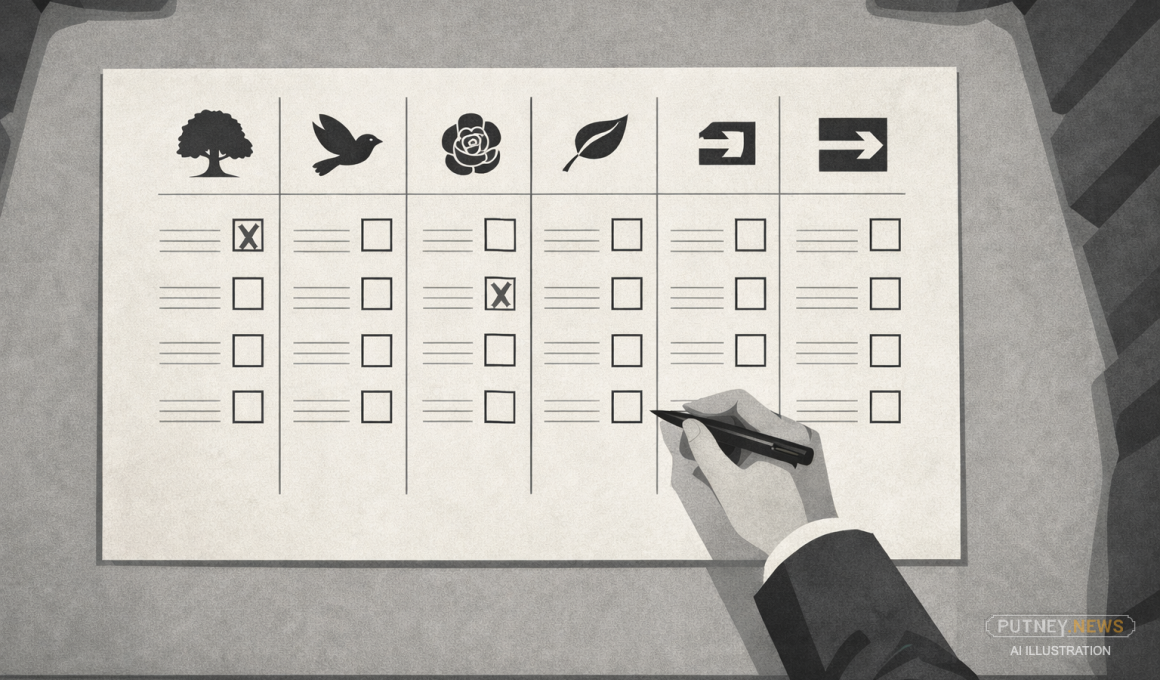
Wandsworth’s official candidate list was published yesterday – and for the first time in the borough’s history, every single voter will face five parties on their ballot paper when polls open on 7 May.
The full list of 295 candidates across all 22 wards is below. Find your ward, see who’s standing, and check whether your sitting councillor is defending their seat.
It has never happened before. It may not happen again for a long time. And in the tightest wards, it could determine who wins the council.
The final count: 295 candidates, up from 202 four years ago. Three parties are responsible for almost all of that growth.
The Liberal Democrats completed their slate, adding 13 candidates to reach a full 58. The Greens went from 37 to 53 candidates, contesting every ward for the first time. And Reform UK, which fielded zero candidates in Wandsworth in 2022 because it didn’t exist locally, has assembled a full 58-candidate slate from a standing start. Together, those three parties now field an average of eight non-Conservative, non-Labour candidates per ward. In 2022, the average was four.
The total count of non-Conservative, non-Labour candidates has more than doubled: from 86 in 2022 to 179 in 2026.
Where the numbers get interesting
The story of this election isn’t just that more candidates are running. It’s where they’re running, and what happened last time.
In West Putney in 2022, the Conservatives and Labour were separated by 0.4 percentage points: fewer than 100 votes across three seats, one of the tightest ward results in London that year. The Liberal Democrats and Greens between them took 11% of the vote. This year, both parties are back, and Reform is on the ballot too.
In East Putney, where Conservative and Labour were again within four points of each other, the Lib Dems and Greens combined for 17.6% of the vote. In Southfields, held by the Conservatives by 3.7 points, they took 16.3%. In Thamesfield – where two of three sitting Conservative councillors are not standing again – the Lib Dems alone took nearly 14%.
These figures are context, not prediction. They show what happened last time. In 2026, Reform adds a further unknown into every one of those wards. The combined Lib Dem and Green vote in 2022 exceeded the winning margin in every single one of the borough’s most competitive wards. Now add 58 Reform candidates to that picture.
One ward stands out differently
Not every interesting story is about marginal seats. In Nine Elms in 2022, the Liberal Democrats took 26.3%, more than four times their borough-wide average. Nine Elms has a higher proportion of newer, younger residents than most Wandsworth wards. Whether that pattern repeats in 2026, in a ward that now also has a sitting Reform councillor – Mark Justin, who defected to Reform – will be worth watching.
The candidates
Sitting councillors defending their seats in the same ward are marked in the lookup above. Seven sitting councillors have moved to a different ward, including Emmeline Owens, who won her seat in Northcote in 2022 and has been redeployed to Southfields, the most marginal Conservative ward in the borough.
Notable incumbents defending their seats include former council leader Ravi Govindia in East Putney. Of the 295 candidates, 245 have no prior Wandsworth electoral record. The three newer parties account for much of it, but even within the established parties, candidate turnover has been high.
What this means for voters
If you live in one of the marginal wards, your ballot paper is genuinely more complicated than it was in 2022. That is not an argument for or against any party. It is a structural fact about how this election works.
Polling day is Thursday 7 May. Polling stations open at 7am and close at 10pm. You will need photo ID to vote.
The 2026 result will reveal whether the expanded slates translate into expanded votes, or whether the bigger ballot paper turns out to be the most dramatic thing about this election.
Source: Statement of Persons Nominated, London Borough of Wandsworth, 10 April 2026.