


“I’ve just heard from Fleur that the funding for Hammersmith Bridge has been approved.” The young Labour candidate’s closing statement drew the loudest applause of the Southfields hustings on Tuesday night. The truth was much less exciting.
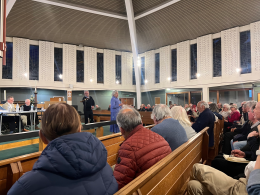
Seven candidates took the stage at St Barnabas Church on Tuesday evening for the third and final hustings of this election series, chaired by Charles Runcie of the Southfields Grid Residents Association. Reform UK sent no candidates for the third consecutive time; one of the two Green candidates was absent. Around a hundred people attended, with a broader age mix than at either of the previous events. The evening was civil and measured, without the sharper edges of Thamesfield or the heckling of Roehampton, and no candidate clearly won the room.
How we assess candidates: every candidate at every hustings is scored on six criteria. Read our methodology.
What the MP actually said
Megs Jacobs named a sitting MP in her closing statement and drew the night’s loudest applause. Earlier that same afternoon, Fleur Anderson MP had led a Westminster Hall debate on Hammersmith Bridge (the fourth such debate in five years) and pressed the minister in charge. A week ago, the government opened up applications to the £1 billion Structures Fund, and the minister confirmed the bridge is “a good candidate” for investment, and also flagged that the government would “assess higher contributions and additional third-party contributions favourably” – the coded language likely means that central government is prepared to put in more than previously offered to open Hammersmith Bridge but it is still far from funding having been “approved”.
Sixty seconds to land a line
The hustings ran on a one-minute format: one minute to answer, a volunteer counting down audibly, a fifteen-second warning, a final signal. Seven candidates, four parties, sixty seconds to land a line.

The bridge claim was the starkest example of what that pressure produces, but not the only one. Fergus Foord told the room there was “only one working CCTV camera in the whole borough.” The council expanded its CCTV network in June 2025 and deployed three new mobile vans in September with 150 extra monitoring hours a month. His intended meaning was almost certainly Southfields-specific, but what he said is not supported as stated.
Emmeline Owens said youth unemployment in London was “the highest it has ever been, I think, at twenty-five per cent.” The London-specific figure for November to January 2026 is 24.6%. The historical claim is arguable: London youth unemployment reached 25% in 2012 following the financial crisis.
Peter Watts and Jacobs both said the Balham neighbourhood warden scheme had “worked really well” and produced “less crime since rolled out.” The scheme is six weeks into a six-month pilot. No formal evaluation has been published.
Three versions of the same problem, from three different parties all keen to demonstrate real progress; all over-egging the information.

The same pressure also showed who kept their footing. Owens opened with four headline financial claims delivered from memory: £200 million reserves almost halved, £140 million budget gap in two years, £80 million in government cuts, £60 million in overspending. All four held up against Budget Paper 26-63.

Guy Humphries gave the correct legal position on HMOs concisely and without spin: “The council has no power to stop somebody from producing an HMO because they’re a part of housing policy which is allowed under national policy. What you can do is control the size and the appropriateness.” Sue Wixley named the Elsenham Street application specifically and gave the correct Local Plan test. Notably, however, none of them mentioned Article 4 Direction, which is the tool other London boroughs have used to deal with this issue.
Watts acknowledged that the Putney Bridge Road cycle lane had reduced road capacity, consistent with this paper’s reporting from TfL consultation documents, and that the balance needed reviewing. One of the few moments where any candidate resisted a clean party line.

The one honest answer on council tax
Council tax produced the evening’s richest exchange. Jacobs said Labour had been offered flexibility above the 5% cap and “said no thank you.” That is narrowly correct on the mechanism but considerably understates what was actually offered. Wandsworth is one of six councils granted unlimited tax-raising power, with no referendum required, for two years from April 2027, through a formal government finance settlement designed to close an £1,100 gap between Wandsworth’s Band D rate and the England average. The government expects these six councils to use the power. Future grant funding has been made contingent on it. Council leader Simon Hogg is publicly refusing: “No, of course not. We will be keeping the same low council tax,” he told a council meeting in December.

The Conservatives have been telling voters that council tax would need to rise by more than 80% under Labour. Jacobs’s rebuttal of the arithmetic was essentially correct. But the figure comes from IFS analysis of what closing the grant-funding gap would require: it is a government expectation of what councils like Wandsworth will need to do, not a Labour policy pledge. The Conservatives have put it in their manifesto as a warning. Jacobs was treating it as a Labour commitment she could rebut.
The UK Statistics Authority wrote to the council leader in March about the “potential to mislead” of the “freeze” language. The issue is not straightforward and voters should be able to count on their political representatives explaining it to them simply and honestly.

Kester Leek was the only candidate on stage who got close to that: the 80% figure is a central-government expectation, not a Labour pledge, and Wandsworth needs “an honest conversation” about what it actually faces. “We live in one of the richest boroughs in one of the richest countries in the world and the idea that we can’t find ways to pay for decent services is farcical.” It was the most honest moment of the evening, and it came from the most underprepared candidate – overall – in the room.
Where they stood
How each party engaged with ward priorities
Based on candidate responses at Southfields Hustings, 21 April 2026. Reform UK did not attend.
| Ward priority | Labour | Conservative | Lib Dem | Green |
|---|---|---|---|---|
| Crime / CCTV / policing | Specific More community safety officers; wardens rolled out borough-wide; more lighting | Specific Fund real police officers through CIL; more lighting; more CCTV | Vague Increase CCTV (overstated against the council's expanded 2025 programme) | Vague Root causes nationally; youth hubs; community cohesion |
| Council tax / finances | Vague Keep “lowest in country”; rejected the Conservative 80% claim, mischaracterising its origin | Specific £137m gap; reserves halving; difficult choices required | Vague Keep as low as possible while protecting services | Specific Honest conversation; rich borough can afford good services |
| District Line | Specific Upgrades testing summer 2026; track circuits not full resignalling (Watts's hedged framing) | Vague Frustration expressed; no specific plan | Vague “Money secured” / “commitment from TfL” — directly contradicted by Network Rail | Specific Full automatic signalling; most technically detailed answer of the evening |
| HMOs / housing | Vague “HMOs symptomatic of housing problem”; 1,000 new homes pledge repeated | Specific Correct statement of national planning law; scale-based control explained | Specific Local Plan test cited; Elsenham Street planning history named | Specific Build, build, build; brownfield first; rent controls nationally |
| Wimbledon Park / AELTC | Specific Against development; voted against; new proposals “good compromise” | Specific Voted against; led planning committee charge; open to negotiated alternatives | Specific Against; praised new alternative plans; cross-borough coordination cited | Vague For public access to golf course land; open to compromise plans on how |
Reform UK: third consecutive absence
Charles Runcie reported from the chair that he had sent “lots of emails, WhatsApp messages and goodness knows what else” to Reform UK. No reply. Reform is fielding two candidates in Southfields. Three hustings in this series, three events without a Reform presence and without a substantive response to organisers.

What comes next
All three hustings in this series are now complete. A written questionnaire remains open; candidates in all three wards have been invited to respond to five questions on the record. Our full election coverage, ward profiles, candidate lists, and fact-checks are on our election page. Next week we will build out specific ward pages and begin interviewing candidates. Polling day is 7 May. Voters will need photo ID at the polling station.
The first hustings report is here. The second is here.
Corrections: 23 April 2026
Emmeline Owens (Conservative): We originally rated her youth unemployment claim as misleading, citing the UK national rate of 16%. The correct comparator is the London rate, which was 24.6% for November to January 2026 — consistent with her figure of 25%. We have updated the candidate card accordingly. Her claim that this is the highest the rate has ever been is arguable: London youth unemployment reached 25% in 2012.
In addition, we originally rated her Paris housing comparison as misleading – and a deeper fact-check revealed it is. But the claim was drawn from an FT chart comparing new housing construction across major global cities, which shows Paris consistently above London. The FT’s own footnote states the underlying data varies by city and may not be directly comparable. The claim is accurate in broad direction but the detail behind it is thin. We have updated the rating accordingly.
Fergus Foord (Liberal Democrat): Foord has been in touch to say he meant to say there was only one working CCTV camera in Southfields ward, not the whole borough. We reported what the transcript shows he said. The borough-wide claim as stated is not supported; if his intended meaning was ward-specific, the evidence base for that is not something we have been able to verify.
Correction: 24 April 2026
Kester Leek (Green): We originally described his position on the Wimbledon Park / AELTC plans as being against the current proposals. The transcript shows he was firmly in favour of bringing the golf course land into public use and open to compromise plans on how – not opposed to the current plans outright. We have updated the party comparison panel accordingly.


Excellent summary, highlighting both correct and incorrect or misleading facts and figures.