


Something is missing from the politicians’ sales pitches this year: vision. We have plenty of issues in Putney, and increasingly local residents have given in to the idea that there’s not much we can do about it. We don’t subscribe to that kind of nihilism, so here is part 2 of Putney 2030: The vision Putney deserves.

Part 2: Opening up the waterfront
Putney sits on one of London’s most beautiful stretches of the Thames. Most residents have no idea what’s hiding beneath their feet.
Walk through the churchyard of St Mary’s on a sunny morning and you’ll pass it without noticing. Set into the abutment of Putney Bridge (Victorian brick, white-painted render, a gentle arch) is a door. Behind it, a barrel-vaulted tunnel runs beneath the bridge road. At the far end, someone is giving clarinet lessons.
The tunnel has been there since the bridge was built in the 1880s. It belongs to the church. Right now it houses a recording studio and a music school. And at the back of that recording studio, there is a blocked-up wall.
On the other side of that wall is Waterman’s Green, one of Putney’s best-kept secrets: a thriving riverside terrace where Tequila Mockingbird and Putney Pies spill out onto the embankment beneath the bridge arches, with bunting, tables, the Thames a few feet away.
The tunnel connects them. The wall is the only thing in the way.

The problem
Putney’s relationship with its own riverfront is one of the great missed opportunities in southwest London. The raw material is exceptional: a wide tidal Thames, magnificent London plane trees, Georgian and Victorian architecture, one of the finest stretches of riverside walking in the capital. But it doesn’t connect. You hit Putney Bridge and you hit a wall.
On the west side of the bridge, Waterman’s Green is already alive. People gather there on warm evenings, sitting under the bridge arches with the river a few feet away. Tequila Mockingbird and Putney Pies use the space brilliantly. It is genuinely lovely and almost entirely unknown outside the immediate neighbourhood.
The Star and Garter stands shrouded in black tarpaulin. One of the most architecturally striking Victorian pub buildings in southwest London, right on the Thames, with ornate arched windows and ironwork balconies. Planning permission exists for its revival as a café and wine bar with residential above. Nothing has happened. On a sunny April morning, there is nobody there.
Right by it, the new riverside park created as part of the Thames Tideway supersewer construction sits largely empty. Good granite paving, steps down toward the river, an extraordinary unobstructed view across to the Fulham treeline. A couple of benches (a seemingly permanent construction hoarding).
The gap between what this riverside could be and what it currently is not so much a planning problem or a funding problem, it is a vision problem.

What the comparison shows
Go to Richmond. The riverside there is a genuine destination, a continuous promenade that people travel to specifically. Putney has equivalent or better raw material. What Richmond or Kingston has that Putney lacks is a coherent vision for the space as a whole, and the will to pursue it.
Across London, councils have turned forgotten infrastructure into civic assets. The Mayor’s Liveable Neighbourhoods scheme funded the Dukes Meadows Footbridge in Chiswick: 115 metres long, running beneath Barnes Railway Bridge on its own piles in the Thames, opened in 2023, connecting the towpath to the riverside park. The ambition required in Putney is no greater than that. The architecture is already more interesting.
The proposal
Three connected moves that together transform the picture.
Open the tunnel. The passage beneath Putney Bridge already exists. It is in active use: a music teacher runs a recording studio from its vaulted chambers, giving saxophone, clarinet and flute lessons beneath Victorian brickwork lit by bare bulbs. The space has surprisingly good bones (a proper barrel-vaulted ceiling, clean proportions, a quality no amount of new construction could replicate). The blocked wall at the far end is not a structural barrier. It is a decision waiting to be made.
The church owns the tunnel. St Mary’s has a new vicar. The businesses on the Waterman’s Green side, who would gain customers directly from the footfall a pedestrian connection would bring, are natural allies. The council is the convener. This requires a conversation to get going.

Activate the riverside park. The Tideway park has everything it needs except a reason to be there. A weekend market. A regular food event. A performance space using the river as a backdrop. The steps, the granite, the view: it is all there.

Connect them. A continuous pedestrian route from the St Mary’s tunnel exit at Waterman’s Green, west along the embankment past the Star and Garter and the Tideway park and onward to the Thames Path creates a cross-Putney flow that doesn’t currently exist. It connects Lower Richmond Road to the pedestrianised waterfront area that holds The Rocket, The Boathouse and Coppa Club, and from there Putney Bridge Road and Wandsworth Park through green space and along the river. The town breathes differently.

For cyclists, the Dukes Meadows Footbridge demonstrates exactly what is possible and how to fund it. A bike path that connects the two parts of Putney without having to go anywhere near the dreaded junction. Wandsworth should be making the case for equivalent investment here.

What the Star and Garter unlocks
The Star and Garter is the hinge. Planning permission exists for a ground-floor café and wine bar. What has been missing is the economic logic to make development inevitable. A continuous, activated riverside route running directly past its door, bringing pedestrians from the tunnel through Waterman’s Green and west toward the Thames Path, provides exactly that logic.
The infrastructure creates the demand. The demand makes the development inevitable. The development transforms the eastern anchor of the whole route.
This is how cities work when they plan well.
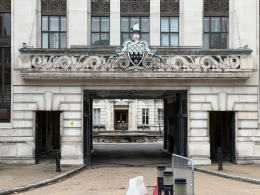
It’s already been agreed to pedestrianise the riverfront by the Star and Garter. This is what it looks like now.

And here’s where we could easily get to, if we plan, coordinate and build a thriving waterfront that attracts visitors and connects up the two side of Putney Bridge.

What it would require
A conversation between four parties who are not natural opponents of this idea: St Mary’s Church and its new vicar, the Waterman’s Green businesses, the council, and the Tideway project team responsible for the riverside park’s long-term management (the park is currently being handed over to Thames Water – which could do with some good PR for a change). Each stands to benefit. None currently has a reason to start the conversation.
That reason is what the next council needs to provide.
The payoff
A riverside that people come to deliberately, not just pass through accidentally. The Star and Garter open and thriving. Waterman’s Green connected to a route, not hidden beneath a bridge. A continuous green walk from the boathouses to Wandsworth Park. A town that finally makes something of one of its greatest and most underused assets, not through grand expenditure, but through the simple act of opening a wall.
The tunnel is there. The music teacher knows where it goes. The question is whether anyone with the power to act is listening.
How important is this to Putney’s future?
PUTNEY 2030 | Issue 2 of 5 | putney.news
This is the second of five pieces examining what bold thinking could change in Putney.


That looks brilliant Kieren- it’s nice now but as you show it could become so much more! A destination.
I wouldn’t open the tunnel people can walk across the road and round to that side
Leave the poor music teacher to do his thing. The tunnel would be a problem at night to manage and it’s shame to make it a dangerous place to navigate.
Tunnels are dodgy at the best of times and who is going to police it?
This is a fantastic idea Kieren. The Embankment could be stunning and a destination in itself. I hate having to interrupt my runs by having to traverse the traffic on Putney bridge as the tunnel is blocked.
I do feel as though Wandsworth Council severely neglects Putney; we’re an afterthought at best. Just look at the neglect of the benches, lighting and barriers on the Embankment – totally deficient for the area.
A Pipe dream and impracticable. The Putney embankment is special because of the Rowing Clubs. To transport their boats to competitions, the clubs use long trailers and there is only one road junction onto the Lower Richmond Road that is clear of parked cars, which is the one by the Dukes Head. If all vehicular access is barred from the embankment, how will visitors to the club gain access?
Lovely idea, though tunnel safety is a concern to all women and others locally, as pointed out and would have to be dealt with. We already have a lot of homeless at Putney Station who’d presumable need policing so they don’t set up camp in the tunnels during the cold winter months. And would it attract more of the unhoused?
My question though is what about the floodings? There have been a number of times recently that you can’t walk past Thai Square for the high tide(?).
What is your proposal for addressing that?