


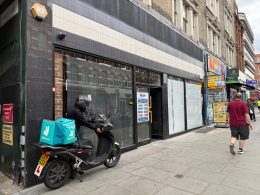
“Thank You, Putney!” reads the notice taped inside the window of Casa Manolo, the Spanish tapas bar and jamón shop that has closed at 124 Putney High Street after eight years. It directs customers to the chain’s branches in Clapham Junction and the Strand, both still trading, and promises “exciting new projects” to come.
Readers named Casa Manolo a high street hero in our February survey, months before it joined the closures list itself. The chain started on the Strand in 2014, built on family recipes and Iberico ham cured in Guijuelo, Spain, and expanded to Chelsea, Angel, Clapham Junction and Putney. The Putney branch was a hybrid of deli and dining room, hand-carved ham, a wine wall and a small kitchen behind it. Events ran through the year, from a flamenco show to an Iberico ham carving masterclass, and the paella was genuinely excellent.
If you have walked down Putney High Street lately, you will have noticed how many shopfronts stand behind hopeful To Let boards. Casa Manolo’s is one more, but the letting brochure for its old unit is the first time anyone has put a number on why.

Putney is where the chains let go
Casa Manolo is not a one-off. It joins Papa John’s, Subway, Wasabi, Simmons and Be At One, and Starbucks, all multi-site operators that shut their Putney branch while keeping the rest of the chain open. Each had somewhere else to go, and Putney was the branch that lost out. Franco Manca is the honest exception: when the chain closed 16 restaurants nationally in April, Putney and Southfields both survived the cull.
So why does Putney keep drawing the short straw? The letting brochure for Casa Manolo’s old unit gives the first real answer.
The letting brochure that explains it
The letting brochure went up in May, while Casa Manolo was still open and serving customers. It marketed the unit at £80,000 a year. That figure, called the rateable value, is the Valuation Office Agency’s assessment of what a shop could reasonably fetch in rent, in this case the rent it judged the unit would have fetched in April 2024. It is built from evidence of rents actually agreed, and it is what business rates bills are based on. The VOA puts 124 Putney High Street at £58,500, more than a third below what the landlord is asking.
It is not one landlord being greedy. Along the street, 158 Putney High Street is asking £48,000 against an assessed value of £33,750, 42% above. The old corner unit near the station asks £110,000 against £94,000, 17% above. The market for these units simply is not clearing. Our audit in April found eight prominent units standing empty along the High Street while asking prices held steady rather than falling to meet demand.
The VOA’s own numbers back this up. Across the 187 shops we matched in its lists going back to 2017, the street’s total assessed rental value is £10,885,250, statistically unchanged from £10,890,395 nine years earlier. Over the same nine years, general prices rose by a third. Putney High Street’s rents have gone precisely nowhere in cash terms, while everything else got more expensive.

Why the shape was never in its favour
There is a second reason this particular unit struggled, beyond price. Surveyors value shops by frontage, not floor space: the first few metres behind the window carry full value, and everything further back is worth progressively less, a method sometimes called Zone A. A shop that is long and thin loses value fast, because so much of it sits behind that valuable first stretch of window. A long, narrow unit like 124, which read as a deli from the pavement with hams hanging in the window, is structurally cheap space no matter what fills it.
Masala Odyssey, further down the street, had exactly the same problem. Another long, narrow shop that never quite worked from the pavement, it has stood empty since its landlord repossessed it in April.
What’s left, and what’s next
The unit at 124 is available on a new lease immediately, kitchenette and basement included, with terms that would let a wide range of shops, cafes or restaurants move straight in. Someone will get a well-fitted space, if the price finds the market. For now, Clapham Junction and the Strand keep the flamenco nights and the ham carving going, while Putney waits to see what “exciting new projects” means.


I live in Putney & am a retail surveyor nationally. The rateable value under VoA is not market rent. Never has been. It is valued in different way on an annual rent where the tenants can be kicked out after 12 months. Higher rents ar winner term security so your comparison piece is completely miss leading and inaccurate.
Shops close because people don’t spend enough money in them. Simple as. Putney has become a convenience centre & evening venue and has lost out to bigger centres with more selection of shops/fashion. Retailers have been cutting back on shop numbers for the last 10 years.
Having a static high street, full of cars, petrol fumes belching out is not helpful for landlords trying to find a tenant. A council problem that needs solving, starting with the traffic. Tubs of flowers and trees is not working!
Thx Kieran,
The Labour council adopted the past Conservative road junction improvements / suggestions, at the south end of the Putney Bridge without an assessment for the Hammersmith Bridge Closure. The result is grid lock on the High Street. Why would you want to be a tenant with the pollution?
Solution; close the west side bridge bus stop as it is not needed ( two are close by) and remove the north leading bus lane so two lanes for the traffic. Things will flow everywhere and at very little cost….worth a try.
What other financial incentives are there for landlords to rent rather than sit on empty shops? Are their tools the local authority can use? Agree that the traffic is an issue – lots of evidence that making it easier to access shops on foot or on bikes helps local economies – smaller more frequent shops pay off overall. At the moment PHS is not a place that encourages browsing but there may still be hope for Lower Richmond Road
There is a 3rd and much bigger reason than your 2 reasons why this particular unit struggled, beyond price. As a restaurant, it was VERY poor, with barely average food and mediocre service. Simple as that
We went to Casa Manolo couple of months ago and it was genuinely one of the worst experiences we had at the restaurant. The service was beyond rude from our waiter and the food was mediocre at best. The prices for the wine suggestions were between £400 to £600 per bottle. This was on the main page of the menu. The prices of tapas were also ridiculous, there was one costing £50. I’m not surprised that this place was always empty.
We’ve had a couple of comments – and some emails sent direct – from people noting that the service and quality of Casa Manolo had been poor in recent months.
We don’t doubt it. It is what happens when a restaurant is under financial stress. In an effort to survive you both cut costs – fewer hours with a chef standing there serving no one – and increase prices – wine markup is the classic example. But you end up providing a worse service, which is turn hastens your demise. It is something the restaurant business is all too familiar with and if reports from Casa Manolo are to be believed, that’s exactly what happened in the lead-up to lease renewal.
The bigger question is what do we do about it? The opening of a new restaurant in Putney is always met with excitement but for restaurants to survive they need regular repeat customers. We have a tendency as consumers to simply assume the businesses around us will continue on but the truth is it is a two-way street, especially when rents are high, costs keep going up, and wages don’t keep pace. By the time you have heard about the fact a restaurant – or any other business – is struggling, it is often too late to save it; the passion and the energy that launched it in the first place has dried up under relentless pressure.
So we will consider – as Putney.news – what positive role we can play in this. How we can help our best businesses not only survive but thrive, and how we can open up a greater understanding within our community about the use-it-or-lose-it aspects of business, especially independent businesses that don’t have the financial ballast to ride out difficult months.
With luck, Casa Manolo’s exit – like many that have come before – can serve as a catalyst for a better future where we can be proud of our High Street once more.