

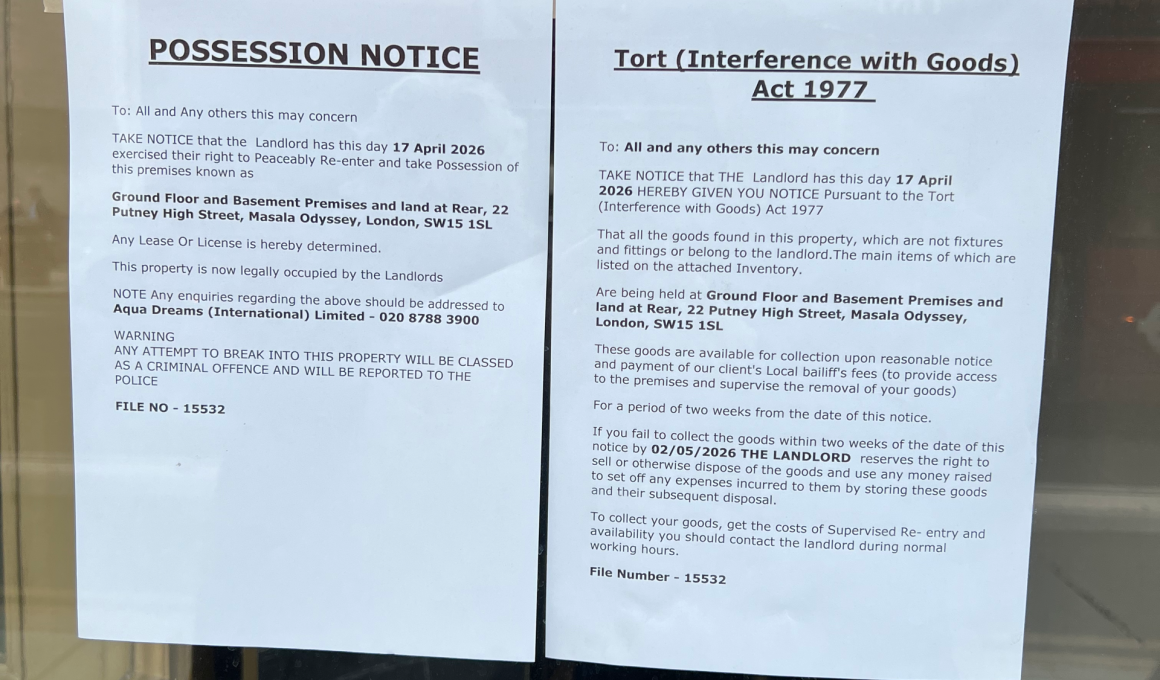
A possession notice recently appeared on the window of Masala Odyssey. The lunch deal board is still inside. The landlord had taken the restaurant back, and nobody had cleared it out.
The notice, photographed last week, records a peaceable re-entry by Aqua Dreams (International) Limited, a property company at 210 Putney Bridge Road. Goods collection deadline: 2 May. And a list of what remains inside: tables, chairs, beer taps, beer kegs, a pool table, a fruit machine, kitchen counters, a walk-in fridge and freezer, CCTV, a printer, and a dishwasher. The restaurant, from the pavement, looks ready to open.
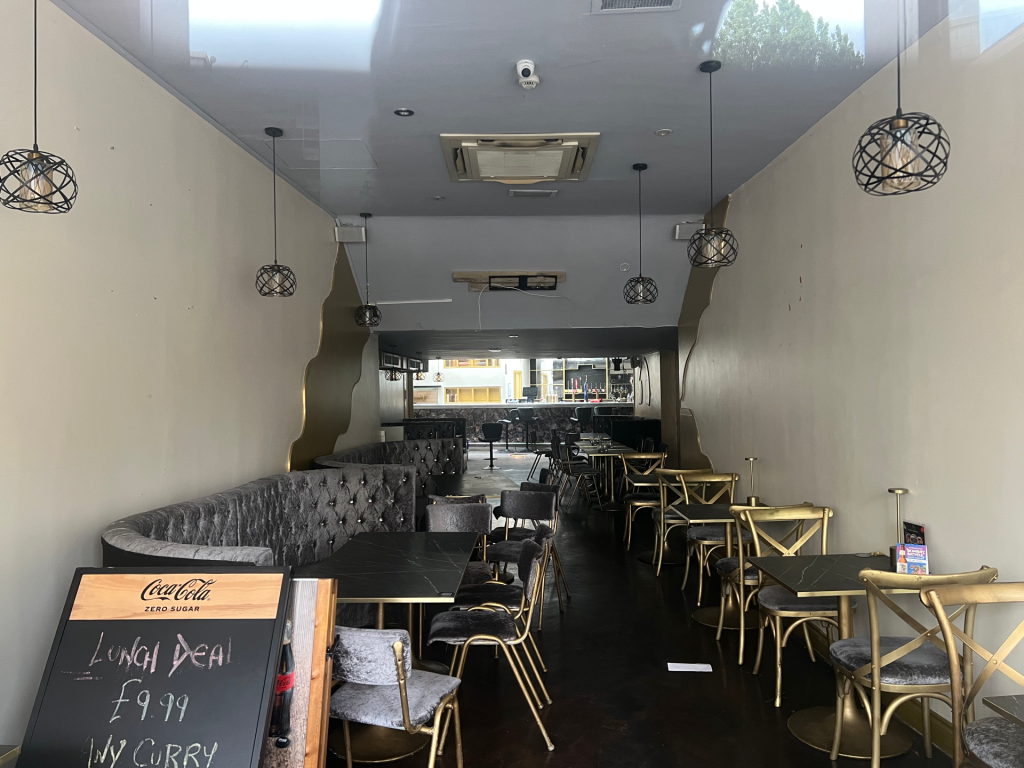
The closure was not a surprise. We reported in December 2025 that the lease at 22 Putney High Street was being offered to potential new tenants. No one came. The site had struggled to hold tenants before Masala Odyssey: Byron closed, then Bone Daddies, which cited “an effort versus reward calculation” when it left in late 2022. A pop-up followed. Then Masala Odyssey received a hygiene rating of 1 (Improvement Necessary) in December 2024. The repossession on 17 April is the end of that sequence.
Twenty-two Putney High Street would be unremarkable on its own. It is not unremarkable in context.
Eight sites, one question
Standing on the High Street on Sunday, the picture is this: Kashmir restaurant on Lacy Road has been closed for ten months. It was occupied by squatters in June 2025 and evicted by bailiffs in July. It is still trashed and empty: nothing inside, nothing moving.
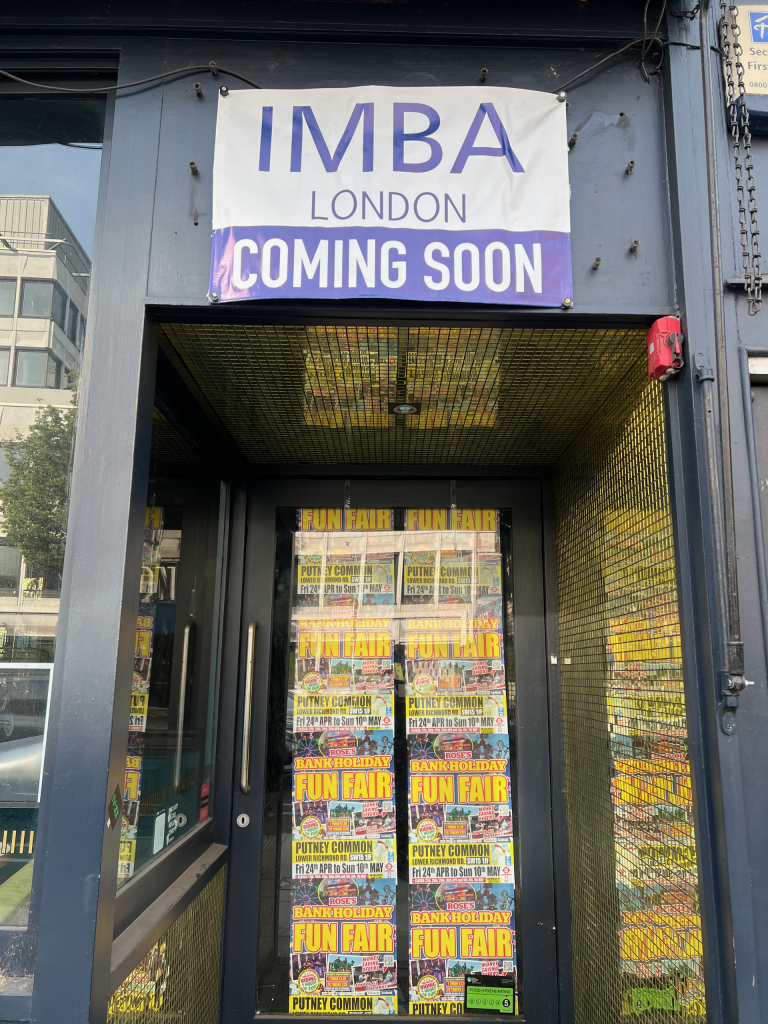
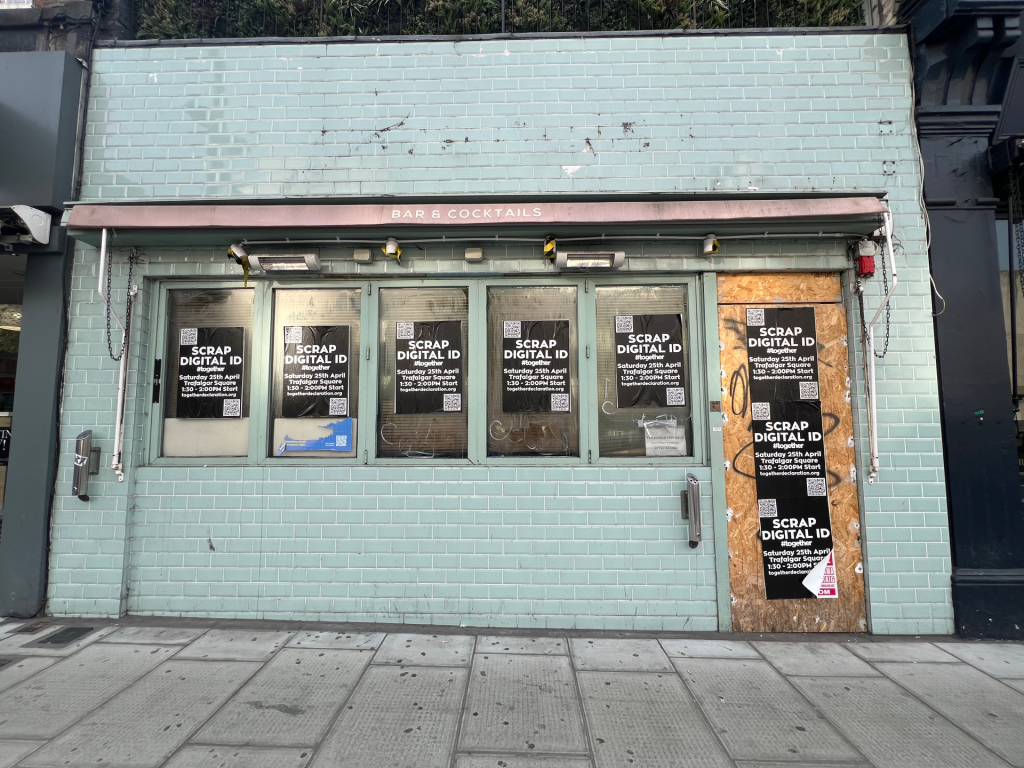
Be At One has been dark since summer 2025. In March, we reported that IMBA London was fitting out the site, one of four simultaneous fitouts we described as “the most concentrated burst of new arrivals Putney High Street has seen since closures accelerated through 2025.” IMBA has not opened. Simmons closed on 1 August 2025. It is still closed. The Boilermaker has been dark since May 2025, when the landlord locked the doors. It is still dark.
The Star and Garter on Putney High Street received planning permission for conversion to eight residential units with a ground-floor café and wine bar. The Conservation and Heritage Advisory Committee reviewed the approved plans in April 2025. That was twelve months ago. Nothing has moved since.
At 31-43 Putney High Street, the hotel development tells the most pointed story. Demolition began in October 2025. In December, we reported the site was on schedule with multiple crews working simultaneously. On 8 April, three weeks ago, we reported that construction had resumed. But then almost immediately afterwards, it went silent. No workers. No activity.
Eight sites. Not one has reopened or delivered on its stated next step.
The recovery narrative
The signals we reported were real. M&S opened. The squatter crisis that defined summer 2025 resolved. Scaffolding came down. Fitouts began. Looking at Putney High Street in November and March, it was reasonable to describe a recovery under way.
Taken together and examined now, the picture is different. The recovery is concentrated in one corner: the M&S stretch, where the anchor tenant opened and trade is visible. In the civic and hospitality heart, the block running from the Boilermaker through Be At One, Simmons, Kashmir, and up to the hotel site, the closures of 2025 have not resolved. Some are in the same condition they were in six or nine months ago. Some are worse.
The structural diagnosis has not changed either. We described it in December 2025: “Landlords demanding rents that Putney High Street’s diminished footfall cannot justify, creating a vicious circle that traffic problems only worsen.” That remains the frame. The White Lion at 14-16 Putney High Street sits on the Historic England Heritage at Risk Register, with a condition rated Poor, trend Declining, with the entry reading “slow decay; no solution agreed.”
Wandsworth Council has powers under the Planning (Listed Buildings and Conservation Areas) Act 1990 to serve urgent works notices on listed buildings in deteriorating condition. The current administration failed to do anything.
Eleven days
Local elections are on 7 May. Thamesfield ward, which covers Putney High Street, has candidates from every party. The hustings have been held. The standard answers, support for local businesses, commitment to regeneration, have been given. The specific questions have not been asked: which landlords have been contacted directly, which enforcement powers have been considered, what the plan is for the sites that have been dark for nine months or a year.
Readers can put those questions to candidates directly. The election guide sets out who is standing and how to contact them. Anyone concerned about the White Lion’s condition can report it to Wandsworth Council’s planning enforcement team; the Heritage at Risk listing and the council’s powers are public record.
M&S is open and trading. The hotel will eventually be built. Putney High Street is not finished. But eight sites remain dark (some closed for months, some for years), and the people responsible for them have not yet been asked, in one place, to account for why.
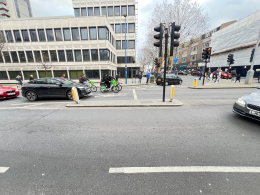

Putney High Street faces the same challenges that all high streets face.
The high street is not dying. The old high street model is.
Closure in not collapse. Many of the brands disappearing from our town centres were already shrinking, restructuring, or abandoning outdated formats. That is not the end of the high street. It is the end of a model built on legacy chains, high rents extraction and consumption led growth.
It is no longer fits how people live, work, and spend.
What is replacing it is messier, more local, and more adaptive: independents, smaller format retail, food, services, health and beauty, leisure, and community-led uses.
The real question is not how we “save” the high street in its old form. It is how we build town centres around stewardship, local capability, and uses people actually value now.
Nostalgia is not a strategy.
Obsolescence is not the same as failure.
And change is not the same as decline.
The high street is not vanishing. It is being reassembled. And the conditions to do this still require systemic change in the incumbent extractive model.
As Richard Sennett argues, resilient cities function as open systems shaped by the people who use them. Our town centres should do the same.