


Among 121 Putney residents who responded to a one-day poll, nearly three-quarters remain skeptical about the council’s latest promise to fix Putney Bridge junction by February, despite a year of mounting pressure and emergency interventions costing an additional £169,000.
The poll this week reveals that sustained public skepticism persists even as the council implements changes. Only 27% expressed cautious hope the February deadline would be met. The rest divided into “I’ll believe it when I see it” (38%), “scrap the junction redesign entirely” (23%), and “too little, too late” (12%).
The poll follows months of comprehensive evidence showing the £835,000 junction redesign has failed. What the latest numbers reveal is how council inaction, followed by slow institutional response, has damaged public trust to the point where even promised fixes struggle to restore confidence.
The pattern of erosion and partial recovery
Four major surveys over four months tell the story of how trust collapsed then partially recovered as the council finally responded:
September 2025: The Putney Action Group’s survey of 1,371 residents found 86% gave the strongest negative response possible to the junction redesign.
October 2025: The council commissioned its own survey, focusing primarily on pedestrians and cyclists in what residents saw as an attempt to generate more positive results. It didn’t work. Even with methodology skewed toward the junction’s supposed beneficiaries, AECOM’s survey of 1,041 responses found 66.9% rated the improved pedestrian crossings and cycle lanes negatively, with only 15.1% positive.
The survey’s internal contradictions revealed the problem. The 78 paper responses completed on-site by surveyors skewed positive. But 912 online responses told a different story. Respondents acknowledged some benefits – wider pavements, crossing islands, visual improvements – but said these were “outweighed by the perceived increase in traffic congestion” with negative secondary impacts including worsened air pollution and delayed public transport. Even when the council tried to measure success on its own preferred terms, residents reported failure.
November 2025: After the council finally acknowledged problems and implemented £169,000 in emergency signal timing fixes, Putney.news conducted a comprehensive survey. Of 763 residents who responded over 60 hours, 90.5% still reported worse journeys. Trust had actually eroded further. The emergency fixes had done little to restore confidence.
December 2025: This latest poll shows some recovery. Skepticism has fallen from 90.5% to 73% as the council implements visible changes and promises more by February. But the damage persists. After months of comprehensive evidence being ignored, followed by emergency interventions that barely helped, residents want proof before believing new promises.
The trajectory reveals institutional failure compounding technical failure: ignore overwhelming evidence, watch trust collapse, finally act, slowly recover credibility.
What the numbers mean
The 73% skepticism combines three distinct groups. The largest (38%) takes a “show me” stance: they’ll believe the February fixes when they see them. Another 23% have given up entirely, wanting the whole junction redesigned from scratch despite the council already implementing a first wave of changes. A further 12% view the February timeline as inadequate regardless of whether it’s met.
Only 27% expressed cautious optimism that the council will deliver on its February promise and that the changes will actually work.
That nearly a quarter of residents still want complete reversal despite bus lane suspensions and promised cycle lane changes shows how deep the credibility crisis runs. The October signal timing adjustments made some improvement but still left significant problems. Residents who’ve endured over a year of gridlock aren’t impressed by slow, incremental fixes to a problem the council created.
The February timeline
The council has promised two more changes by early 2026. In February, the cycle-only left turn from Putney Bridge Road onto Putney High Street will be suspended after council transport lead Henry Cheung admitted usage was “relatively modest.”
In January, Bus Stop M outside TK Maxx will see carriageway widening to prevent buses blocking traffic when they stop. This week saw Putney MP Fleur Anderson celebrate the fact that BT has agreed to move two public telephones that currently prevent widening.
One change has already been implemented: the southbound bus lane outside the Odeon Cinema was suspended in December on a trial basis.
But as Cheung warned at the November 20 transport committee, “code works and signal processes” are required, plus TfL validation. “There’s a time lag,” he said, explaining why phone box removal for the TK Maxx work would take until January.
After a year of gridlock that left elderly residents in tears at packed public meetings, talk of time lags and signal processes doesn’t inspire confidence.
Why skepticism persists
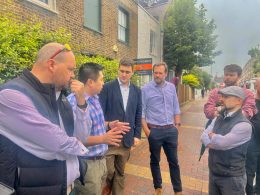
The poll was conducted the day after we reported on a council and TfL walkabout at the junction. Residents responding to the poll had just read about officials watching a bus block traffic at the very junction they’d spent over a year failing to fix properly. They then lived through the council’s transport lead blaming Margaret Thatcher for the congestion.
The one-day poll’s 121 responses shows strong engagement on the issue. All respondents live in Putney. The needle moving from 90% negative to 73% skeptical indicates progress, but not confidence.
Residents saw comprehensive evidence ignored. They watched trust collapse as emergency fixes barely helped. Now they’re being asked to believe in February deadlines and time-lagged processes.
The largest group’s response: “I’ll believe it when I see it.”

Please keep up the good work ! A minor point on this article which needs tweaking – the years have a typo (should be 2025)
Thank you – and you are absolutely right re: the dates. Thanks for the spot – updated.