

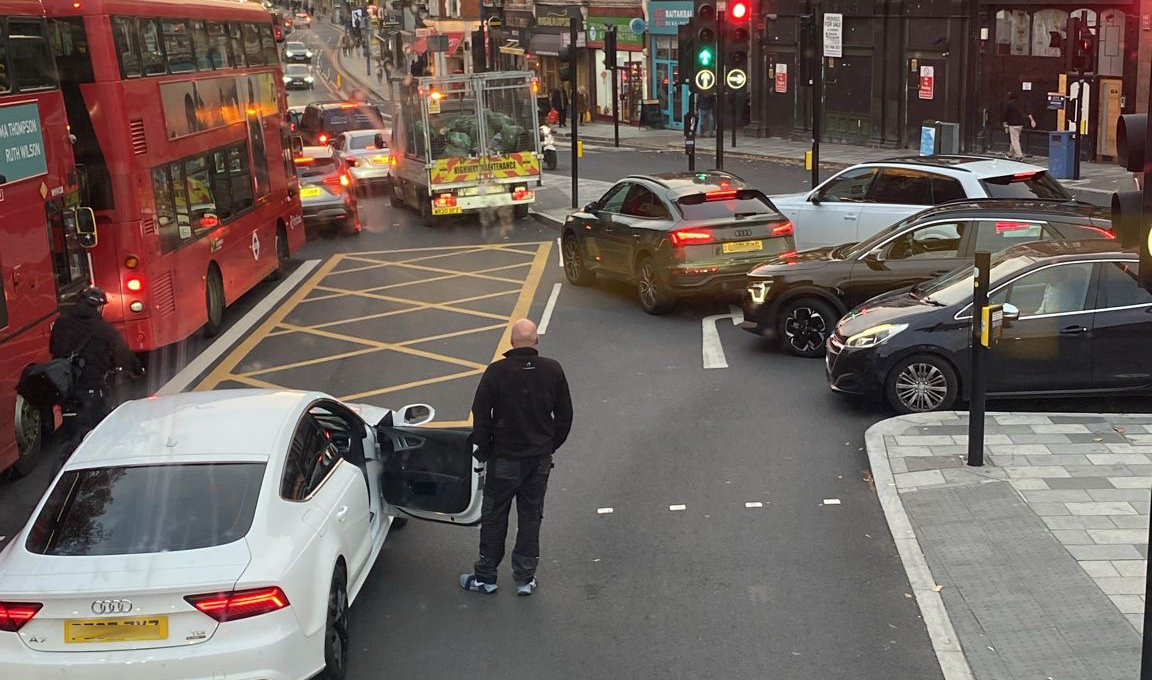
Two days after walking Putney Bridge junction with frustrated residents, Wandsworth’s transport cabinet member responded to a motion on traffic chaos by citing a single morning’s travel through Wandsworth High Street and launching into a tangent about Margaret Thatcher’s privatisation of Thames Water.
Cllr Jenny Yates made no mention of Monday’s walkabout during her response to the Conservative motion at last night’s full council meeting. Instead, she told councillors that “Putney High Street has been congested for many, many years” – a dismissal that will land badly with residents who have spent 18 months documenting a crisis that 91% say has made their journeys worse.
The exchange illustrated the gulf between how councillors discuss traffic in the chamber and what residents experience on the roads.
The Conservative motion
Cllr Emmeline Owens brought a motion declaring that “gridlock is having a serious, ongoing impact on residents and businesses” and that “there is no credible or publicly articulated plan” to address it.
Owens acknowledged Monday’s walkabout – “the right thing to do” – before noting “it has taken far too long to get to this point.” She spoke as a parent stuck in queues trying to get her children to sports fixtures: “I know the frustration when a 10-minute journey takes an hour.”
Her speech called for the council to “openly challenge” the Mayor of London and Hammersmith & Fulham’s traffic management, and criticised what she called an “ideological fantasy” that “you can simply keep turning the screws on drivers to reach a car-free nirvana.”
“To be clear, this vision is a myth, and you’ll keep hurting people as long as you cling to what is an unserious and disqualifying ideological fantasy,” Owens said. “It’s not a serious way to run a city and frankly cruel.”
The language was strong – perhaps too strong to build the cross-party consensus residents have repeatedly asked for. But the underlying point about ideology overriding evidence deserved a serious response.
What Yates said instead
Yates opened with data showing car ownership has fallen while population increased, and that vehicle mileage remains below pre-COVID levels. Then came the anecdote.
“In November last year, I went down Wandsworth High Street and it was gridlocked,” she said. “This morning I went through there and the traffic was flowing freely. So what was going on last November? Emergency works by Thames Water.”
This led to a tangent about Thames Water’s privatisation under “a Tory government, the Thatcher government” – an odd diversion in a debate about Putney Bridge junction, which has nothing to do with water utilities and everything to do with signal timing failures and design flaws that have been documented for over a year.
On Putney specifically, Yates acknowledged the junction scheme “caused unexpected congestion on Lower Richmond Road and Putney Bridge Road” – the closest she came to admitting the scale of the problem. But she immediately pivoted to blame: “The scheme your party initiated.”
She then offered the line that will frustrate residents most: “Putney High Street has been congested for many, many years, Councillor Owens.”
This dismisses a year of resident campaigns, survey evidence, legal threats, and public meetings as nothing more than complaints about business as usual. It suggests that 18 months of documented crisis is simply how Putney has always been – a claim that residents who remember life before the junction redesign know to be false.
A pattern of anecdotal dismissal
Yates’ reliance on personal observation to counter systematic evidence follows a pattern. At November’s Transport Committee meeting, one cycling advocate’s personal experience – that she personally finds the junction “much nicer” – was given equal weight to survey evidence from 51 cyclists showing 77% found their journeys worse.
Last night, Yates’ anecdote about one morning’s drive through Wandsworth High Street was offered as counterweight to over 1,700 survey responses documenting the junction’s failures.
This is not how serious transport policy is made. Anecdotes are not data. One good morning does not erase a year of gridlock. And the plural of anecdote is not evidence – it’s just more anecdotes.
What she didn’t say
Notably absent from Yates’ response:
- Any mention of Monday’s walkabout with TfL, residents, and council officials
- The February package of fixes being prepared for Transport Committee
- The bus layby work scheduled for January
- The experimental traffic orders being considered for side roads
- Any concrete timeline for improvements
Three days earlier, she had walked the junction, heard residents’ frustrations, and watched as a bus blocked traffic directly in front of TfL officials. Last night, none of that appeared in her response. Instead: Thatcher, anecdotes, and “always been congested.”
The engagement gap
The walkabout on Monday represented genuine progress – cabinet members and TfL staff spending 90 minutes on the ground, hearing directly from residents, watching the problems unfold in real time. Officials acknowledged communication “isn’t good” and committed to a comprehensive February package.
But the gap between that Monday engagement and last night’s chamber rhetoric raises questions about whether anything has changed. If the walkabout mattered, why wasn’t it worth mentioning? If 18 months of resident frustration registered, why dismiss it as “always been congested”?
Residents aren’t asking for miracles. They’re asking to be heard – and to hear back that their concerns are understood, not deflected with anecdotes and ancient political history.
The traffic won’t improve because councillors score points off each other in the chamber. It will improve when systematic evidence is taken seriously, when timelines are set and met, and when the people who make transport decisions understand what residents actually experience.
On that measure, tonight’s debate achieved nothing.



Tone deaf council. No accountability. Awful.
I’ve lived in Putney for over 20 years. Councillor Yates is quite correct in stating that “Putney High Street has been congested for many, many years”.