


Changes to ease Putney Bridge junction gridlock are rolling out, with one measure already implemented and two more scheduled for early 2026.
Bus lane suspension – done
The southbound bus lane outside the Odeon Cinema has been suspended on a trial basis. The problem: during evening peak, traffic wanting to turn left onto Putney Bridge Road couldn’t use the bus lane, creating congestion that backed up onto both Putney Bridge and Lower Richmond Road.
TfL is now monitoring whether the suspension improves flow.
Whether it helps enough remains to be seen. When buses stop outside the Odeon, cars still struggle to pass – meaning some of the same backup occurs regardless of lane markings.

Cycle lane suspension – February 2026
The cycle-only left turn from Putney Bridge Road onto Putney High Street will be suspended in February 2026. The facility was designed to let cyclists turn left and access Felsham Road, a quiet westbound route, with a separation island installed for protection.
Almost nobody uses it.
Council transport lead Henry Cheung described usage as “relatively modest” at the November 20th transport committee meeting. AECOM’s post-implementation study confirmed minimal cyclist usage. Meanwhile, the cycle-only signal phase reduces green time for motor vehicles turning right from Putney Bridge Road – time the junction desperately needs.
Survey videos show cyclists who want to make this movement simply use the pedestrian crossing and western pavement instead.
The council is exploring whether to reintroduce the facility later with a redesign that wouldn’t cost vehicle green time.

Bus Stop M (TK Maxx) – January 2026
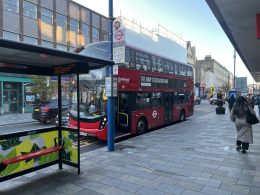
The most visible daily cause of congestion – Bus Stop M outside TK Maxx, also called “Putney Exchange” – is scheduled for changes in January 2026.
The problem is severe: when buses stop, there’s insufficient carriageway width for vehicles to pass. This happens dozens of times daily. We captured it again Sunday evening. It’s particularly bad during bus driver changeovers, when buses sit stationary for extended periods.
The solution involves widening the carriageway by reducing footways opposite TK Maxx and removing two phone boxes.
However, Cheung warned at the transport committee that this takes time. “Code works and signal processes” are required, plus TfL validation. There’s a time lag in getting phone boxes removed.
The logic: resolving this friction point could allow more green time to be reallocated to Lower Richmond Road and Putney Bridge Road, because traffic would flow better on the High Street itself.

What’s actually happening
Eighteen months after the £1 million junction redesign created gridlock, the council is methodically scaling back its own work: suspending bus lanes, removing cycle infrastructure nobody uses, and widening roads to let traffic pass stationary buses.
These are part of the £169,000 emergency measures to fix problems created by the original scheme – which 91% of residents say made their journeys worse.
The changes are incremental. The timelines stretch into 2026. Whether they’re enough remains to be seen.
Have you noticed any improvement since the bus lane suspension? What other changes would help? Email us at news@putney.news or comment below.



Your first para is very interesting – I am a cyclist and often cycle PBR, Hight Street LRR. I had no idea that cyclists could actually turn L at the PBR/High Street junction to use Felsham Road! Have I missed signage? The cycle lane on PBR is useless and I’m very pleased it’s being scrapped. Also very pleased to hear the cycle lights are going too – also useless as no one uses them. Thank you for so clearly highlighting the changes – just a shame it’s taken WBC so long to wake up and address the problems. Anyone using this new layout on foot, cycle or vehicle could have identified these issues a year ago! Makes me wonder how much do these people get paid?