


Council Leader Simon Hogg and Cabinet Member for Transport Cllr Jenny Yates walked Putney’s troubled junction on Monday afternoon alongside senior TfL staff and members of the Putney Action Group, assessing progress on congestion fixes first identified in a February walkabout.
The 90-minute visit, which took place between 2pm and 3.30pm, marks a renewed push to tackle the problems that have plagued the £1 million junction redesign. Officials confirmed they plan to bring a comprehensive package of measures to the Transport Committee in February rather than implementing piecemeal changes.
Also present were Cllr Leonie Cooper, who also serves as our GLA representative, local councillors Nick Austin (Conservative, West Putney) and Ethan Brooks (Conservative, Thamesfield), council officers, four TfL staff, and three members of the Putney Action Group: Mick, Fran, and Keri.

The TK Maxx bus layby: finally moving
The bus stop outside TK Maxx has been identified as a key pinch point since February, with buses stopping in the carriageway blocking traffic flow. Council documents show the council submitted proposals to TfL in March and again in June, but progress has been slow.
During Monday’s walkabout, officials confirmed they intend to cut into the pavement to create a bus layby – approximately 0.8 of a lane width, allowing buses to pull in so traffic can pass. The work will begin on the Marks & Spencer side of the High Street, as utility boxes under the TK Maxx pavement complicate work on that side initially.
Henry Cheung, the council’s transport officer, told the Transport Committee in November that creating this bus pull-in would “reduce the friction” on the High Street, but warned it would take “a number of months” to complete because physical changes require TfL validation followed by monitoring periods. The carriageway widening is scheduled for January 2026.

Werter Road junction: Experimental changes coming
The walkabout included detailed discussion of the junction near Sainsbury’s, where vehicles trying to turn right back into traffic on the High Street prevent cars from turning left, and add to congestion. Officials confirmed they are considering temporary changes using an Experimental Traffic Order (ETO) – a faster mechanism that allows the council to try solutions, gather feedback, and reverse them if they don’t work. It also allows residents a right to object and requires approval to be permanent.
There was also discussion of a more ambitious option: pairing two nearby side roads with complementary turning restrictions (one left-only, one right-only) to distribute traffic from Oxford Road. This is still being assessed.
The council’s approach is to present a coordinated package to the February Transport Committee rather than make isolated changes, hoping multiple simultaneous fixes will have greater combined impact.

Traffic light technology: the cyclist detection problem
TfL officials acknowledged limitations in the current SCOOT traffic management system. The system, which manages traffic lights across the junction, relies on sensors that detect vehicles in the carriageway but struggles to identify cyclists.
This means when cycle boxes are empty, the system still allocates green time for cyclists; time that could otherwise be given to queuing vehicles. Officials discussed whether newer technology called Pulse, which better detects different road users, could improve efficiency.
As previously reported, the cycle gate’s five-second head start has to come from somewhere, and every signal cycle includes time for the cycle gate phase whether cyclists are present or not.
Notably, TfL confirmed they had considered using Putney as a testbed for this newer signal technology but decided against it because the junction was already under intense scrutiny. From an organisational perspective, it would not be a great idea to roll out new technology in a place where it’s being very carefully watched, in case it went wrong and people blamed the new system.
The problem on display
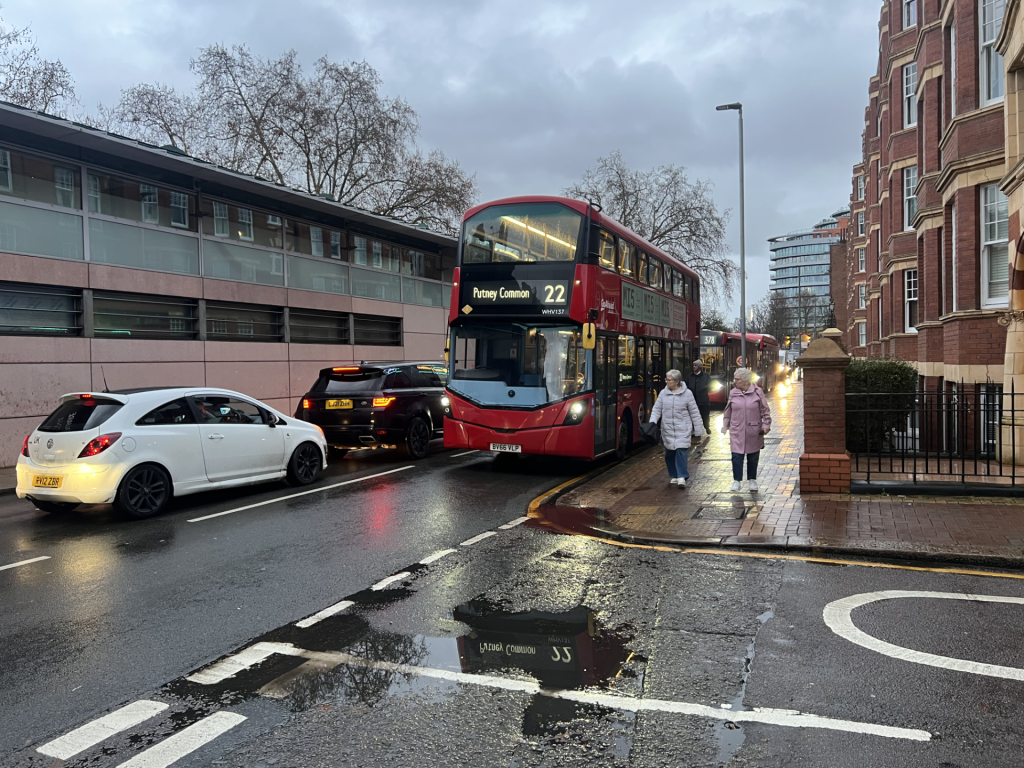
The walkabout provided officials with not one but two live demonstration of the problems residents have reported for months. On Lower Richmond Road, a Route 22 bus waiting for a driver changeover blocked traffic and caused immediate tailbacks – the very issue that led the council to request TfL move bus stops Q and P away from the bridge.
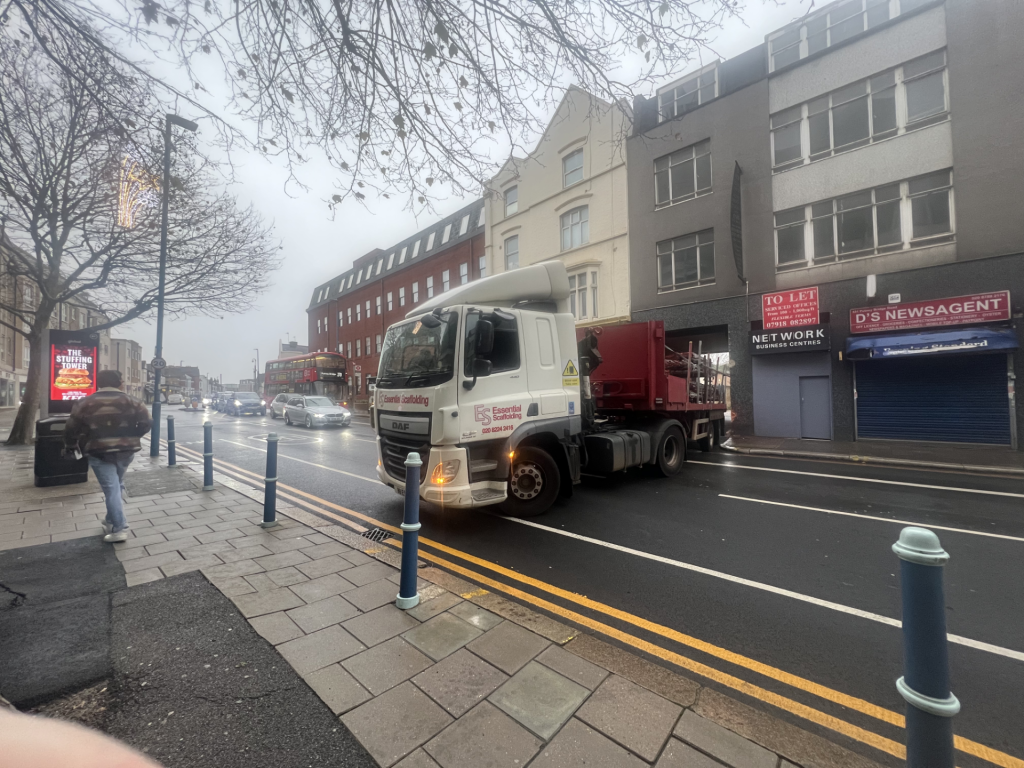
Earlier, a scaffolding lorry attempting to reverse into the narrow arch on Putney Bridge Road blocked traffic in both directions while officials watched. The lorry is for the demolition of the blocks on the corner of Putney High Street and Putney Bridge Road (where a new hotel with retail space underneath is planned) but has been told it couldn’t unload on the main road. The manoeuvre into the restricted space caused significant delays.
Both incidents illustrated how single disruptions cascade through the constrained junction.
Air quality monitoring: modern technology on the horizon
Officials from the council’s air quality team confirmed they are working to modernise pollution monitoring. Current monitoring uses diffusion tubes that are collected monthly and sent to a laboratory – a process they acknowledged is slow.
One official expressed enthusiasm for newer, cheaper technology that provides live readings. The plan is to run new sensors alongside traditional tubes to demonstrate equivalent reliability, potentially building a case to persuade central government (DEFRA) to accept modern monitoring methods.
The council confirmed it expects to have air quality data from side roads within a couple of months. Residents have been concerned that the congestions levels caused by the junction have meant increased pollutions levels on side roads (Putney High Street itself has gone from being “the most polluted road in Europe” to one that is beneath UK legal limits and not even the polluted in Putney).
Communication gap acknowledged
Officials acknowledged that communication with residents “isn’t good” but offered little concrete commitment to improvement. The council is working on a webpage that will cover what changes are coming and in what timeframe – something that Cllr Cooper and Cllr Locker pushed on at the Transport Committee meeting back in November and was pretty much the only useful thing to come out of the meeting.
The Labour-run council continues to argue that it inherited the junction scheme from the previous Conservative administration and has consistently blamed TfL’s failure to implement the signal timings that the design assumed. Internal emails show Cabinet Member Yates has been pressing TfL to accelerate approvals, writing in July: “We’re going to face so much renewed public anger in September if we don’t do things now that will help.”
In the same correspondence, Yates expressed frustration at TfL’s approval processes: “We really need TfL to comment on our concepts and options, to enable us to gauge what is likely to be approved before putting the time into detailed design. Otherwise we risk doing nugatory work.”
The council first sent proposals for the TK Maxx bus layby to TfL in March, expecting dialogue. After waiting and chasing, they were told they had to submit a formal third-party request. They submitted this in June – and months later, the work remains incomplete.
TfL defended the delays as part of a well-considered approval process than ensures any changes achieve what they set out to achieve.
What happens next
The Transport Committee meets next in February, where officers plan to present a range of coordinated measures. Until then, TfL continues signal optimisation work, though the council has noted buses still experience delays of up to an hour on some mornings.
For residents, the walkabout represents recognition of the scale of the problem – but concrete improvements remain months away, pending TfL validation processes that have already stretched proposals first identified in February across most of 2025.
Due to the local elections in May, there will be very little council committee work carried out past February, so unless the Cabinet steps in to to agree and push changes, there is a risk that approval of new changes dries up until the summer.



We haven’t really been able to experience the traffic chip timings as further roadworks and temporary traffic lights appeared subsequent to the changes. (Those recently outside Nat West Bank and causing the closure of the Putney Exchange bus stop (towards Putney Mainline Station).
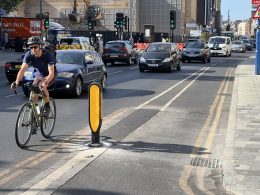
For the 220 / 270 buses turning right towards the bridge, this used to be 2 lanes, now one lane is bollard protecting a cycle lane forcing buses from the bus lane to try to merge into the outside lane to turn right.
Buses always had difficulty even accessing the ‘Brewhouse Lane’ bus stop / bus lane due to poor lane discipline by other road users whose near side wheels encroached into the bus lane preventing buses from accessing the lane and making progress.
With the recent temporary lights at Nat West Bank, cyclists and mopeds / mopeds were taking it upon themselves to mount the pavement to get around the stationary traffic startling pedestrians and is / a safety issue.
I don’t know why we are obsessed with and pandering to cyclists at the delayed travel expense to everyone else.
Why is there not a Temporary Traffic Light Cszar in each borough who goes out and checks that they are even phased properly rather than just plonked there!! And responsible for monitoring the effect on traffic flow.
And it should be compulsory in non residential areas to be working 24 hours to fix whatever they have dug up the road to fix and maybe 8am to 8pm in residential areas.
There must also be an end to the pavement cosmetics / tinkering nonsense every December / January whereby Councils have to spend all their budget else they won’t be allocated the same or more again the following year so a lot is spent on unnecessary pavement ‘cosmetics’ just to spend the money.
Prior to the new timings and traffic congestion I could sit on a 93 bus and fully charge my phone from one end of Putney High Street to the other!!!
Tfl had temporary service adjustments such as curtailing 93’s to Putney Green Man so none hardly got to Putney Bridge but nothing put up at Putney Bridge station to inform anyone for the 93 to take a bus up to Green Man to get the 93, and you supposedly have a Bus Station Controller at Putney Bridge and a tube Station with access to white boards and poster printing facilities !!
A shambles all round.
The Councillors should have been there on Saturday. It was absolute chaos on LRR and surrounding roads all day with parked vehicles unable to move and left turn from LRR impossible. Living in these streets is becoming intolerable and I hate to think what would happen in an emergency.