

Part VI: The current situation and future outlook
Where we are now (November 2025)
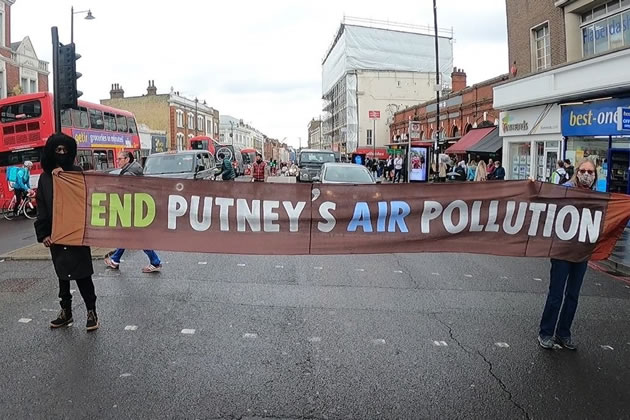
Putney’s air quality has never been better in the modern monitoring era. The 2025 annual mean of 33 μg/m³ represents:
- Compliance with UK legal standards for two consecutive years
- 78% reduction from the 2012 level
- No hourly exceedances for three consecutive years
- Putney High Street no longer even the most polluted location in Wandsworth
The Putney Society’s eight monitoring locations show an average of around 25 μg/m³ across the area, approaching the WHO interim target.
However, the recent traffic congestion has created a new challenge. The installation of additional monitors on Chelverton, Disraeli, Werter and Weiss Roads in September 2025 responds to residents’ concerns about traffic displacement from the High Street. Early readings suggest these residential roads are experiencing pollution levels not seen since before the ULEZ expansion.
The council is actively working with TfL on traffic management improvements scheduled through January 2026, including signal timing optimisations, lane reconfigurations, and enforcement measures.
The Citizens’ Assembly
In 2022-2023, Wandsworth Council held a Citizens’ Assembly on Air Quality – a deliberative democracy process bringing together a diverse group of residents to consider the evidence and produce recommendations. Their key recommendations included:
- Adoption of WHO interim targets as council policy
- Expansion of school streets programme
- Anti-idling enforcement
- Support for active travel infrastructure
- Wood burning restrictions
The council adopted many of these recommendations in its 2024 Air Quality Action Plan, including the ambitious WHO interim target of 25 μg/m³ by 2030.
The path to WHO guidelines
Reaching the WHO annual mean guideline of 10 μg/m³ would require a further 60% reduction from current levels: a challenge of similar magnitude to what’s already been achieved.
Several factors will determine whether this is achievable:
Vehicle fleet evolution: The continued transition to zero-emission vehicles will help, but the pace of improvement will likely slow as we approach the limits of what vehicle technology alone can deliver.
Non-exhaust emissions: Brake wear, tyre wear, and road surface degradation will become proportionally more significant as exhaust emissions decline. These are harder to address than tailpipe emissions.
Traffic volumes: Unless traffic volumes themselves decline, there’s a floor to how low pollution can go even with perfect zero-emission vehicle adoption.
Wood burning: Residential wood burning, particularly popular in Wandsworth, contributes significantly to particulate matter. Cultural change and enforcement will be needed.
Regional sources: A proportion of particulate matter originates from continental European agriculture and industry. Local actions alone cannot address these sources.
Built environment: Street canyon effects and proximity to major roads mean some locations will always have higher concentrations than others.
Realistically, achieving WHO guidelines across all of Putney may require 15-20 more years of sustained effort, assuming continued policy support and technological advancement.
Conclusion: Lessons from Putney
Putney’s transformation from the most polluted high street in the UK to achieving legal compliance represents more than just a local victory. It demonstrates what can be achieved when community activism, scientific evidence, political will, and technological innovation align.
The key lessons from Putney’s experience are clear:
- Citizen science can challenge official narratives and force action
- Clear identification of pollution sources (the 68% from buses) enables targeted solutions
- Sustained public pressure and media attention are essential for maintaining momentum
- Political commitment at the highest levels can unlock resources and accelerate change
- Technology transitions (diesel to hybrid to electric) can deliver dramatic improvements
- Multiple interventions working together achieve more than single solutions
- Continuous monitoring prevents backsliding and identifies new challenges
The fight for clean air in Putney is not over, but the progress achieved shows that even the most intractable-seeming environmental problems can be solved. For the children who now walk to school breathing air that meets legal standards, for the elderly residents who can shop without fear, and for the 100,000 people who live, work, and visit Putney, the air is cleaner than it has been in decades.
This success story, built on 15 years of determined community action, scientific rigour, and political engagement, offers hope and a blueprint for other communities facing similar challenges. The message from Putney is clear: change is possible, but it requires persistence, evidence, and the courage to demand better.
Next page > Key Figures and Organisations


The best piece of journalism I have ever read about Putney. And the most positive. Now we tackle traffic jams.