

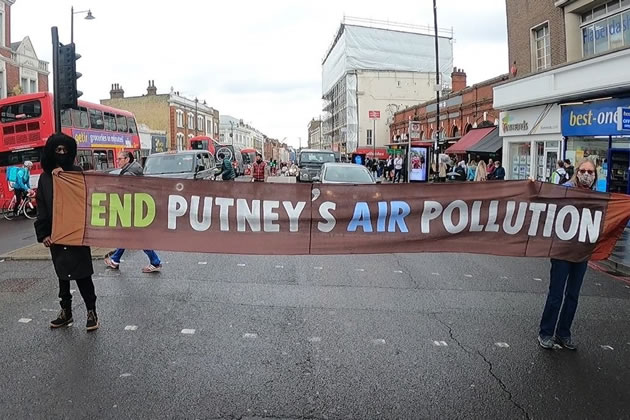
A comprehensive account of how community activism, political pressure, and persistent monitoring transformed Putney High Street from London’s most polluted location to a success story in urban air quality
Introduction: The human cost of dirty air
Every day in 2011, thousands of Putney residents breathed air that was slowly killing them. Children walking to school along the High Street inhaled nitrogen dioxide at levels that would damage their growing lungs, potentially stunting their development for life. Elderly residents with heart conditions faced increased risks with every shopping trip. The UK Health Forum estimates that air pollution contributes to 40,000 premature deaths annually across the country – and Putney High Street had earned the shameful distinction of having the worst air quality in London, with NO₂ levels nearly four times the legal limit.
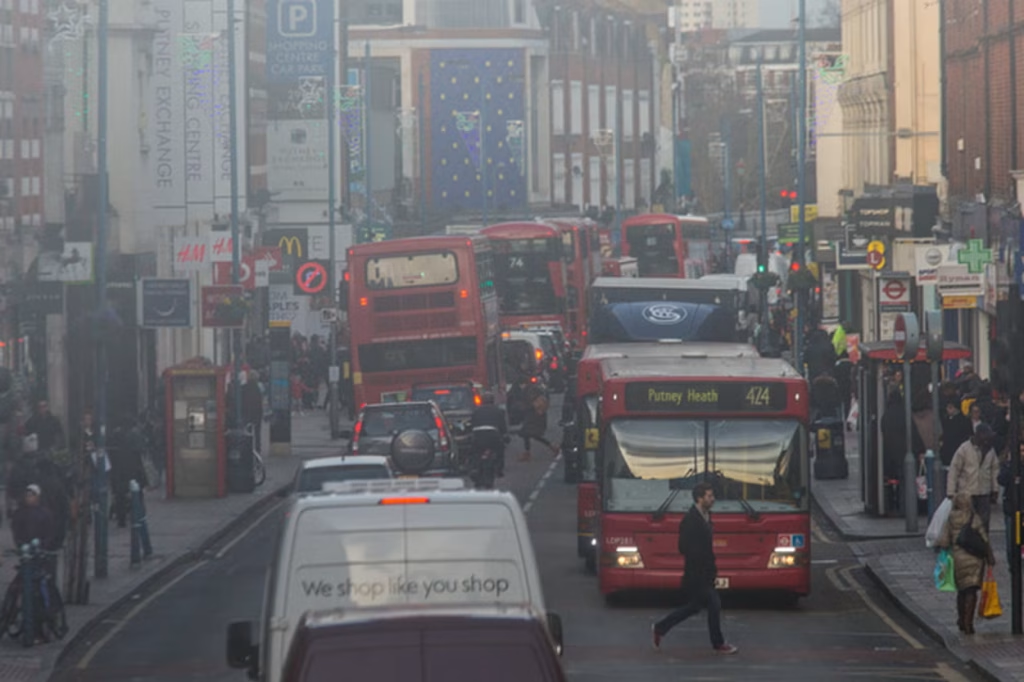
This invisible crisis was hiding in plain sight. Over 100 buses an hour thundered through the narrow shopping street, joined by thousands of cars, vans and lorries using the vital Thames crossing at Putney Bridge. The air was visibly hazy on still days, with a distinctive acrid smell that residents had grown accustomed to – not realizing that this acceptance was costing years of their lives. For those with asthma, bad air days meant staying indoors. For parents, it meant impossible choices about which route to school might do the least harm to their children.
Yet officially, according to Wandsworth Council and Transport for London, there wasn’t a problem significant enough to warrant urgent action.
What happened over the next 15 years – from 2011 to 2025 – represents one of the most successful community-led environmental campaigns in modern London history. It is a story of citizen science, political pressure, scientific vindication, technological transition, and ultimately, dramatic improvement in the air that 100,000 local residents breathe every day.
This is the account of Putney’s air quality crisis and its resolution.
Part I: Discovery and Mobilisation (2011-2012)
The Putney Society Takes Action
The story begins not with officials or politicians, but with concerned residents. In 2011, frustrated by what they perceived as inaction despite mounting health concerns, members of the Putney Society decided to gather their own evidence.
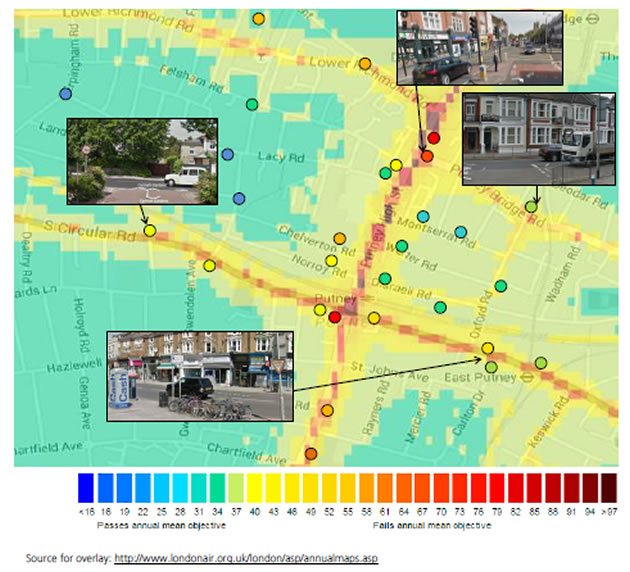
Dr Carolyn McMillan, then Chair of the Putney Society, and Jonathan Callaway, Deputy Chair, organised the installation of nitrogen dioxide (NO₂) diffusion tubes across 36 sites in central Putney. With support from the community mapping organisation Mapping for Change, volunteers conducted a four-week monitoring exercise that would transform the debate.
The results were alarming:
- NO₂ levels were 75% in excess of EU limits not only on Putney High Street (already monitored by Wandsworth Council) but also at Putney Cross and on Putney Hill
- NO₂ levels were 25% in excess of EU limits along Upper Richmond Road and close to the High Street
- EU limits were exceeded on several residential roads in Putney
- The pollution effects clearly spread well beyond the immediate vicinity of major roads
Dr McMillan stated: “Our research confirms that concerns about high air pollution levels in central Putney are justified. Airborne pollutants produced by vehicles have known adverse effects on the health of people of all ages, but particularly of children and the elderly. We urge Wandsworth Council to work with Transport for London, local people and other stakeholders to urgently tackle this problem.”
The Groundbreaking 2011 Study
Recognising the seriousness of the situation, Wandsworth Council commissioned Transport Research Laboratory (TRL) to conduct a comprehensive emissions source apportionment study for Putney High Street. The report, published as PPR595, used automatic number plate recognition cameras and video traffic analysis to definitively establish pollution sources.
The findings were stark and specific:
Buses contributed over two-thirds (68%) of NOx emissions despite making up only 10% of vehicle flow.
This was a revelation. Cars, which made up two-thirds of total vehicle flow, contributed only 14% of NOx emissions. The study found that 76% of buses were Euro III emission standard for PM (particulate matter), but their NOx emissions were “disproportionately high.”
The majority of the bus fleet – 177 diesel buses using the high street – fell below the ‘Euro 4’ emissions standard. They were simply too old and too dirty for such an intensively used urban corridor.
The TRL study provided the evidence base that would drive everything that followed. Wandsworth Council now had scientific proof of the primary pollution source, giving them the leverage to demand action from Transport for London, which operated the buses.
First Steps: Hybrid buses arrive
In October 2012, TfL began replacing the older, higher-polluting diesel buses with cleaner models. From October 2012 to March 2013, 46 of the worst-polluting buses were replaced with new models, including ten low-emission hybrids. A further 85 older diesel buses were retrofitted with advanced catalytic reduction systems.
Deputy council leader Cllr Jonathan Cook stated: “Buses are by far the greatest source of pollution on Putney High Street and these upgrades can’t come soon enough. The council’s air quality investigation is the only one of its kind in London and has pushed Putney right to the front of the queue for new buses.”
The initial results were modest but encouraging: a 20% reduction in pollution levels. But this still left Putney three times above the UK legal limit.
Next page > Part II: Crisis and Publicity (2013-2016)




The best piece of journalism I have ever read about Putney. And the most positive. Now we tackle traffic jams.