

Part V: Analysis and lessons
What made the difference?
The transformation of Putney’s air quality from crisis to compliance wasn’t accidental. Eight key factors combined to create this success:
1. Community-led evidence gathering
The Putney Society’s decision to conduct their own monitoring in 2011 was transformative. It provided independent verification of the problem, created media interest, and forced official acknowledgment. The continued monitoring programme from 2022-2025 ensured accountability and provided real-time feedback on intervention effectiveness.
2. Targeted source identification
The TRL emissions source apportionment study (PPR595) was crucial. By precisely identifying buses as responsible for 68% of NOx emissions, it focused efforts where they would be most effective. Subsequent validation by King’s College London (showing 60% contribution from diesel buses) reinforced this evidence base.
3. Political accountability
The issue was raised at every level of government – from local councillors to the Mayor of London to Parliament. Assembly Members from all parties questioned successive mayors. The moment when Sadiq Khan launched his mayoral campaign on Putney High Street in 2016 was pivotal.
4. Media attention
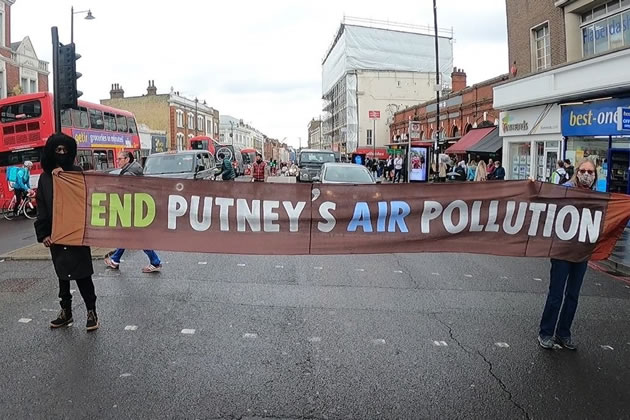
The “most polluted high street” label, while unwelcome, proved invaluable. It created a narrative that media could follow, politicians couldn’t ignore, and residents could rally around. The visual of shopkeepers closing doors against toxic air was powerful.
5. Technological solutions at scale
The progression from retrofitting old buses to introducing hybrids to deploying electric vehicles demonstrated how technology, when applied systematically, could deliver dramatic improvements. The £10 million retrofit programme and subsequent fleet replacement showed serious investment.
6. Multiple intervention approach
No single solution would have been sufficient. Bus upgrades, delivery restrictions, ULEZ expansion, public realm improvements, and school streets all contributed. The cumulative effect was greater than the sum of parts.
7. Sustained pressure
This wasn’t a short campaign but a 15-year effort. The Putney Society, residents, businesses, and politicians maintained focus even when progress seemed slow. Persistence was essential.
8. Regional and national policy alignment
The ULEZ expansion, national air quality strategies, and evolving EU/UK standards created a supportive policy environment. Local action was reinforced by wider regulatory changes.
The limitations of success
While celebrating the achievement, it’s important to acknowledge what hasn’t been solved:
Particulate matter: While NO₂ has improved dramatically, particulate matter (PM10 and PM2.5) remains a concern. Putney High Street’s 2024 PM10 level of 17 μg/m³ is well within legal limits but PM2.5 levels still exceed WHO guidelines.
Traffic displacement: The recent congestion has raised legitimate questions about whether pollution is being displaced from the High Street to residential streets. The installation of monitors on Chelverton, Disraeli, Werter and Weiss Roads in September 2025 will provide data on this concern.
Measurement limitations: All official monitoring is at fixed locations. The recent congestion highlights how local conditions can vary significantly from monitored sites.
Next page > Part VI: The current situation and future outlook


The best piece of journalism I have ever read about Putney. And the most positive. Now we tackle traffic jams.