

Part II: Crisis and Publicity (2013-2016)
When the air became visible
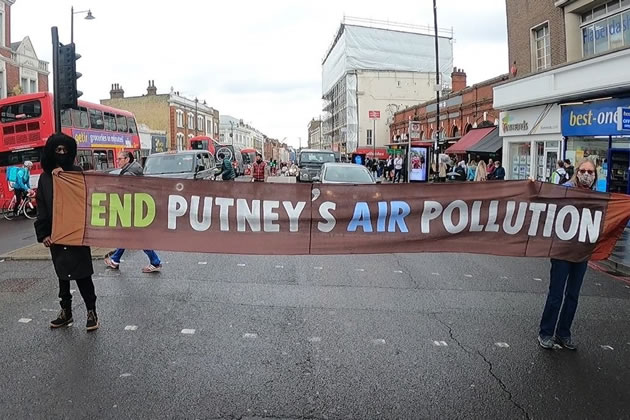
January 2013 brought a public relations crisis for the authorities. Calm weather conditions sent nitrogen dioxide readings “soaring off the scale,” as campaigners put it. The fumes were so bad that the Evening Standard reported shopkeepers were being advised to keep their doors shut to protect customers from toxic air.
The Putney High Street kerbside monitor recorded 72 “bad air” hours in the first nine days of 2013 alone. The legal annual maximum was 18 hours. The average NO₂ reading in the previous year was 155 μg/m³ – nearly four times the legal limit of 40 μg/m³.
Simon Birkett, founder of Clean Air in London campaign, told media: “Levels of nitrogen dioxide are off the scale in Putney and other parts of London. The Mayor must start issuing pollution warnings and banning the oldest diesel vehicles of all sorts.”
Assembly Member Jenny Jones was blunt: “Putney High Street is a disgraceful example of the Government and Mayor’s failure to take responsibility for air pollution. As a result even more people will die prematurely, suffer worse asthma and other respiratory conditions.”
The low emission bus zone
In early 2013, the Mayor and TfL announced a £10 million bus retrofit programme, the largest of its type in the world. Putney was the focus of intensive effort: 94 double-decker buses travelling through Putney were fitted with Selective Catalytic Reduction (SCR) equipment. Trials had shown this system could reduce harmful nitrogen oxides (NOx) emissions by up to 88%.
The equipment was revolutionary for its time, but its rollout exposed how deeply embedded the pollution problem had become. Even with these interventions, Putney remained severely polluted through 2013, 2014, and 2015.
Persistent pressure from the community
Through this period, with growing widespread concern, the Putney Society maintained their monitoring programme, regularly measuring, documenting, and publicising air pollution levels. They organised public meetings, invited academics from King’s College and Imperial College London, engaged with local schools and health professionals, and kept the issue in the public eye.
In 2016, a King’s College London analysis commissioned by the council provided further vindication of the TRL findings: more than 60% of NO₂ pollution in Putney High Street still came from diesel buses.
National spotlight: “Most polluted High Street”
In 2016, Putney High Street gained the dubious distinction of being identified as the most polluted high street in the UK. The Putney Society installed a further set of NO₂ measuring tubes, with results showing concentrations around 125 μg/m³ – more than three times the legal limit.
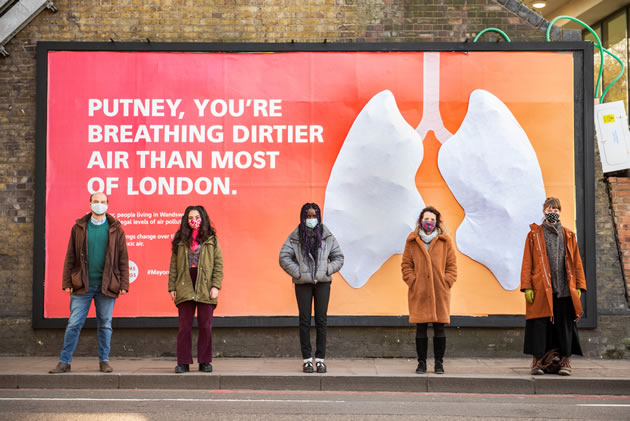
The publicity was intense and sustained. The campaign group ‘Mums for Lungs’ hired a billboard outside East Putney station and the London Forum of civic societies ran a campaign at the city level. The issue was raised repeatedly in the London Assembly, with members questioning the Mayor about specific actions and timelines. Between 2013 and 2021, at least 15 written questions about Putney High Street air quality were submitted to City Hall.
Crucially, in 2016, Sadiq Khan launched his campaign to become Mayor of London standing on Putney High Street, committing to reducing levels of pollution. This political commitment would prove vital.
Next page > Part III: Breakthrough and Progress (2017-2020)



The best piece of journalism I have ever read about Putney. And the most positive. Now we tackle traffic jams.