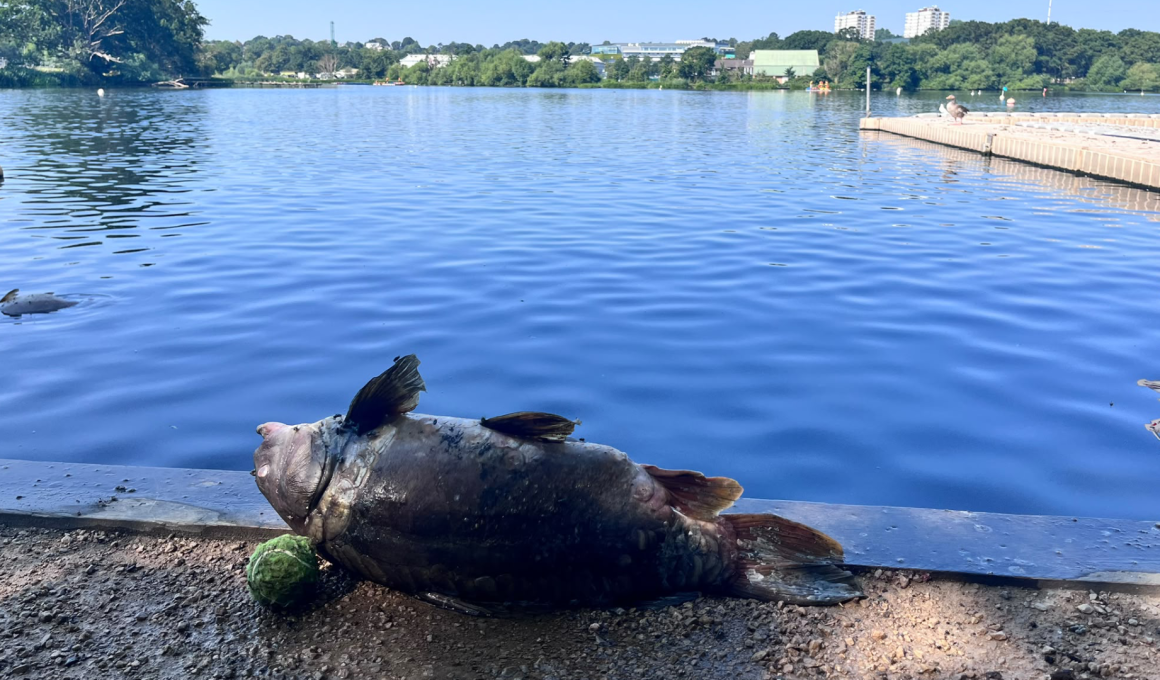
Thames Water has refused to explain what it knows about the fish deaths in Wimbledon Park Lake last month, saying disclosure could hinder live investigations into potential pollution at the site.
A local resident asked Thames Water a series of questions under the Environmental Information Regulations: what it found when it looked into July’s fish deaths, what it knows about a reported 2025 pollution incident linked to the All England Lawn Tennis Club site next door, whether AELTC holds a formal consent to discharge trade effluent from its Church Road site, and who is responsible for maintaining the drain that feeds the lake.
Thames Water’s answer, dated 6 August, refused all five.
The water authority relied on regulation 12(5)(b) of the Environmental Information Regulations, an exception that allows a public authority to withhold information where releasing it would harm an ongoing investigation or a fair hearing. In its own words, there is a live pollution investigation going on.
On 9 July, Thames Water and Merton Council told residents that the fish deaths were probably linked to the summer heat, which lowers oxygen levels in shallow water, while the Environment Agency said much the same: early observations pointed to high temperatures, low water levels and algae, with no evidence at that stage that pollution was to blame. Merton Council, which owns the lake, imposed a swimming and dog ban and Thames Water installed aeration equipment, and nothing more was said publicly about the cause until this week.
It’s not clear whether an investigation into pollution began after 9 July, or if it was already running when the company gave at the height of locals’ concerns, or if Thames Water is simply using the exception as a blanket to refuse to answer any questions – something that is not uncommon among local authorities.
But it is the second July running that fish have died in the lake, and the second time officials have pointed to the weather at the same time that a pollution investigation is also taking place. There is of course a wider issue: the larger and still unresolved fight over AELTC’s plans to expand its grounds onto the neighbouring former golf course. Residents who are already frustrated with the tennis club’s attitude to the park and lake are all too aware that both events have happened while the Wimbledon tennis tournament has been going on. AELTC denies any responsibility.
In July 2025, campaigners reported a similar issue and pointed to AELTC, whose grounds run along the lake’s western edge, though the club’s response at the time was that the surface water culverts running under its site and Church Road are adopted sewers, managed by Thames Water rather than owned or operated by the club, with no direct discharge flowing from AELTC into the lake. Thames Water’s own network data recorded a storm overflow near Home Park Road around the same time, though the company cautioned that an overflow record alone does not confirm pollution, and AELTC’s account, if it still stands, places the drainage squarely inside the network the new letter says is now under investigation.
The tournament brings an enormous number of people as well as outside contractors onto the site and, residents note, there has been no repeat of the fish deaths since the tournament ended, despite a longer and hotter spell.
As for Thames Water’s refusal to provide any information: a tribunal has already rejected the kind of blanket reliance on this exception that its letter claims. In April 2024, Northumbrian Water was ordered to hand over discharge data withheld under the same regulation, on the same basis that a live Environment Agency and Ofwat inquiry made disclosure too risky. The tribunal disagreed, ruling that treating the exception as engaged whenever information is “directly relevant” to an ongoing inquiry was “a generalised approach” it did not accept, and ordering the company to disclose within 35 days.
What you can do
Anyone who sees dead fish, distressed wildlife or unusual water conditions can report it to the Environment Agency’s 24-hour incident hotline on 0800 80 70 60, or through gov.uk’s water pollution reporting service.
Thames Water can be asked to carry out an internal review of its refusal, in writing, within 40 working days of 6 August, to EIR.Requests@thameswater.co.uk and after that, if still unsatisfied, to the Information Commissioner’s Office.