

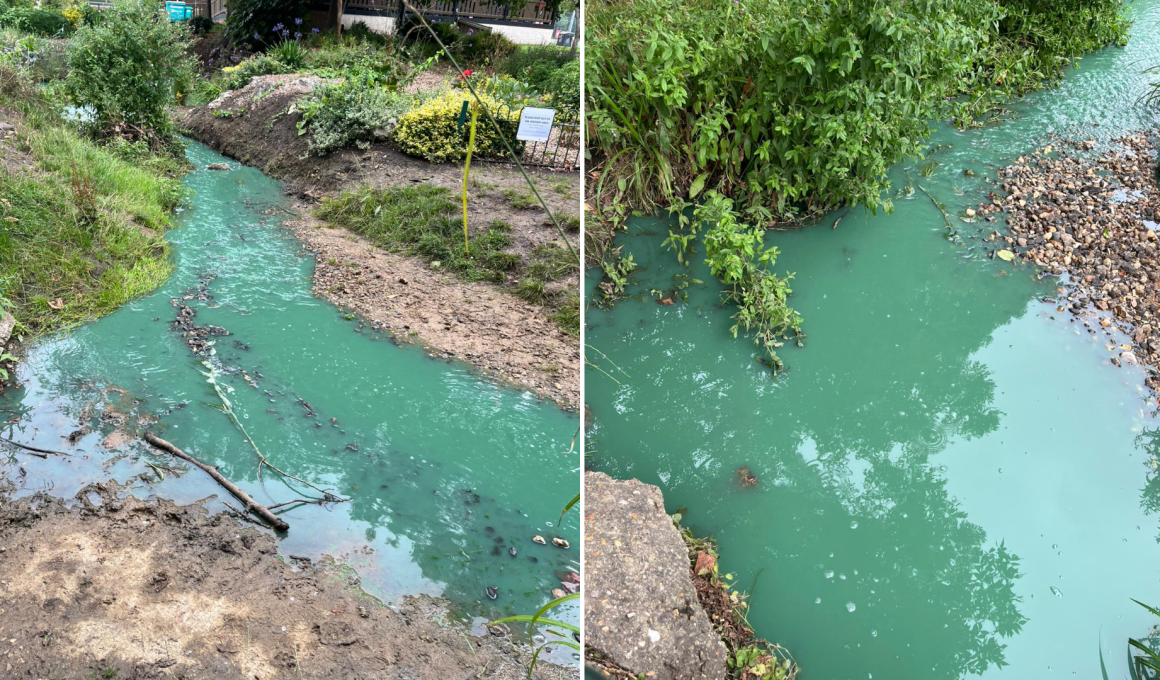
UPDATED A vivid, cyan‑green plume that appeared in a brook downstream of Wimbledon Park Lake has triggered alarm among local campaigners, ecologists and anglers.
Many now believe the spill may have originated from drainage linked to the All England Lawn Tennis Club (AELTC), and fear it may foreshadow far more serious pollution if the club’s expansion plans are approved.
The spill was first noticed last week, when images circulated showing a bright turquoise discolouration in the brook. The colour dissipated over the next few days, but the incident prompted calls to the Environment Agency and Merton Council, and reignited scrutiny of the lake’s water quality.
Thames Water’s Event Duration Monitoring (EDM) system recorded a storm overflow near Home Park Road on or around 19 July, coinciding with heavy rainfall, although Thames Water emphasises that EDM signals alone do not confirm pollution or watercourse contamination.
Locals point to AELTC drainage network
Residents and ecologists note that one of the lake’s three underground tributaries runs from the All England tennis site west of Church Road. While the other two originate on Wimbledon Common and collect suburban run‑off, the AELTC-controlled tributary is under single ownership, and campaigners have highlighted that the club does not carry out routine water quality testing on its discharge line .
Campaigners fear that chemical run-off or stormwater discharge from AELTC facilities could have triggered the spill. Unverified reports also suggest Thames Water tankers were seen pumping out drains near Church Road and releasing water into the freshwater system during the tennis fortnight.
Campaigners warn expansion could magnify risks
The incident has only added to scrutiny of AELTC thanks to its current planning application for major tennis development, includes 38 additional courts and a show‑court complex on Metropolitan Open Land. One of the concerns about the development is possible water pollution. Local ecologist Dr Dave Dawson has previously warned that the proposals would bring:
- Increased chemical usage and intensive irrigation, raising nutrient loading into the lake
- Stormwater drainage, which, even when treated, will likely carry enough nitrate and phosphate to exacerbate blue‑green algal blooms
- A planned dredging operation to deepen the lake, which could disturb historic sediment and release pollutants locked on the lake bed
There is reason to be concerned: in 2022, a dog drinking from the brook after an algal bloom suffered severe poisoning and nearly died.
Lack of oversight compounds concern
Local groups point to the absence of routine testing across all inlets feeding the lake, including the AELTC conduit and drainage from nearby golf course land. A response by The Wimbledon Society noted: “There is no routine testing of the water in any of these… pollutants from [AELTC] are readily controlled. The All England do not monitor their pipe.”
With planning deliberations ongoing, campaigners as well as local dog‑walkers, anglers, children and wildlife users are concerned that the spill serves as a warning: without stronger monitoring and environmental safeguards, further contamination is all too possible if the AELTC development and lake dredging proceed unchecked.
UPDATE: 1 August
In response to this story, the All England Lawn Tennis Club said the incident in Wimbledon Park Lake was the result of a blue-green algae bloom, confirmed by Merton Council’s inspection, and not linked to any de-rigging operations or discharges from the Club.
A spokesperson said:
“Blue-green algae is a natural manifestation of the hot temperatures experienced this summer and is affecting water bodies across London and the UK.”
They added that surface water culverts running under the AELTC site and Church Road are adopted sewers managed by Thames Water, not owned or operated by the Club, and that no direct discharge flows from AELTC into the lake, as had been suggested by some campaigners.
Regarding future lake management, AELTC said its plans include de-silting the lake as an early phase of the golf course redevelopment, with the aim of improving water quality, enhancing oxygenation and biodiversity, and creating a public boardwalk. The Club says new silt traps and wetland habitat creation will improve long-term resilience and ecological health.
Campaigners, however, remain concerned that the proposed development could increase nutrient runoff and aggravate the risk of future algal blooms. Ecologist Dr Dave Dawson previously warned that lake nutrient levels are already high, and that greater irrigation and chemical use could worsen the problem.
We will continue to report as more information becomes available, including any findings from the Environment Agency or Thames Water.




Planning deliberations are not currently ongoing! At a Judicial Review of the GLA’s grant of planning permission for a vast commercial development on this Metropolitan Open Land, the judge decided that the GLA grant of consent was not illegal in planning terms. What is still at issue is the Senior Councel advice that the land is held in Statutory Trust for Public Access. Also there are restrictive covenants on the land that say the land must not be developed in the manner proposed. There is a case to be heard in Chancery next January about the Trust issue. That could put the kybosh on AELTC’s outrageous greed. Big hurdles for AELTC to try and jump, and they will throw millions of ££££’s in their attempts.