

Wandsworth’s Cabinet will decide the future of Putney Bridge junction on 7 October, in a decision covering at least £1m. It’s the first time in eighteen months that the problem has been treated this seriously. And for the first time, the two councillors in charge both represent Putney.
Alongside some additional junction changes, the council is promising a consultation on traffic across the wider high street. Thirteen days before Cabinet meets, on 24 September, the council’s transport committee sits for the first time since February. A meeting due in June was cancelled. When the council’s package was published in July, we looked at what was actually new, and found just three of the eight measures were.
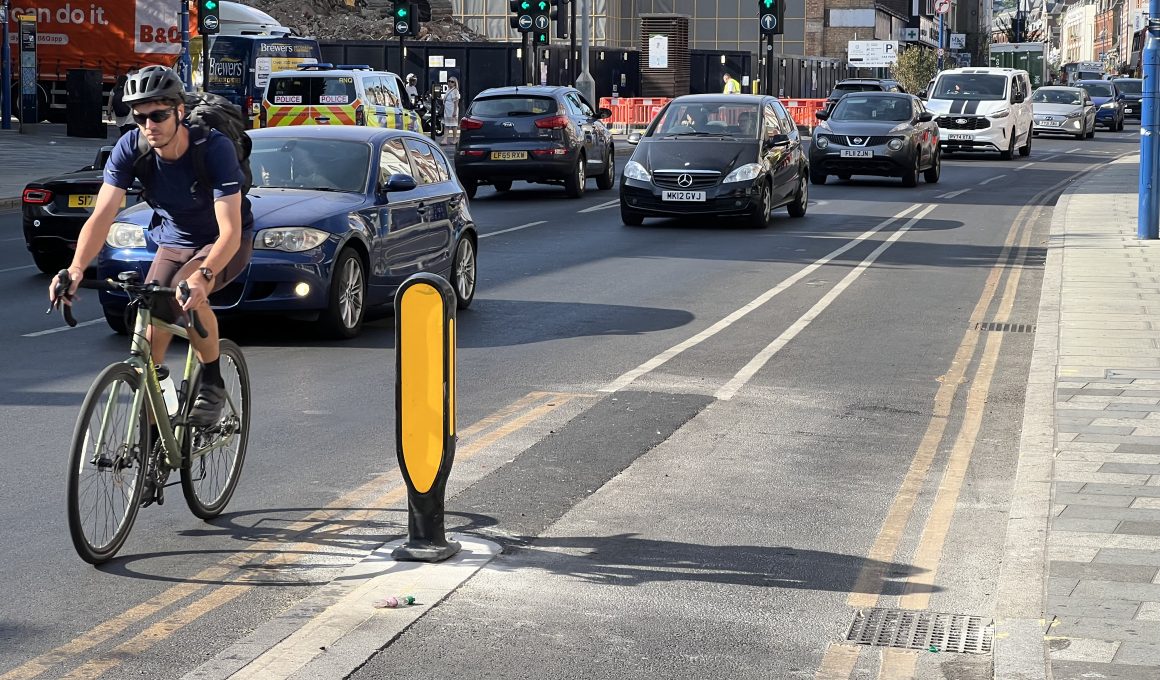
Since then there has been actual progress with new measures. Work is already visible on the ground. A sign went up on Putney Bridge Road warning of highway improvements. The cycle wands have already been removed, provided some additional space for the mode of transport that accounts for over 80% of the junction’s users: cars and lorries.
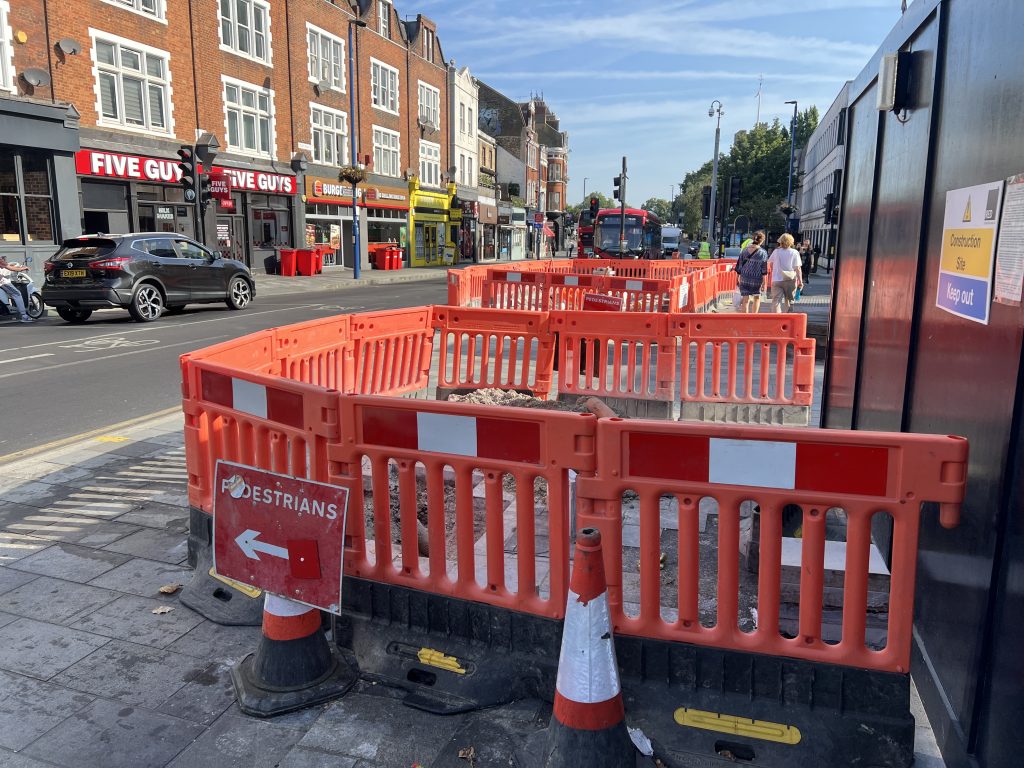
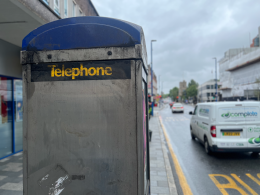
In addition, the BT phone box has finally been removed after a wait of a year, freeing up space for the bus stop outside TK Maxx to be set in, and so, hopefully, improving traffic flow. A new, wider pedestrian crossing is being added to the bottom of Putney High Street, in space previously taken up by a small bike path that even cyclists have admitted they never used.
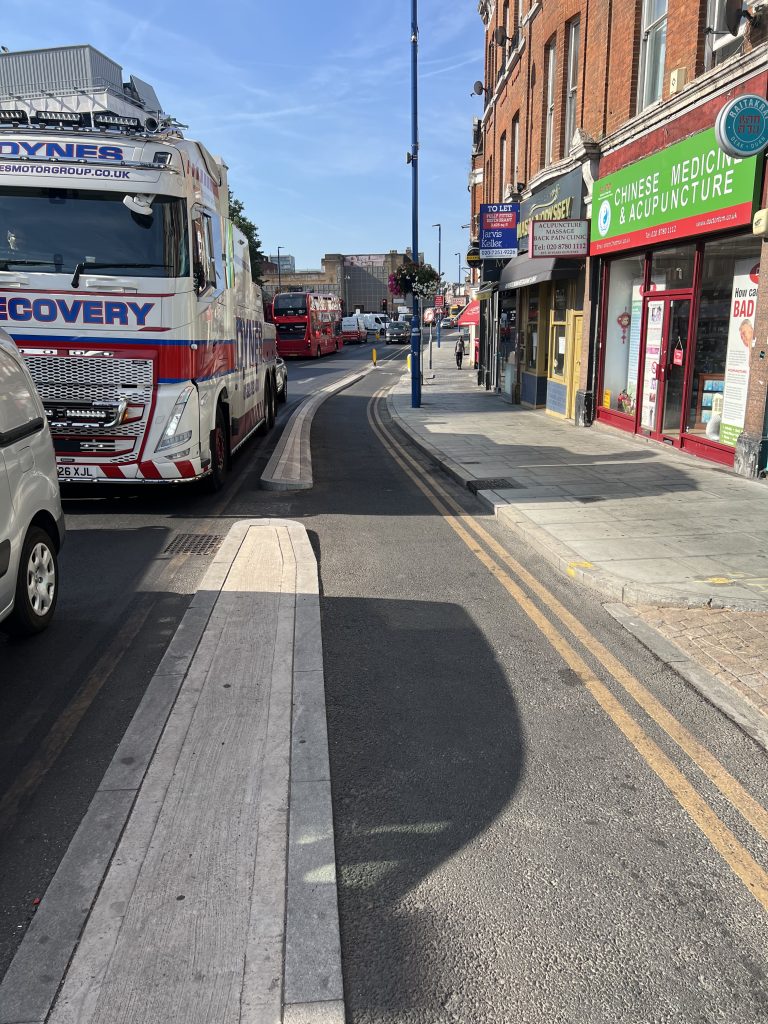
Council leader Robert Morritt has told residents what else to expect: the traffic island by Snappy Snaps finally taken out, the cycle lane by Franco Manca made narrower, and work under the road itself on the wiring that controls the traffic lights.
If ever you were in any doubt about council priorities, the sudden surge in activity has come at a time when one of Thamesfield’s local councillors, Cllr Robert Morritt, just became leader of the council, and the new cabinet member for transport, Cllr Nick Austin, both lives and works just off Putney High Street – and so has been living with the same appalling traffic as the rest of us for over 18 months.
Now we just need some measurable goals
That’s the good news. The bad news is that it remains unclear whether the changes will be sufficient to return the junction back to even its previous unsatisfactory state, before the botched junction redesign.
Cllr Austin has given one number so far: eleven more cars getting through the lights on Lower Richmond Road each time they turn green, once Transport for London (TfL) agrees to change the timings. That tells you how many more cars get through. It doesn’t tell you how long your journey will take, how long you’ll queue, or when you should expect to notice a difference.
Some residents are not convinced the new changes will do enough. Cllr Morritt hasn’t given any numbers either. “People will form a view on if we can make it work,” he wrote on a resident’s forum. “My plea is give it a chance and see if it’s better when the works are done.”
That’s an honest thing to say, eighteen months into a problem with no quick fix. But it also means, in his own words, that nobody at the council has actually said what “better” looks like, or given a date by which anyone could check.
That’s not because the council has no data. Its case for doing this work in the first place was built on numbers: traffic counts across the bridge, modelling of how the traffic lights are timed, the same kind of data behind Austin’s figure of eleven extra cars. None of that data has been used to say what success would look like. Not even the simplest version: comparing traffic now to what it was before this junction was rebuilt, something the council’s own figures could already show. The council measured the problem to justify doing the work. It hasn’t measured anything to say when the work is finished.
Some of what is being taken out was there for a reason. Residents have pointed out that the width of the cycle lane was a safety feature. The council leader’s response has been that “there’s a balance to be struck” between traffic, air quality and safety, and that the council is “trying to alter the balance a little bit” including over air quality. Balance is good. But isn’t a target either.
This junction has been “fixed” multiple times before. Before the current layout was even approved, TfL warned the council in writing that it would cause “extensive queuing.” It did. When engineers later checked, they found the traffic lights hadn’t even been set up the way the approved plan said they should be. Once they put the real settings into their model, it produced the same queues residents had been complaining about.
The council also said in July that the junction needed fixing because traffic was getting worse. Its own figures show fewer cars, not more: 37,313 vehicles a day crossed Putney Bridge in 2024, down from 42,498 in 2018, a fall of more than 5,000 vehicles a day, even with Hammersmith Bridge shut the whole time. And nobody, this time or any time before, has pointed to a document that says how the council would know if any of it had worked.
A published target would give residents something none of that history has: a way to check the council’s own account against what actually happens on the ground, rather than being asked, again, to give it time and trust that this attempt is different. That is what eighteen months of “wait and see” has amounted to so far, on a scheme with a record of being told it would work and being wrong.
What we’ll measure, and what’s still open
Putney.news already holds two years of data on Route 85 buses through the junction, and the results of our own survey of 763 residents whose journeys go through it. Our own analysis has already found the buses are 41% worse than the rest of the borough. We’ll track both between now and the Cabinet decision, whether or not the council sets its own measure first.
The transport committee meets on 24 September. Cabinet makes its decision on 7 October.
Correction, 9.30am: We originally stated that work had begun on narrowly the bike lane outside Franca Manca. A look at Monday morning reveals that the work crews on that area last week did a different job. The road has been patched up but the bike lane remains the same.


I hope that we will broaden the view of what success for Putney looks like. What do we want? To me it is a healthier, more vibrant High Street – economically and physically – where people of all ages want to visit, shop, and cleaner air and less road danger. Sure – we need to look at the junction. But by looking only at cars and motor traffic we will continue to degrade the heart of Putney. We need at the same time to look at how we can move around less by private car and more on foot and wheels. None of the measures proposed help local trips on foot or on a bike. High Streets that design for walking and cycling do better economically – and are much more pleasant to be in.
Slightly fearful of the backlash this may generate, but I am going to make a suggestion and see what ideas pop up. This is not a concrete, costed proposal – just an idea – in the spirit of open discussion and constructive problem solving.
Let’s start with what is absolutely, absolutely essential for motor traffic in the High Street. I would say this is only emergency vehicles, buses and public transport, and motor vehicles for those with limited mobility. And possibly those where the individual’s vehicle is necessary for their core work during the working day – not just the commute – although a ride on the train & underground will show that all sorts of workers are hauling tools with them. How many car journeys is that? Could the junction and High Street cope?
Then let’s think about the next tier – areas where there is some individual and council choice in what they prioritise and how we could get around. For example – short local journeys to school, shops, services, short commutes and similar – at least some of these do not need a car. How many journeys is that? Or, commutes where there is a public transport option. Can the High Street and junction cope – unlikely as traffic very ongested even before the junction work. If not – how should the council, TfL etc prioritise – should they keep their focus on moving cars (least efficient) – and what are the consequences for local businesses and residents in the next 1 to 20 years if they continue to do so? Or should some of the transport design money and energy go into better infrastructure so that at least some of these journeys can be made safer and more convenient on foot and by bike rather than by car and for work public transport) – and what are the consequences for businesses and local residents now and in the future if we take a broader, strategic approach to how we move around?
No backlash from me Ruth P, I like the safer cycle lanes and much improved pedestrian crossings.
The more people use public transport, the better.
As for the current trend for these ridiculous monsterous 4×4 “cars”, no mention of the additional space they occupy in both length and breadth when considering the congested state of the high street….