


Wandsworth Council wants to charge utility companies and contractors up to £2,500 a day to dig up Putney’s busiest roads, in large part to ease congestion. But none of the eight measures used to judge the scheme will cover queuing traffic or residents’ journey times.
The council’s evaluation plan instead tracks the number of works on charged roads, days saved through companies working together, works that avoided a charge and waivers granted. It also estimates the carbon saved by cutting peak-time works.
Reduced congestion and more reliable journeys head the list of benefits the council expects from the scheme. Nothing in its plan will show whether the scheme delivers the benefit it puts first.

The method London boroughs use to choose which roads are charged draws on journey-time data from INRIX, a traffic data company, and on TfL bus data, according to the versions Merton and Harrow have published. Wandsworth’s Cabinet paper says the council is part of the same pan-London framework but does not say what data it used. None of that journey-time data will be used to judge the scheme.
It is not the first time the council has proposed changes to ease Putney’s traffic without setting out how it will tell whether they work. When it announced its latest changes to the Putney Bridge junction in the summer, it set no target for what they should achieve. It does monitor journey times at the junction, using TfL bus data and number-plate cameras, according to its own website. The junction was redesigned in 2024, a change the council acknowledges resulted in “unexpected congestion”. None of that monitoring features in the lane rental plan.
We invited the council and Transport for London (TfL) to comment last week, asking among other things how residents would be able to tell whether the scheme was reducing disruption. Neither has replied; we will add any later response as an update.
Other gaps in the consultation
Government guidance says a lane rental consultation should include the council’s cost-benefit analysis and the reasons each street is classed as traffic sensitive. Wandsworth has not published either, although its consultation page says it “will publish all documents in line with the Department for Transport’s requirements”.
A cost-benefit analysis is where a council shows its working. The guidance says it should weigh all of a scheme’s effects, good and bad: the delays saved by moving roadworks out of the rush hour against the delays caused by more work in the evenings and at weekends, and what the charges will cost utility companies and the council’s own works. Merton’s analysis put those charges at almost £1.5m a year. Without one, Wandsworth residents cannot see what the scheme is expected to save, what it will cost or how much work will move into evenings and weekends. The scheme would cover 11.6 per cent of Wandsworth’s roads, and above 10 per cent the guidance requires councils to give a “strong and clear rationale”, backed by evidence, for the extra coverage.
The Public Sector Equality Duty requires the council to consider whether a decision falls harder on some groups than others, such as older or disabled people. It also commits the council to give “due regard” for the duty; the Cabinet paper that approved the consultation records the scheme’s equality implications as “N/A”. The scheme also charges for digging up pavements, and nothing in the papers shows how those works were considered for disabled pedestrians.
The duty matters on roads such as Putney Hill, in the scheme’s top charging band, where around one in seven adults living near the top of the hill is retired, among the highest shares in the borough. Lower Richmond Road, charged along its whole length, has narrow pavements in places, and around the stretch charged at the top rate, the shares of retired and disabled residents are both above the borough average.

Among other omissions and errors, the council also gets two Putney roads wrong: Bemish Road, off Lower Richmond Road, appears as “Beamish Road” in one row, and it says Westbridge Road runs from Putney Hill to Putney Heath. The council presumably meant Wildcroft Road, which starts by Putney Hill and crosses Putney Heath. Westbridge Road is more than two miles away in Battersea.
After the consultation closes on 13 November, the council’s Executive Director of Environment has authority to make minor changes and submit the final application. Under legislation passed this year, that application is due to be decided by the Mayor of London rather than the transport secretary. Charging is expected to begin in May 2027.
We read four other London councils’ lane rental papers to see what Wandsworth left out.
Members can see what those councils published that Wandsworth has not, and how far their own checks changed the roads they charge, in a chart. They can also read about the busy Putney road the scheme leaves out, and how this decision fits the council’s record this year.
Already a member? Log in
What members get from this story
- What four other councils published that Wandsworth hasn’t, in one chart
- How far their checks changed the roads charged, and how Wandsworth’s coverage compares
- The busy Putney road the scheme leaves out, and the council’s record on decisions this year
Already a member? Log in
Have your say
The consultation closes on 13 November. Responses can be submitted on the council’s consultation page or by email to Wandsworthlanerental@wandsworth.gov.uk, quoting “Wandsworth Lane Rental Scheme consultation”.
Respondents may wish to ask the council to publish its cost-benefit analysis and any equality assessment, correct the road list, explain how Putney’s roads were chosen and commit to measuring journey times at the Putney Bridge junction.
You can also email your ward councillors with the box below. If they reply, please forward their answer to postbox@putney.news.
Everyone ticked gets the email. Untick anyone you would rather not write to.


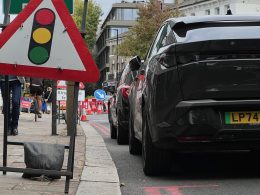

Thames Water have erected a sign about forthcoming work in the High St starting on 4 Nov. The last time they dug the road up the work was completed by late afternoon yet the traffic signalling restricting traffic to just one side (even though the road was repaired) remained in place until the next morning. I wrote to the Council asking who was responsible for this unnecessary delay – themselves or TfL but got no response. Hopefully there will be better coordination between all parties this time.