Wandsworth Council has spent the past year refusing to release data on its flagship Access for All programme. In the past week, it has published two press releases boasting about the scheme’s success, citing figures nobody outside the council can check.
The council claims 100,000 bookings, 93,000 leisure centre visits, and more than 12,000 enrolled members. It calls Access for All “Britain’s best concession scheme.” It has never provided evidence for any of these claims beyond headline numbers, and is currently the subject of an active Information Commissioner’s Office complaint over its refusal to do so.
The complaint, brought by Putney.news, follows a year-long FOI battle in which the council has blocked, delayed, and stonewalled requests for the programme’s actual usage data. It delayed one request for six months by promising all the detail would be provided in a Cabinet report but when the report was finally published, it did not contain the information promised.
What the council won’t tell you
We have asked Wandsworth Council for three things: year-by-year usage data from the programme’s launch in July 2023, the number of people who have actually used the service, and any internal evaluation of whether Access for All actually works. The council refused.
When the only report on the three-year £5m scheme (Paper 25-322 [pdf]) was published, it covered only four months of the expanded scheme, contained no Phase 1 data whatsoever (two years, missing), provided transaction counts but no unique user figures, and admitted that a member survey had not yet been conducted (it ran an online survey for one month in October 2024 and won’t release the results).
The council’s own technology makes the missing data all the more telling. Every member carries a QR-coded card that creates “a live profile” each time it is scanned. The system tracks individual usage. The council knows exactly who is using Access for All, how often, and for what. It simply refuses to share that information.
Numbers that don’t add up
The 18 March press release announced “more than 11,000” enrolled members and said the scheme was gaining “around 250 new members a week.” Six days later, the 24 March release put membership at “more than 12,000.” At 250 a week, the scheme would have gained roughly 214 members in six days, not 1,000.
The headline figure of 100,000 bookings tells a similar story. Without unique user data, it is meaningless as a measure of reach. We don’t how many people that are enrolled actually use the programme. We don’t know how usage is spread: are a large number of people using the discounted services occasionally, or are a small number of people heavy repeat users? The council refuses to say. The programme has also failed to define was success looks like, set any goals or metrics, introduce evaluation criteria, or undertake any user surveys.

Meanwhile, the programme has been steadily expanded into increasingly marginal territory. It now covers e-bikes and e-scooters through Lime, Forest, and Voi, fishing permits (two used in four months), allotments (two), hall hire (zero), and Putney School of Art (three enrolments). In one promotional push it offered cut-price fireworks tickets. Each new addition inflates the list of “offers” the council can promote, whether or not anyone uses them. The programme is funded by a £4.85 million reserve. Of that, the latest figures we have show that £2.98 million has been allocated and £1.87 million remains.
A council with a credibility problem
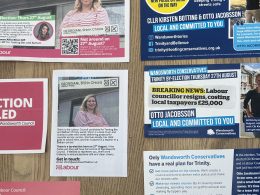
This pattern is familiar. Earlier this month, the UK Statistics Authority wrote to Council Leader Simon Hogg to tell him his repeated claims to have frozen council tax were misleading residents. A Putney.news fact-check of the council’s pre-election leaflet found all four financial claims did not withstand scrutiny. The council’s official response confirmed rather than rebutted the original findings.
Access for All fits the same mould: big claims, no verifiable data, and active resistance to anyone trying to check. When Paper 25-322 went to Cabinet on 22 September 2025, the recommendation was simply to “note” the report. No questions were asked. No scrutiny was applied. The ICO complaint remains the only mechanism through which the public might eventually see the numbers behind the slogans.
The people are real. The question is whether the council’s story is.
The case studies in the press releases are genuine. Georgina, 60, is using Access for All to study art at Putney School of Art and Design. Dave, 75, says he could not afford classes without it. Ellen, 75, calls the scheme “wonderful.” Suzanne, 82, uses her allotment discount to help cover the cost of getting to her plot.
Nobody disputes that Access for All helps the people it reaches. The question is whether a council spending £4.85 million of public money on a programme it calls “Britain’s best” should be required to prove it, rather than simply assert it, six weeks before voters go to the polls.
What to do if you think you’re eligible
Access for All is open to Wandsworth residents receiving certain benefits or on low incomes. You can check eligibility and apply for membership on the council’s website, or contact the team at accessforall@wandsworth.gov.uk.
If you want to see the data behind the council’s claims, you can file your own FOI request through WhatDoTheyKnow or directly to the council’s FOI team.