

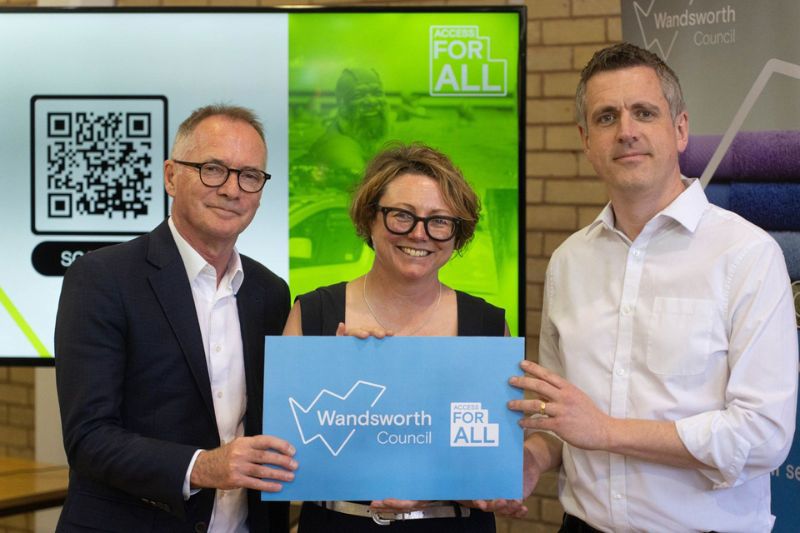
Wandsworth Council spent nearly three years and £4.85m of public money on its Access for All concession scheme; a program it continually called “Britain’s Best” despite having never measured how many residents actually used it, or asked people what they thought of it.
The admission came through an Information Commissioner’s Office (ICO) investigation started by Putney.news a year ago. This week the ICO ruled in our favour and ordered the council to release key data by 21 June.
Some data we asked for will not be released because the council doesn’t have it. That includes how many people actually use the scheme. Wandsworth Council “does not log individual usage” it told the regulator, despite every user’s personal membership card being scanned each time they use the scheme.
It also confirmed it had undertaken no internal evaluation of the scheme two years into the program despite noting it needed to do so at the outset.
We have documented the council referring to the scheme as “Britain’s Best Concession Scheme” at least 29 times: in press releases, at Cabinet meetings, in a statutory equality document, in a magazine delivered to 159,000 homes, and in Labour’s 2026 election manifesto.
No independent body has ever rated concession schemes nationally. The superlative was entirely self-awarded, and for two years constantly repeated. We asked the council for its documents justifying this claim. It repeatedly refused. When the regulator asked, it admitted there were none. The council never evaluated a scheme it claimed was the best in the country.
What the council was saying
Access for All launched in July 2023 offering free gym and swim sessions to eligible residents. The following year the council expanded it into a wider concession scheme, investing £4.85m and branding it “Britain’s Best Concessionary Scheme.” When it did so, it committed in its own governance documents to evaluating whether the scheme was actually reaching people. That evaluation was never completed.
Every figure the council published was a transaction count – bookings, visits, sessions, where one person attending twice counts twice – or a membership registration. It never published how many distinct residents actually used an offer.
The distinction is not academic. By far the greatest use has been leisure-centre visits, with the council reporting 29,775 between May and August 2025 (at the other end, zero people hired a hall or took online classes). The number of actual people behind those visits is far smaller. The upper limit is 3,302 – the total number of members signed up. But the true figure could be as low as 250, which would equate to the scheme costing taxpayers £20,000 per user.
The council has chosen not to evaluate its own service, and because it either doesn’t store the information, or it has refused to provide it, it is almost impossible for anyone else to either. The ICO’s order should open the curtains a little.
In September 2025 the council published a progress report on the scheme. It covered only four months of the programme’s two-year history, contained no unique-user figures, and admitted a survey of members had not yet been conducted. When Cabinet considered the report, leader Simon Hogg said that day: “The scheme’s success so far speaks for itself.” No questions were asked.
The language used by senior councillors in public and at Cabinet meetings during this period gives a sense of how the scheme was being presented. Cabinet member for the environment Paul White told a Cabinet meeting: “Access for All has been very successful and been very, very central to the way this council wants to address our public. And it’s the biggest and most generous concessionary offer in the country.”
Cabinet member for finance Angela Ireland described it as “Britain’s best concessionary scheme.” Deputy leader Kemi Akinola called it “the best Wandsworth has to offer available to all.” Hogg himself, at Cabinet in July 2025, told fellow councillors: “This is Britain’s best concession scheme”, and cited “more than 100,000 sessions of gym and swim” as evidence, without clarifying that sessions are not people.
How we found out
We asked the council in March 2025 for its usage data: year-by-year figures, a count of distinct users, and the internal evaluation. The council refused, telling us to wait for the September progress report. When that report arrived with none of what we had asked for, we appealed internally. The council upheld its refusal, telling us that releasing the data earlier would be “premature” and give only “a partial picture.”
We took the case to the Information Commissioner, the independent regulator that enforces the public’s right to information from public bodies. In March 2026 the regulator asked whether we wished to continue. Six days later, Hogg cited “take up of these opportunities” as proof the scheme was working – at the same time it was refusing to hand over that information. The council continued to defend its position.
The regulator ruled against the council this week, finding it had no valid legal basis for withholding the data in the first place. It must disclose leisure and community events data going back to July 2023 by the end of next month. For six other service areas and any internal evaluation, the council told the regulator it simply held nothing. You cannot withhold data you do not have.
This is our first case at the Information Commissioner against Wandsworth Council, although we have forced information out before. The green grant breakdown came in December 2025 when a central government department released data about Wandsworth Council that the council itself still refuses to publish. This is the first time the independent regulator has ordered the release of information following a Putney.news request.
The first story in this series ran in August 2025. Our analysis of the September progress report found the scheme’s accounts included zero hall hire uses and 33 pest control uses across four months. Our March 2026 story set out the full complaint.
What happens next
The 21 June deadline falls to the new Conservative administration, which takes formal control at the Annual Council on 27 May.
The new leadership has announced a review of council spending; it has already identified Access for All as a programme it is looking at. It is possible the entire program will be scrapped. The council that spent three years calling it Britain’s best is gone. Its successor must now hand over the data its predecessor spent 14 months refusing to release.
When it arrives, we will publish it. The scheme cost £4.85m of public money. We are about to find out how many residents it actually reached.
The council did not respond to questions before publication.
If you want to know more
You can read the regulator’s decision here [pdf].
The 21 June deadline is public. If the council misses it, the regulator can take the matter to the High Court. We will be watching.
If you believe a public body is withholding information it should release, you can make a complaint at ico.org.uk/make-a-complaint.



These findings do not surprise me at all. This was another way for Labour to pay off its supplicant client voter base. Luckily they are no longer the majority.
Excellent investigating reporting. Thanks