

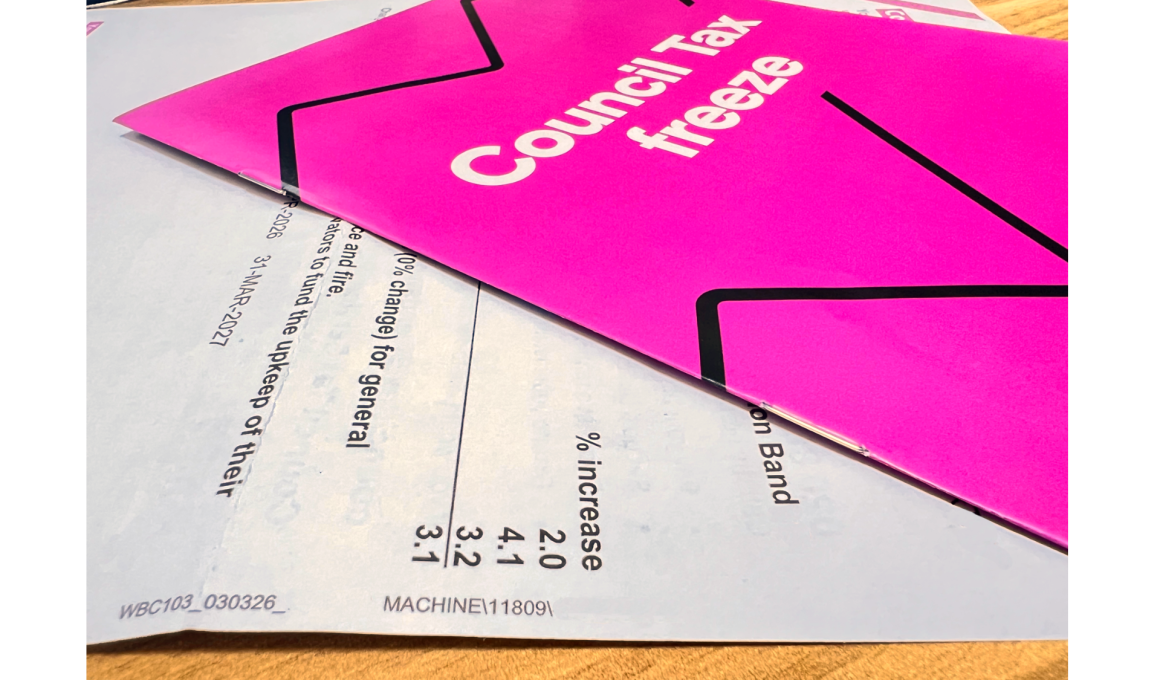
This weekend, Wandsworth residents opened their council tax bills and found a bright magenta leaflet in the same envelope. It said one thing: Council Tax Freeze.
The bill itself told a different story. Turn to the breakdown and your total Band D charge has risen from £990.07 to £1,020.35, an increase of 3.1%. The Wandsworth precept is frozen, but the adult social care precept (also set by Wandsworth) rose by 2%, the GLA precept by 4.1%, and the Wimbledon and Putney Commons Levy by 3.2% (the Levy is only paid by some Wandsworth residents but at between £50-100 is less than 5% of the overall tax bill).
We have covered this ground before. The council dropped the “freeze” language after the BBC called it misleading, then quietly revived it.
The leaflet did not stop at the freeze claim however. Under the heading “How we keep your council tax low,” it made four specific financial claims about the administration’s record. We checked all four against the council’s own published documents: committee papers, budget reports, and scrutiny records. No anonymous sources. No inference. Every verdict is grounded in what the council has put on the public record.
All four claims are false.
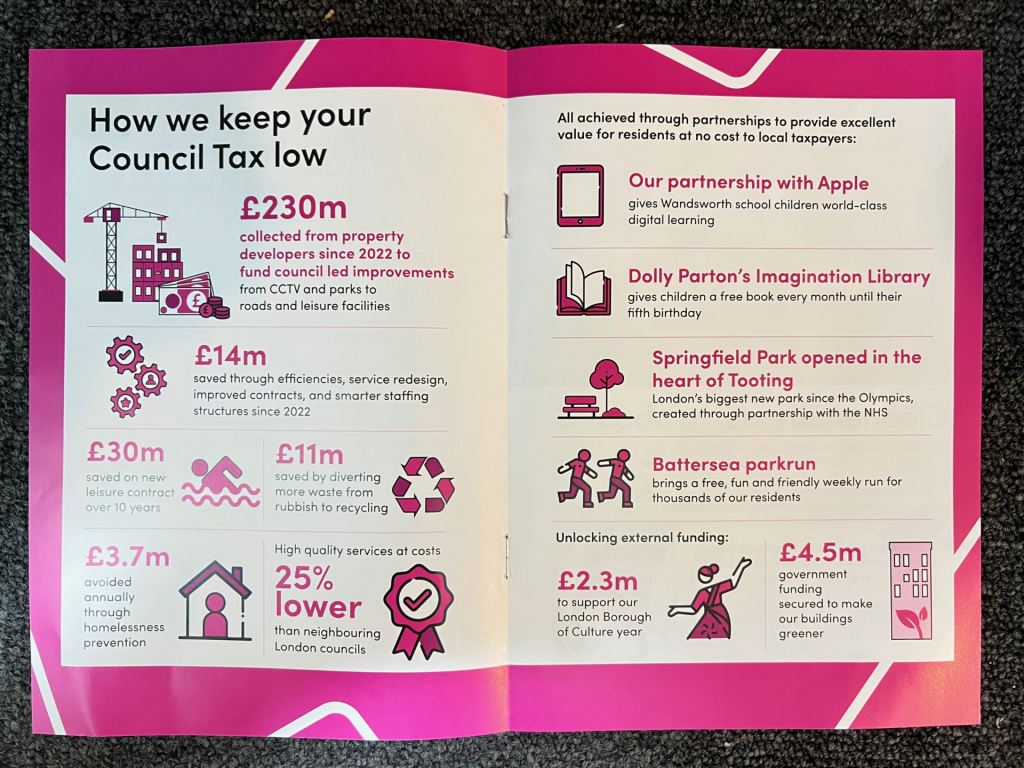
Claim 1: £230m from property developers
The leaflet says Wandsworth has collected £230m from property developers since 2022, presented as an achievement of the current Labour administration, which took office in May 2022.
The council collects this money through its Community Infrastructure Levy (CIL), a charge on new developments used to fund local infrastructure. The scheme has operated since November 2012, under the previous Conservative administration.
We examined every Infrastructure Funding Statement published by the council from 2012/13 through to 2024/25.
The total collected across all thirteen years of the scheme is £263.4m. Of that total, £204.6m (78%) was collected before Labour took office. Labour’s three years have produced £58.8m, 22% of the cumulative total.
Annual CIL income under Labour has averaged £19.6m, compared to £25.9m under the Conservatives, a 24% fall. The sharpest single-year drop was from £31.6m in 2021/22 to £13.9m in 2023/24, a 53% decline.
The leaflet says “£230m collected from property developers since 2022.” That is not what the Infrastructure Funding Statements show.
There is also further context the leaflet omits. CIL commitments already approved by the council total £281.5m, £18m more than has ever been collected. Projected receipts to 2030 will not fully close that gap.
Sources: Infrastructure Funding Statements 2012/13–2023/24 (Paper 24-377, Finance OSC, 4 December 2024); Infrastructure Funding Statement 2024/25 (standalone, wandsworth.gov.uk, 17 December 2025); Cabinet Paper 26-64 (General Fund Capital Programme), 23 February 2026.
Claim 2: £30m saved on new leisure contract
The leaflet says the council has saved £30m on its new leisure contract over ten years. In June 2025, Cabinet approved a new leisure management contract, reappointing Places Leisure to run seven of the borough’s eight leisure centres.
Cabinet Paper 25-177, the public report considered at that meeting, contains one reference to £30m. It appears in paragraph 9 and describes the investment required to maintain current provision over the life of the contract: a cost the council needs to spend, not a saving it has made.
The actual savings figure is not in the public paper at all. Recommendation 4 of Cabinet Paper 25-177 explicitly directs Cabinet to “note the financial savings as set out in the exempt part of the paper (Paper No. 25-177A).” Paper 25-177A has never been published. It remains exempt from public disclosure.
The council’s own “Delivering Value for Money” PR page (3 February 2026) attributes the figure to “smarter long-term service contracts,” plural, not specifically the leisure contract. The figure may have a real basis in a savings calculation inside 25-177A, but that calculation has never been published or scrutinised. The public paper inverts the meaning of the £30m figure entirely.
The saving may exist inside 25-177A. What is in the public record is a cost, not a saving, and the actual figure has been withheld from scrutiny.
We have submitted a Freedom of Information request for Paper 25-177A.
Sources: Cabinet Paper 25-177 (Leisure Management Contract Award), Cabinet, 16 June 2025; Cabinet Paper 25-237, Appendix C (Finance OSC, 3 July 2025); Council “Delivering Value for Money” page, wandsworth.gov.uk, 3 February 2026.
Claim 3: £3.7m through homelessness prevention
Wandsworth Council says it is saving £3.7m every year by preventing people from becoming homeless before they end up in emergency accommodation. The figure does not appear in any committee paper, budget report or scrutiny document.
What we found instead was a council repeatedly promising to produce the evidence, and then not producing it.
In October 2024, the Housing Overview and Scrutiny Committee noted that a budget monitoring report was “short of detail in regard to the impact of the work undertaken to alleviate the use of temporary accommodation” and was told more detail would be provided in future.
It didn’t arrive. In November 2024, a budget monitoring report described the cost analysis as ongoing: the work would “evidence long run savings” once complete. In January 2025, a further budget report used almost identical language. Another paper from the same month said the financial benefits were “expected” to materialise “only in future years.”
By June 2025, an outturn report was still saying the evidence base “will be monitored carefully to provide an additional evidence basis going forward.”
In July 2025, Cabinet considered Paper 25-257, the annual report setting homelessness forecasts and targets for the year ahead. This is the document where a verified cost avoidance figure, if it existed, would appear. It does not contain one. What it does contain is the finance director’s assessment of how the homelessness budget actually performed: spending came in at £33.4m against a revised budget of £26.5m, an overspend of £6.9m.
In October 2025, Housing committee members were still pushing for better information. The committee minutes record members asking officers to provide more detailed data in future reports.
Then, on 3 February 2026, eight weeks before the 7 May elections, the figure appeared for the first time. Not in a committee paper. Not in a budget report. On the council’s own “Delivering Value for Money” webpage, which stated: “£3.7m avoided each year in homelessness costs through early intervention.” No source was given. No methodology was explained. No committee had approved it.
The same figure then appeared in the election leaflet.
The financial picture makes this harder to accept, not easier.
In the year the council says it is saving £3.7m annually through prevention, its homelessness budget overspent by £6.9m. The housing service was handling a 19% increase in homelessness applications. Temporary accommodation numbers were rising. The prevention budget itself overspent.
Prevention work has real value: the council’s own papers show real cases resolved, real households helped. The arithmetic of comparing prevention costs against temporary accommodation costs, which runs to nearly £3,000 a month per family, is a legitimate exercise. But there is a difference between a projection and an achieved annual saving. The council’s own papers treated the analysis as incomplete and the benefits as future and uncertain right up to the moment this figure appeared in PR copy.
Sixteen months of committee papers promised this evidence. It never arrived. A figure then appeared on a webpage, unverified and unsourced, eight weeks before an election.
That is not an achieved saving. It is a claim without a foundation in the public record.
Sources: Cabinet Paper 24-171 (Cabinet, July 2024); Paper 24-356, para 13 (Housing OSC, November 2024); Paper 25-11, para 13 (Housing OSC, January 2025); Paper 25-12, para 37 (Housing OSC, January 2025); Paper 25-191 (Housing OSC, June 2025); Cabinet Paper 25-257, Table 21 (Cabinet, July 2025); Paper 25-237, Appendix C (Finance OSC, July 2025); Paper 25-334 minutes (Housing OSC, October 2025); Council “Delivering Value for Money” page, wandsworth.gov.uk, 3 February 2026.
Claim 4: £14m saved through efficiencies
The council says it has saved £14m through a programme of efficiencies and service improvements. Its own budget documents say otherwise.
What the document actually says
The £14m figure comes from Cabinet Paper 26-63, the budget report presented to Cabinet on 23 February 2026, three weeks before this leaflet landed on doormats. Paragraph 32 of that report describes a transformation programme with an “initial ambition” of reducing the council’s costs by £45m a year. It then says that initiatives worth £14m have been identified and that “committee budgets have been reduced accordingly.”
The council has reduced budget lines by £14m. That is an accounting assumption, a plan on paper. It is not the same as £14m actually being saved.
We know this because it has happened before.
In 2024/25, the council wrote £2m of planned savings into its adult social care budget. By the end of the year, those savings had not been delivered: the department overspent by £1.79m, partly because the savings never arrived. In the same year, planned savings in children’s services through staffing changes, operational improvements and system redesign also failed to materialise, adding another £1.5m to costs.
Both cases are documented in the council’s own financial results for 2024/25, Paper 25-237. We reported on both at the time.
The current year isn’t going well either.
The Q3 financial monitoring report for 2025/26, Paper 26-67, presented to Cabinet on the same day as the budget, shows the council is already forecasting an overspend of £5.594m for the current financial year. That is the year in which the £14m of transformation savings are supposed to be landing.
The full picture is starker. The £14m represents just 31% of the transformation programme’s total target of £45m. The remaining £31m has not been identified. The council’s own paper says those savings are still “to be developed further as the detailed business cases are scoped out.” The council does not yet know where the other £31m is coming from.
The leaflet presents £14m as an achieved saving. The council’s own documents show it is a budget reduction not yet tested against reality, in a year when the budget is already overspending, delivered by an administration that has twice before claimed savings that never came.
That is not a saving. It is a plan, and an incomplete one.
Sources: Cabinet Paper 26-63, para 32 (Budget and Council Tax 2026/27, Cabinet, 23 February 2026); Cabinet Paper 26-67 (Q3 Financial Monitoring 2025/26, Cabinet, 23 February 2026); Cabinet Paper 25-237 (Finance OSC, 3 July 2025).
What you can do
The source documents behind these verdicts are available through the council’s committee meeting archive at wandsworth.gov.uk.
To request the exempt leisure paper (25-177A) or the methodology behind the £3.7m homelessness figure, submit a Freedom of Information request via WhatDoTheyKnow, which handles the process for you.
Housing OSC and Cabinet meetings are open to the public. Dates and agendas are published on the council’s website.
Our questions to Wandsworth Council
Putney.news sent the following questions to Wandsworth Council on the day of publication. If the council replies, we will update this article with their answers in full. The questions are published here so readers can see exactly what we asked and judge any responses for themselves.
Claim 1: £230m from developers Your leaflet says £230m has been collected from property developers since 2022. Council records show the CIL scheme has run since 2012 and that 78% of the total was collected before Labour took office. Why does the leaflet attribute the full cumulative figure to the period since 2022?
Claim 2: £30m leisure saving Your leaflet says £30m has been saved on the new leisure contract. The public version of Cabinet Paper 25-177 contains one reference to £30m, describing money the council needs to spend to maintain current provision, not a saving. The actual savings figure is in a companion document that has never been published. What is the saving, how was it calculated, and why has the supporting document not been made public?
Claim 3: £3.7m homelessness prevention Your leaflet says £3.7m is avoided every year through homelessness prevention. This figure does not appear in any committee paper, budget report or scrutiny document. Your own Housing committee papers described the financial analysis of prevention activity as incomplete as recently as June 2025. The figure first appeared on a council webpage on 3 February 2026. Where does it come from, how was it calculated, and which officer or committee approved it?
Claim 4: £14m efficiency savings Your leaflet says £14m has been saved through efficiencies and service improvements. Your own budget paper from 23 February 2026 describes this as a reduction in budget lines, not confirmed savings. In 2024/25, your administration budgeted for £2m of social care savings and £1.5m of children’s services savings that were later confirmed as undelivered. What evidence exists that the £14m has actually been saved rather than assumed?
Putney.news is an independent hyperlocal publication covering Putney and SW15. We are editorially independent and receive no funding from Wandsworth Council or any political party. If you value this kind of accountability journalism, please consider subscribing.



Living in Wandsworth, you get used to hearing about council tax.
For decades, it’s been the headline, the political slogan on every leaflet that comes through the door: “the lowest council tax in the country.” It was presented as the ultimate prize, the single most important measure of a successful council. But for many of us living here, that argument has felt increasingly hollow. The idea that all we want is the cheapest possible bill is fundamentally a misreading of what people value in their community. It’s a political argument, not a resident’s one.
What we actually want is a borough that works well. We want clean streets, parks that are safe and well-maintained, and libraries that are properly staffed. We want to know that the elderly and vulnerable members of our community are getting the support they need. These aren’t luxuries; they are the basics of a functioning, decent place to live. And for years, it felt like we were being asked to accept a gradual decline in these services as a fair trade for that low council tax bill.
The core of the issue is fairness, and the whole system is built on a foundation that just isn’t fair
It is “regressive” tax is one that hits people on lower incomes harder than it hits the wealthy. Council tax is a textbook example of this. Imagine two households living next door to each other in identical houses. In one house lives a retired couple on a fixed pension of £20,000 a year.In the other lives a banker earning £200,000 a year.Because their houses are the same, their council tax bill is the same .. let’s say it’s £1,000. For the retired couple, that £1,000 represents a huge chunk of their annual income (5% in this case). It’s a bill they really feel. For the banker, that same £1,000 is a drop in the ocean (just 0.5% of their income).The bill is the same, but the burden is completely different. The tax is based on the value of your property, not on your ability to pay it.
To make matters worse, those property values are from 1991, so they don’t even reflect the massive explosion in London property wealth that has made some people incredibly rich. That’s why it’s a system that benefits the wealthy at the expense of everyone else.
So it low handing political fruit that Labour have continued to pick without looking at the structural inequality baked into this out dated system . Kinda like the political system itself !!
So, let’s be absolutely clear. When politicians peddle the intellectually bankrupt argument that our council tax hasn’t increased, while the bill that actually lands on our doormat has gone up by over 3%, they are treating us like fools. Trying to hide behind the technicality that the increase is for the GLA or social care isn’t just disingenuous, it is a masterclass in political cowardice. It’s an insult to our intelligence. We pay one bill, and that one bill has risen.Stop hiding behind accounting tricks and semantic games. Own the decisions you make.
If you believe in your policies, have the courage to make a real argument for them instead of insulting residents with this transparent spin.
This is excellent and well laid out analysis thank you for investing the time and determination.