

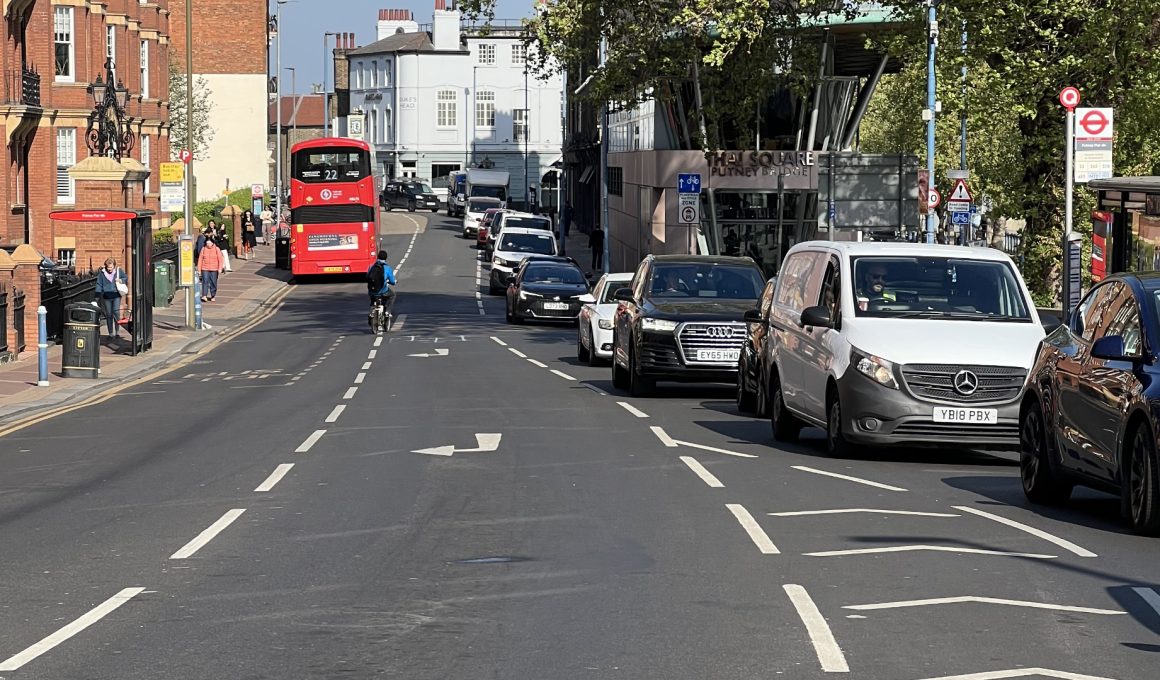
This was the worst week for transport in Putney in recent memory. By Friday, it had become something else entirely.
The week began with the District Line on strike. Six dates across April, May and June had been confirmed, and we documented them in detail. On Wednesday, with the tube already disrupted, road traffic backed up more than a mile from Putney junction to Barnes station, captured in a time-lapse taken by this publication.
On Friday, the District Line failed again, this time not by strike but by signal failure, when East Putney broke down during what was supposed to be a running day. At the same time, five bus routes collapsed across the same corridor. For anyone trying to get around SW15 on foot, wheel, or wing, there was no functioning alternative.
Putney is one of the best-connected parts of London outside the centre. Two tube stations, a mainline railway, multiple bus routes, direct access to the river. On Friday, for a significant portion of the day, none of it worked.
It was Strike Day 4 of the RMT action. The signal failure at East Putney severed service between Parsons Green and Wimbledon, adding infrastructure collapse to planned industrial action. TfL’s own status alerts headlined all five bus failures as “PUTNEY AREA DELAYS”: no service on route 37 between Wandsworth and Green Man, no service on route 14 between Putney Bridge and Putney Heath, routes 39 and 93 cut between Green Man and Putney Bridge, and route 265 cancelled between Barnes Common and Putney Bridge.
A large number of SW15 residents worked from home and absorbed the disruption that way, with the week’s failures falling hardest on those who had no choice but to travel.
Why it keeps happening
None of this was unforeseeable. East Putney is, by TfL’s own data, the worst tube station in London for signal failures, losing 147 hours to signal disruption in 2024. That is more than double the next worst station on the network. A Putney.news FOI investigation published last month found that the three worst-performing signal stations in London are all on District Line branches serving Putney, Wimbledon and Richmond. Asked how often it records a good service, TfL replied: “We do not record information on when a ‘good service’ is running.”
The buses that failed on Friday are the same routes previously documented as among the least reliable in the capital. The underlying cause is not complicated: Victorian-era signalling infrastructure that has been causing failures at East Putney for over a century, combined with bus routes that cannot absorb the simultaneous corridor pressure that a tube strike creates. When the strike removed the District Line as an alternative, the buses bore the full weight. They failed.
There is no short-term fix. TfL has committed to signalling upgrades on the Wimbledon branch but has not published a timeline. Signalling modernisation on London Underground typically runs on decade-long programmes.
On top of bus and Tube failure, the road traffic was the worst it has ever been, and levels of frustration with the failed redesign of Putney Bridge junction never higher.
The next dates
Friday was not the last time this pattern will repeat. The remaining strike dates are confirmed: Tuesday 19 May and Thursday 21 May; Tuesday 16 June and Thursday 18 June. Each strike runs from midday to 11:59am the following day, disrupting the afternoon of the first day and the morning commute of the second. ASLEF drivers are not striking, so TfL expects severe disruption rather than a complete shutdown. The District Line will run some services; it will not run normally.
On the days surrounding those strikes, the signal infrastructure at East Putney will still be Victorian. The bus routes will still be the same routes. And if Wednesday’s traffic is any guide, the roads will not absorb the difference.
Check tfl.gov.uk/campaign/strikes before each date for any last-minute updates or cancellations. If you rely on the 37, 14, 39, 93, or 265 during strike periods, do not assume they will provide reliable cover for the District Line. Friday showed what happens when they are asked to carry that load. South Western Railway from Putney station is not affected by the RMT tube action and remains the most reliable alternative for central London destinations on strike days.

“The buses that failed on Friday are the same routes previously documented as among the least reliable in the capital. The underlying cause is not complicated.”
Indeed it isn’t: just too many cars for the network to carry. Some day, hopefully before too long, someone n piwer will decide they need to be restricted by one means or another.
In your timelapse it struck me how many vehicles were private cars. To an extent the solution is in our own hands. I wonder how many of those cars had a single occupant. Maybe try and count them as a % next time?
Let’s start fixing this by voting this council out of office.
Unfortunately the Mayor extended ULEZ instead of extending the congestion zone to inner London, which would have reduced traffic, cut emissions and raised revenue . It would have cost very little. The 20mph extension has also impacted bus running costs and timetables.
There is now no money left for basic infrastructure maintenance.
Crossing Hammersmith Bridge yesterday, the one that is heated in the winter and cooled in the summer but somehow “Green”, it looked like an eye sore with modern light dangling and wooden fencing hiding it’s features.
The amount of public money that has been wasted on vanity projects supported by a few extremists is extraordinary. Alternatives are never considered and to question these disasterous policies is treated like blasphemy.