

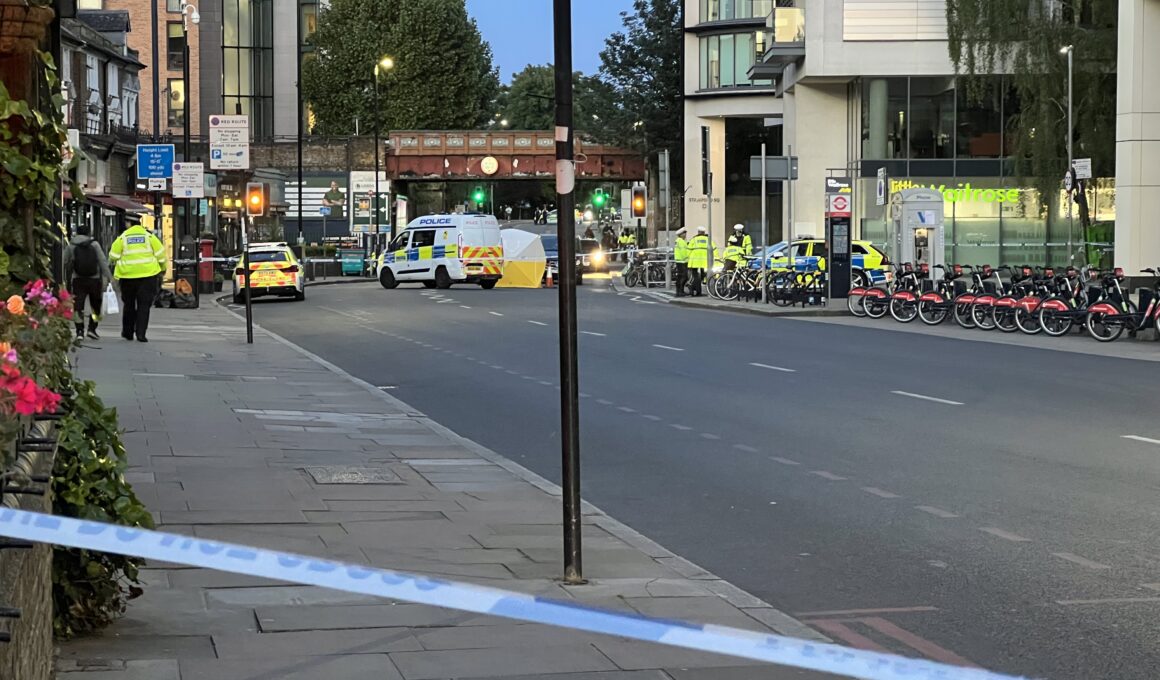
Transport for London will replace the dangerous traffic signals at East Putney tube station following the death of an elderly woman at the crossing in May, documents obtained by Putney.news can reveal.
The £80,000 upgrade was approved in July, three months after the woman was killed during evening rush hour at a crossing residents had been warning about for years. Despite the tragedy and public attention, TfL has provided no useful updates to the thousands of people that use the crossing every day.
But through document requests, internal TfL emails reveal that a fix is planned – one that could still be months away, however, as the project has a deadline of March 2026.
The woman died at a Pelican crossing that creates dangerous confusion where pedestrians see flashing green signals while drivers see flashing amber – both groups believing they have right of way. TfL’s own data shows they knew this was a dangerous location, classified as “Priority 2” and recording 35 casualties including five pedestrian injuries before the fatal incident.
TfL’s site inspection the day after the woman’s death confirmed an additional hazard: when two buses stop at the nearby bus stop, the second bus blocks pedestrians’ view of oncoming traffic, creating a dangerous blind spot.
The new system vs the old one
| Feature | Current System (Pelican) | New System (Ped-Ex + PCATS) |
|---|---|---|
| Pedestrian Signals | Steady green → Flashing green → Red | Green → Red (no flashing) |
| Driver Signals | Red → Flashing amber → Green | Red → Green (no amber phase) |
| Problem Phase | 8-second danger zone where both groups think they can proceed | Eliminated entirely |
| Countdown Feature | None | Digital timer shows seconds remaining |
| Clarity | Ambiguous flashing signals | Clear, unambiguous signals |
| Safety Risk | High – conflicting interpretations during flashing phase | Low – no conflicting signals |
Key Improvement
The dangerous 8-second flashing amber/green phase is completely removed. This eliminates the confusion where pedestrians see flashing green (interpreted as “finish crossing”) while drivers see flashing amber (interpreted as “proceed if safe”), creating a conflict where both believe they have right of way.
The digital countdown timer removes guesswork – pedestrians know exactly how many seconds they have left to cross, helping everyone (especially mobility-impaired users) make informed decisions about whether to start crossing.
While the right decision has ultimately been made and the process has been thorough, it is also the case that it will have taken TfL up to ten months to respond to a pedestrian death with the necessary safety improvements, revealing a deeply bureaucratic approach even to emergency responses, and one that may have contributed to her death in the first place.
The crossing improvements only came to light through Freedom of Information requests from Putney.news. Documents show that by 16 July, a senior TfL official had confirmed: “I would like us to proceed with the signals modernisation and upgrade to include pedestrian countdown for c. £80k.”
TfL developed two options in response to the tragedy as well as community and political pressure: a simple £5-10k conversion deliverable in 8 weeks, or a comprehensive £80k modernisation. They chose the second option, which will be completed “within the financial year” i.e. by March 2026. The upgrade will “remove the flashing amber stage for traffic and the flashing green stage for pedestrians, which will make the signal stages clearer for both pedestrians and traffic.”

Already under review
It is a bitter irony that the woman died in the middle of an existing TfL consultation on safety improvements for the same exact stretch of road. The consultation has been long overdue with residents noting the issues for years: it opened in January 2025, closed in March, produced a report in September, but prompted action only after someone died.
The documents and public response to the consultation also reveal contradictory decision-making. Publicly, TfL said it must wait for police investigations before proceeding. On 4 June, a TfL official wrote: “Given the recent fatality in the area, we will need to wait on the outcome of the police investigation.” Yet, due to public and political pressure, it was simultaneously approving safety upgrades. Internal documents reveal that intervention from the deputy mayor, prompted by Putney’s MP, was able to force action on a specific point. It is worth noting however that even with that pressure, urgent action means nine months or more from approval to implementation.
While the traffic lights upgrade now has a deadline of March 2026, the broader £3.6 million East Putney Urban Realm scheme remains “on hold” indefinitely. Perhaps most frustratingly, TfL has provided no public information about the crossing upgrade since approving it in July. It took a FOI request to discover that TfL has approved exactly what residents have been demanding: a change to the timing of lights.
For an organisation committed to Vision Zero – eliminating all deaths and serious injuries by 2041 – TfL’s response to an actual death shines a light on how slow-moving London’s transportation authority is, even when trying to act urgently.
Timeline: East Putney crossing safety delays
| 2021-2025 | Residents complain about dangerous crossing design |
| 20 January 2025 | TfL launches public consultation on East Putney improvements |
| 3 March | Public consultation closes |
| 19 May (5:30pm) | Elderly woman killed at crossing during evening rush hour |
| 20 May | TfL site inspection confirms “blind spot” problem from buses |
| 4 June | TfL tells stakeholders they must “wait on the outcome of the police investigation” |
| 16 July | TfL privately approves £80,000 crossing upgrade – comprehensive modernisation chosen over cheaper quick fix |
| 10 September 2025 | TfL finally publishes consultation report and shelves broader safety scheme indefinitely |
| 27 September 2025 | Freedom of Information request reveals approved crossing upgrade |
| March 2026 | Target completion date for new crossing signals (TfL’s financial year deadline) |
Broader implications
London is a big city and this East Putney case is just one incident but it does raise questions about TfL’s ability to deliver timely safety improvements. The problem with the blind spot created by buses and the right-of-way confusion created by providing move-forward signals to both pedestrians and road traffic at the same time have been well-known and warned about for years. Unfortunately it took the death of one elderly woman to finally drive change – and even then change has been too slow. The works were approved in July; it is now nearly October.
The implications are particularly concerning for other problematic issues over traffic in Putney. The redesigned Putney Bridge junction, for example, clearly needs major improvements following nine months of extreme traffic congestion, but despite copious evidence, TfL and the council are still following their own internal timeline and are in fact-finding mode. Based on TfL’s East Putney timeline, residents could be waiting years for action.
The East Putney improvements will make the crossing genuinely safer, with modern signals and countdown timers that eliminate dangerous confusion. TfL deserves credit for choosing the comprehensive upgrade over a cheap fix. They deserve criticism however for the timeline and the glacial pace of their emergency response. It is hard not to consider the fact that it required someone to pay the ultimate price for the transport authority to give it adequate attention.


Try to rescue a TV ad of decades ago, maybe 1980’s, where an army officer followed by a line of ducks cross a pedestrian crossing when the lights start to change to amber. One of the best ads and a successful campain. Well worth to find it