The managing director of London’s only licensed heliport has launched a blistering attack on plans to build a 34-storey tower next door, warning that its balconies could send laundry, toys and even plastic bags flying into the path of helicopters — with potentially devastating consequences.
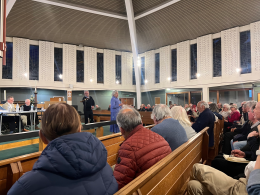
Speaking at a recent meeting of the London Heliport Consultative Group, Will Curtis described the proposed building as “almost deliberately shaped to cause turbulence.” The risk, he said, was not just theoretical. “It looks a bit like a corn cob,” he added. “And you couldn’t have picked a better way to generate air disturbance if you tried.”
Curtis went on to explain that the tower’s open balconies could easily become sources of dangerous airborne debris. “Even if it’s just a plastic bag or a child’s toy, if it gets caught in a rotor or sucked into an engine, the consequences could be fatal. Even in the best-case scenario, you’re talking about a £1.5 million engine overhaul.”
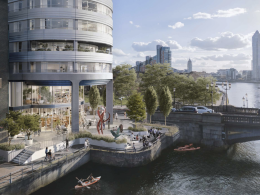
The comments were among the most vivid in a flood of objections submitted earlier this month in response to planning application 2025/0907, which proposes replacing the existing five-storey Heliport House with a dramatically taller residential-led tower. The scheme, named Nest Battersea, would deliver 143 homes along with ground-floor commercial space, a café, gym, and rooftop gardens.
The site lies within Wandsworth’s designated Tall Building Zone TB-B2-05 and forms part of the borough’s wider residential intensification plans along the York Road corridor. In policy terms, that makes the building’s height technically permissible — a point repeatedly emphasised by the developer and planning consultants. But in practical terms, the proposal has triggered a now-familiar London dilemma: a clash between meeting housing targets on paper and managing the real-world consequences for residents, infrastructure, and in this case, airspace safety.

Not opposed, but concerned
Notably, several statutory consultees have not opposed the scheme outright but have called for firm conditions. The Health and Safety Executive highlighted concerns over internal layouts in wheelchair-accessible flats, charging arrangements for e-bikes, and roof-level safety features. Thames Water, for its part, insisted that the developers demonstrate their plans won’t strain local water pressure or sewer capacity. The Environment Agency acknowledged the site’s location in Flood Zone 3 but agreed that with raised floor levels and a robust evacuation strategy, the risks were manageable.
Even the UK’s air traffic control body, NATS, didn’t block the scheme entirely — but issued a strong caveat. It warned that the tower could interfere with Heathrow’s H10 radar and must not rise above 50 metres until a radar mitigation scheme is in place. A crane operation plan would also be required to prevent disruption during construction.
The developers, Dutch architects Concrete working with London-based HTA Design, have a different perspective of “corn cob tower” – they describe it as a sculptural “lantern” — slender, stepped, and clad in light brick with glowing rooftop features that pay homage to the site’s past as a candle-making location. But not everyone is convinced. The Royal Borough of Kensington and Chelsea, whose residents would face the tower across the Thames, submitted a formal objection describing the design as “generic and unattractive.” Their response argued that far from being a beacon, the tower would diminish the architectural prominence of landmarks like Albert Bridge and overwhelm the views from the Thames-side conservation areas in Chelsea and Sands End.
The developers have tried to soften the impact with public realm improvements, including enhancements to the Thames Path, seating areas, greenery, and active street-level frontages. These gestures are designed to knit the building into the wider pedestrian network, transforming a currently disconnected stretch of riverside into something more inviting and accessible.

Public hostility
Still, public reaction was overwhelmingly negative. Sixty-nine formal objections were lodged before the deadline, including numerous detailed and passionate responses from residents in neighbouring towers such as Altura and Orbis Wharf. Concerns ranged from the loss of sunlight and privacy to increased congestion on local bus routes, GP surgeries, and schools. Some feared that the tower, if approved, would trap them between two ongoing construction sites, sandwiched by the new Highlight development on one side and Nest Battersea on the other.
Several residents raised aviation safety concerns of their own, pointing to the 2013 Vauxhall helicopter crash as a stark warning about the dangers of tall buildings in close proximity to air traffic routes. Others, like local campaigners Mrs S G B MacLean and Ms Roxy Williams, focused on planning policy, arguing that the tower breaches the spirit if not the letter of Wandsworth’s Local Plan and the London Plan.
Not all voices were critical. Seven letters were submitted in support, with residents from further afield praising the development’s potential to ease the housing crisis and regenerate a neglected stretch of riverfront. One supporter, Dr Lorenzo Venturini, wrote that the proposal “aligns with the strategic aims of both Wandsworth and London Plans” and highlighted the site’s brownfield status and transport links as key advantages.
A handful of general comments were also submitted. Heathrow Airport called for careful coordination to prevent radar interference and ensure safe crane use. One local resident suggested the developer should be required to fund the long-discussed Diamond Jubilee pedestrian bridge — a project that would significantly improve walkability in the area.
Tensions have also surfaced around the planning process itself. Curtis, the heliport’s managing director, told the consultative group that his team had not been consulted before the application was submitted — something he described as “extraordinary” given the life-safety implications.
But that account is disputed. Planning documents show that the heliport was named as a key stakeholder and subject to multiple rounds of engagement. The developers say they incorporated heliport concerns into their modelling, including solar glare assessments, wind tunnel tests, and aviation safeguarding reviews. Indeed, the design team claims to have consulted widely with civic societies and community groups — though, in the end, every one of those groups submitted formal objections.

What about the turbulence claims?
The wind tunnel testing commissioned for the proposed 34-storey tower focused on assessing wind conditions at street level, balconies, and rooftop amenity areas. These tests used the Lawson Comfort Criteria, an industry standard designed to evaluate the suitability of external spaces for everyday activities like sitting, walking, or standing based on wind speed and frequency. While appropriate for ensuring resident comfort and pedestrian usability, this methodology is concerned solely with human-scale experience on the ground and does not account for effects on aircraft or rotor turbulence.
In developments located adjacent to active aviation sites like the London Heliport, it is more typical — and often expected — to conduct aerodynamic turbulence assessments or Computational Fluid Dynamics (CFD) modelling specific to aircraft safety. These studies help determine whether a tall structure could generate disruptive airflows or wake turbulence in nearby flight paths. The absence of such analysis is notable given heliport operator Will Curtis’s explicit concerns that the building’s design could create dangerous turbulence during helicopter takeoffs and landings. His comparison of the tower’s form to a “corn cob” — seemingly shaped to amplify air disturbance — underscores the urgency for aviation-specific modelling, which remains missing from the application.
What will happen?
While councillors will ultimately weigh a range of views when deciding whether to approve the tower, few voices will matter more than the heliport’s. It is, after all, known locally as the “Heliport Tower,” and any risk to aircraft safety — however hypothetical — could prove decisive.
And yet, recent planning decisions by Wandsworth Council have raised eyebrows. Faced with mounting debt and a pressing need to boost rental income, the borough has shown a growing willingness to support dense high-rise schemes that promise financial return, even in controversial or constrained locations.
That economic pressure could tilt the balance. But with London’s only operational heliport raising alarms — and calling out the council’s consultation claims — the battle over Battersea’s tallest tower is far from over.
How the council lands this one remains to be seen. But when the structure itself has already received a nickname and aviation experts are warning about airborne debris, it’s clear that no amount of brick cladding will protect the scheme from political turbulence.