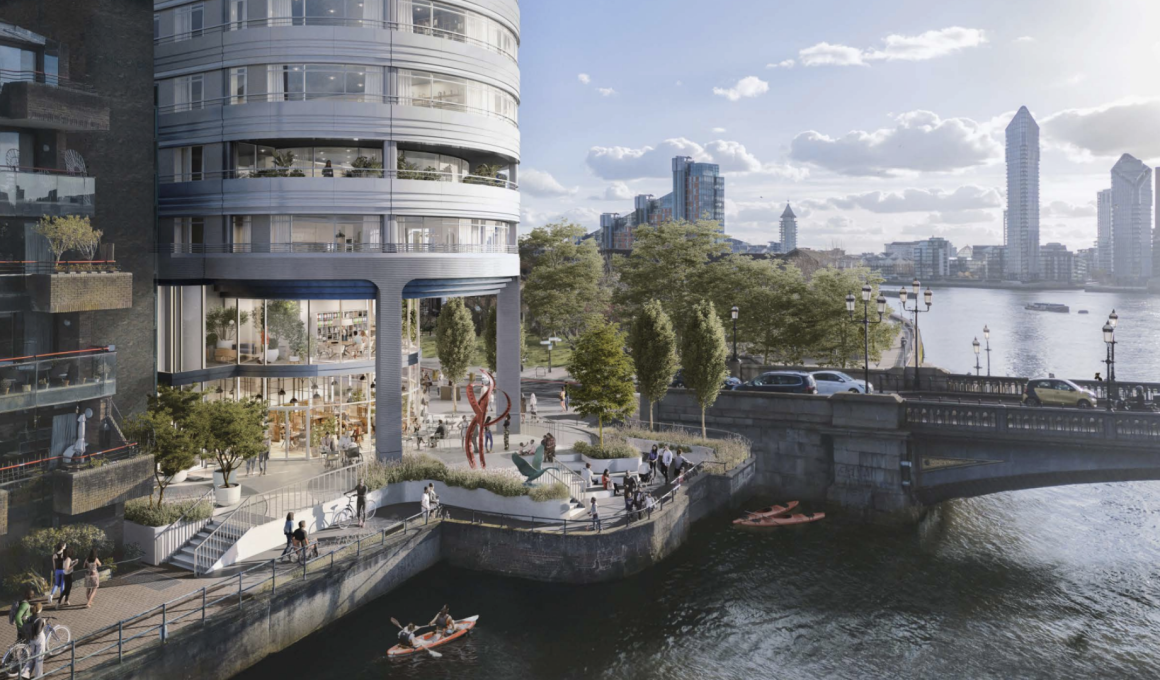
A government planning inspector has killed the proposal to build a 29-storey tower next to Battersea Bridge, ruling in a 34-page decision [pdf] that it was “not exemplary, extraordinary, remarkable or distinctive, just tall.”
Inspector Joanna Gilbert dismissed developer Rockwell’s appeal on 14 May, four years after the scheme first emerged and just over a year after Wandsworth Council rejected it unanimously. The tower will not be built. But the inspector’s decision contains one passage that goes beyond the result: a pointed rebuke of Wandsworth’s own argument on housing that will outlast this particular battle.
What the inspector found
The tower, designed by Farrells for developer Rockwell, would have stood at nearly five times the maximum height Wandsworth’s planning rules allow for that part of the riverfront. The area around Battersea Bridge is zoned for buildings of up to six storeys. The proposed tower was 28 storeys plus a ground floor, nearly five times that limit, and still more than twice the height allowed in the taller-buildings zone immediately next door.
| Zone or building | Height (storeys) | Height (metres) |
|---|---|---|
| Mid-rise zone maximum (where the site sits) | 6 | 18m |
| Adjacent tall buildings zone maximum | 12 | 36m |
| Proposed Glassmill tower | 29 (28 storeys + ground floor) | ~97m |
Gilbert found the tower would “appear alien and isolated in its very height in this location, harming spatial character.” In language rare for a planning decision, she asked whether the site was “worthy of the gesture” of a tall building, and concluded it was not. The scheme, she wrote, “would have a harmful effect on the character and appearance of the area.” That harm, she ruled, outweighed the benefits, substantial as some of those benefits were.
What was on offer and why it wasn’t enough
The proposal included 110 homes, 54 of them at social rent (the most affordable type). A community space of 274 square metres would have been provided at a token rent, with three local charities already having expressed interest. A legal agreement signed in April would have delivered £1.08m in contributions to local infrastructure: £436,000 towards cycling and walking improvements, £152,000 for employment and skills, £147,000 for children’s play space, and £110,000 for arts provision.
All of that is now gone. The legal agreement signed before the hearing is void.
Gilbert gave the housing offer real weight. She acknowledged it, she considered it, and she found it still did not tip the balance. As she wrote in her formal conclusion: “The proposal would be contrary to the development plan taken as a whole, and there are no material considerations that indicate that planning permission should otherwise be granted.”
As we reported when the inquiry closed in March, this was always the central question: could the housing and community benefits outweigh the harm to the character of one of south-west London’s most sensitive riverside sites? The answer is no.

The rebuke Wandsworth will want to forget
Wandsworth argued at the inquiry that, since it is meeting its own housing targets, it bears no responsibility for London’s wider housing shortfall. The inspector called that position “ill-considered.”
Her reasoning is worth reading. London completed just 8.1% of its annual housebuilding target in 2025/26. In that context, she wrote, the council’s assertion that “it is not the Council’s responsibility to contribute to wider London housing needs” and that the worsening delivery crisis warranted giving housing only “moderate weight” appeared to her “ill-considered.”
The council won the case. The inspector still thought its reasoning on housing was wrong.
This matters beyond Glassmill. Wandsworth will face future planning appeals where housing delivery arguments are central. The inspector’s language goes on record. It is the kind of finding that developers’ legal teams will quote.
What happens next for Rockwell
The developer’s only remaining option is a legal challenge in the High Court under planning law, which must be filed within six weeks of 14 May (by around 25 June). Such a challenge cannot simply disagree with the inspector’s conclusions. It can only argue that she made a legal error. The inspector’s planning judgement itself cannot be overturned by a court.
How this result came about
The Putney Society was one of six civic societies that obtained formal status at the inquiry, allowing them to cross-examine witnesses directly, rather than simply submit letters of objection. The others were the Battersea Society, Chelsea Society, Cheyne Walk Trust, Friends of Battersea Park, and Wandsworth Society. Their involvement, confirmed when they applied for that status in January, gave the planning argument a rigour that went beyond the standard objection process. SW15 residents helped shape a south London planning outcome.
The scheme started at 35 storeys when Rockwell first submitted it in April 2024 and was reduced to 28 storeys plus a ground floor before the inquiry. The Design Review Panel had rejected the height argument twice, in December 2023 and February 2024. The reduced scheme was never shown to it. Wandsworth Council refused the application unanimously in April 2025. Rockwell appealed. A seven-day public inquiry heard evidence in March 2026.
The inspector’s 34-page decision [pdf] is final unless Rockwell takes the High Court route. The tower is dead.