

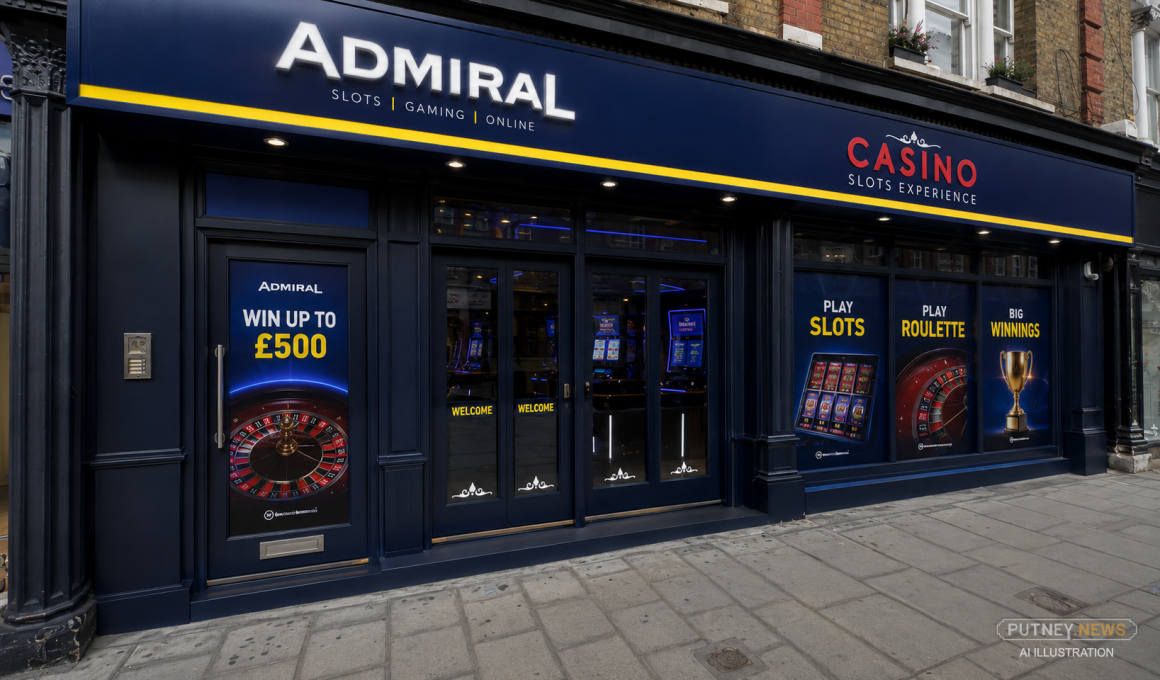
Wandsworth has granted Admiral a gambling licence for the third arcade on one stretch of Putney High Street, after its own committee admitted its policy has no rule against it.
The Licensing Sub-Committee’s decision, issued on Friday, overrides objections from Fleur Anderson MP, a former prison chaplain and a resident, and 58 written representations lodged during consultation.
Anderson told the committee a third venue would result in “clustering and harm to the public and vulnerable people.” Former prison chaplain Elizabeth Bridge said vulnerable people “at their lowest mentally could consider self-harm options” and that another gambling venue would make that worse. None of it moved the outcome, because the law does not work the way most objectors assume it does.
Why 58 objections and an MP weren’t enough
Section 153 of the Gambling Act 2005 creates a presumption to permit gambling premises unless the evidence clearly undermines one of three licensing objectives: preventing crime and disorder, ensuring fair and open gambling, and protecting children and vulnerable people. Members agreed that “whilst there had been a large number of objections, the threshold for a refusal had not been met.”
No Responsible Authority, such as the police or trading standards, objected to the application. That mattered heavily: with nobody identifying evidence of location-specific harm, the presumption to permit was left largely uncontested on the facts before the committee.
Then there is the sharper point. Members noted that “the Council’s own Policy did not contain restrictions based upon clustering of similar AGC venues nearby, though that may be a factor if such an application were to be received again.” In plain terms: nothing in Wandsworth’s gambling policy stops three arcades opening within a couple of hundred metres of each other, and the committee knew it, and said so, while granting the licence that a clustering rule would have addressed.
Merkur Slots trades 50 metres from the new site, and two licensed bookmakers sit within 160 metres; Admiral itself once ran an arcade on this same street, from the 1990s until 2004.
There’s also a procedural gap worth noting. Anderson had gathered a petition against the venue at the earlier planning stage, but it could not be taken into consideration at this hearing because it had not been formally submitted to the Licensing Sub-Committee. A petition that carried real evidence of public feeling was, for this specific decision, legally irrelevant.
What the council has now promised
The committee did not simply wave the objections away. Members “expressed sympathy for residential concerns” and agreed it would be “beneficial for the Licensing Committee… to review the Council’s Statement of Principles under the Gambling Act 2005,” the document that governs how these applications are assessed, including whether clustering should count against a new venue.
No date has been set for that review. Wandsworth’s current Statement of Principles took effect from January 2025 after a 2024 public consultation, and isn’t due its routine three-yearly renewal until early 2028. A review prompted by this decision would therefore be an early, out-of-cycle response to the gap the committee has just admitted exists, not a scheduled update arriving on time.
That review, once it has a date, is where residents’ input will actually count under the rules as they stand. Objecting to a specific licence application, however many people do it, cannot on its own change a policy that doesn’t yet recognise clustering as a factor. Watch for the consultation to open on Wandsworth’s website, and take part when it does.
The case law behind the decision, and what it actually says
The committee’s Decision and Reasons cite two authorities in support of granting the licence. Handled carefully, because one of them is being used to argue something close to its opposite.
In Royal Amusements v Sheffield City Council, decided February 2025, a district judge upheld a council’s REFUSAL of a gambling premises licence, on the basis that vulnerability mapping can justify saying no without direct evidence of harm actually occurring. Wandsworth’s notice cites the case not to argue it supports granting this licence, but to distinguish it: the committee’s reasoning is that Putney’s application did not show the kind of location-specific harm that justified refusal in Sheffield. That’s a narrower, more defensible argument than “the case says grant,” but it is also the kind of distinguishing argument a new law could have stopped this from needing to be made at all, had a clustering-specific power already been in force.
The safety argument, and the number nobody in the room disputed
Luxury Leisure’s barrister, Gary Grant, told the committee the company’s own data showed roughly 170,000 customer interactions and 150 to 160 self-exclusions a week across around 300 venues nationally, in the first half of 2026. Company evidence also cited a roughly 95 per cent pass rate on independent Challenge 25 test purchases.
Objector Elizabeth Bridge did the arithmetic the company’s own figures invite: 150 to 160 exclusions a week across 300 venues works out to roughly one exclusion per venue every two weeks. She called that insufficient protection. Nobody in the room disputed the number itself; the committee’s written reasons don’t engage with it directly.
Luxury Leisure’s submission also pointed to a wider industry context, citing Gambling Commission figures showing arcade numbers nationally remain well below their 2011 and 2012 peaks, and argued that self-exclusion schemes let a customer barred from one arcade be automatically barred from nearby ones, so more venues close together can mean a wider safety net rather than a weaker one.
One further detail from the hearing record: the company’s G4 Safer Gambling accreditation, cited as an industry gold standard, had lapsed by the time of the supplementary agenda, and was renewed only in March 2026.
What happens now
Objectors and the applicant have a right of appeal to Lavender Hill Magistrates’ Court within 21 days of the decision. We will report if either side takes that route.
Also at the licensing committee
The same Sub-Committee has granted an alcohol licence for the Athletic Stadium in Wimbledon Park, a Merton Council-owned sports venue, to operator GrassRoots Padel Ltd, despite objections from Dr Nick Steiner, speaking for the Friends of Wimbledon Park, over antisocial behaviour risk from the nearby Wimbledon Park Arena.
The applicant agreed a reduced events cap, down from 24 to 20 a year, and a firm 10.30pm finish for exception events after five objections were narrowed from an original eight.


What a scandal! Putney High Street certainly needs to have empty shops occupied again by teputable owners, but these exploitative gambling joints are not amongst them. For shame, wabdswirth!