Lawyers for the company behind a planned 24-hour gambling arcade on Putney High Street have rejected residents’ complaints, claiming most of the 58 objections against it cannot be considered under the law at all.
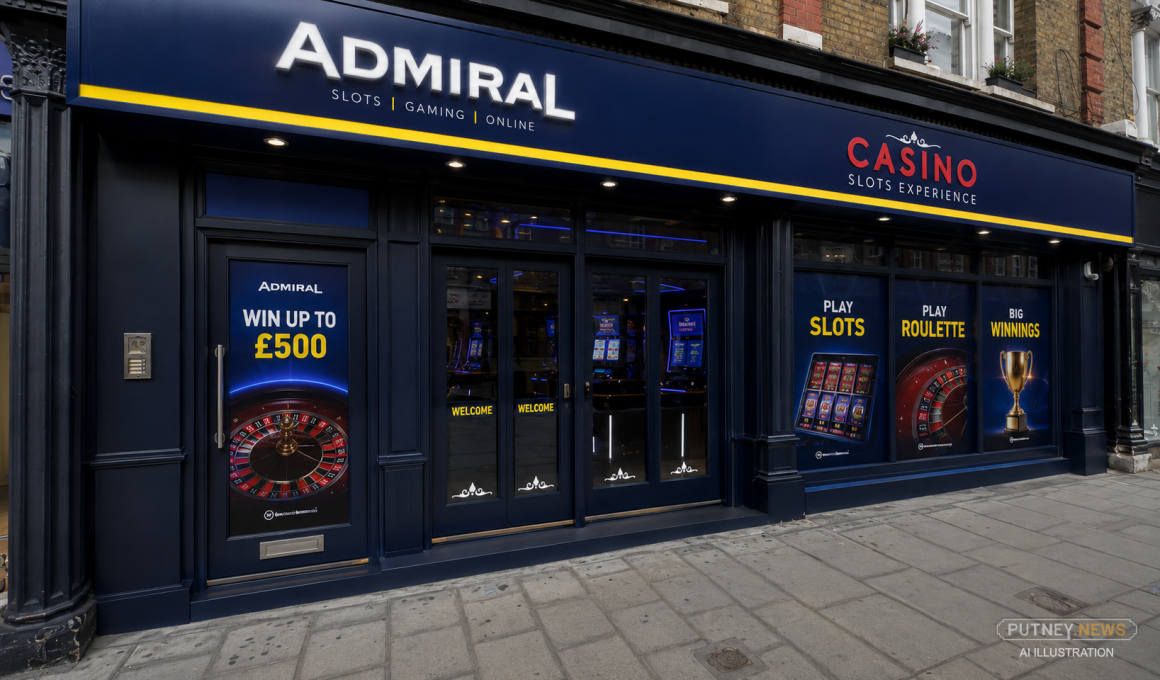
Admiral wants to open the arcade at 160-162 Putney High Street, the former Lost Society bar opposite the station, empty since 2022. Its lawyers argue that 40 to 45 of the 58 objections rest on grounds a licensing committee is not allowed to weigh, whatever their number and however strongly residents feel them.
Among those 58 are a former prison chaplain and a former magistrate who once sat on the council’s own licensing committee. Fifty-eight objectors wrote in but not one Responsible Authority did: not the police, Gambling Commission, or the council’s safeguarding team. That gap, dozens of residents against total official silence, is what a Licensing Sub-Committee panel must weigh when it meets this Thursday at 6pm.
The consultation closed in February, so only those who objected in writing during that window can speak at the hearing, and their combined speaking time is capped at 20 minutes. Everyone else can still turn up in person or watch the webcast. The hearing is at Room 123, Wandsworth Town Hall.
Admiral’s written case, filed by counsel Gary Grant on 29 June, does not just answer the 58 objectors. It scores them.
The three tests, and how Admiral answers them
A gambling licence can only be refused on three grounds: crime and disorder, fair and open gambling, and protecting children and vulnerable people. Nothing else counts. Not a moral objection to gambling; not a resident’s gut feeling that the street doesn’t need another arcade. That is the law that ties the council’s hands, and it tips the scale toward yes unless one of the three tests clearly fails.
On crime and disorder, Admiral leans on silence. No police objection. Then a report from Leveche Associates, a firm of former senior Met officers hired to watch the site and comparable venues. Their observers found eight quiet customers in a rival arcade at 1.23am, and a safe, orderly scene at an Admiral branch in Clapham at 3.02am. No loitering. No disorder. Nothing linking the machines to trouble on the street.
On fair and open gambling, the second test, Admiral’s answer is shorter still: not our problem. That objective, the company argues, belongs to the Gambling Commission’s national regulation of operators, not to a single premises hearing.
The third test is the one that matters. Protecting children and vulnerable people is what nearly all 58 objectors were really arguing, and it is the one Admiral actually engages with rather than waves away. Putney Library sits 80 to 100 metres from the site. School-run buses stop outside between 3.30pm and 4.30pm. Admiral’s answer is Think 25 ID checks, staff rostered around school hours, a supervised lobby, and an independent test-purchase pass rate of around 95%. Leveche’s observers watched schoolchildren walk straight past the existing arcades, “showing no interest” at all.
The cluster, and the law that isn’t switched on yet
A third gambling venue on one stretch of high street. That is the objection that will not go away. Merkur Slots trades 50 metres from the proposed site. Two licensed bookmakers sit within 160 metres. Admiral itself ran an arcade on this exact street once before, from the 1990s until 2004, a history its lawyers now use to frame this as a return, not an intrusion.
A new law could have stopped Putney’s gambling cluster. It just isn’t switched on yet. Admiral’s own submission says so, in a footnote: the power that would let the council weigh clustering is not in force, so numbers on a map cannot decide Thursday’s outcome on their own.
Then Admiral goes further, and turns the cluster argument on its head. More gambling venues nearby, it argues, means vulnerable customers are safer, not less safe. Self-exclusion schemes let a customer who bars themselves from one arcade get automatically barred from others close by, so more machines together, the argument runs, means a wider safety net. The company also points to Gambling Commission figures showing arcade numbers nationally have fallen well below their 2011 and 2012 peaks. Call this “proliferation,” the company says, and you’d simply be wrong.
The site has form. 624 objections at the planning stage did not stop planning permission being granted, without any restriction on hours. Admiral argues the committee should be slow to reach a different conclusion on largely the same concerns the planning process has already weighed and passed.