

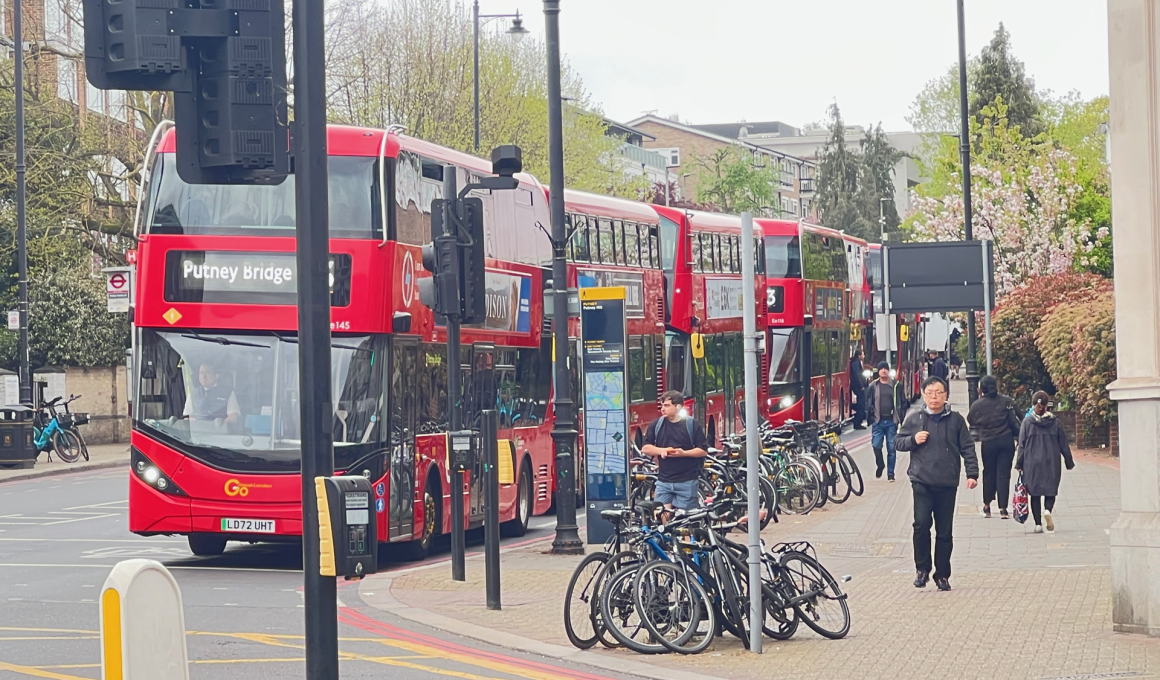
Sally was at Putney Bridge station, on the Fulham side of the river, when she watched an out-of-service bus pull in and change its blind to a Route 22. That bus should have carried on over the bridge and down Lower Richmond Road, where her own stop is. It didn’t. It turned round and headed back towards central London. It explains why she always seems to be waiting a long time at her usual stop.
She is far from the only Putney resident who has noticed the same pattern – and not just the 22: the 85, the 93, 265 and 430. In the past fortnight, we have received a raft of reader reports complaining about the buses stopping earlier or not appearing at all. And yes, the reason is exactly what you think it is: Putney Bridge Junction and High Street congestion.
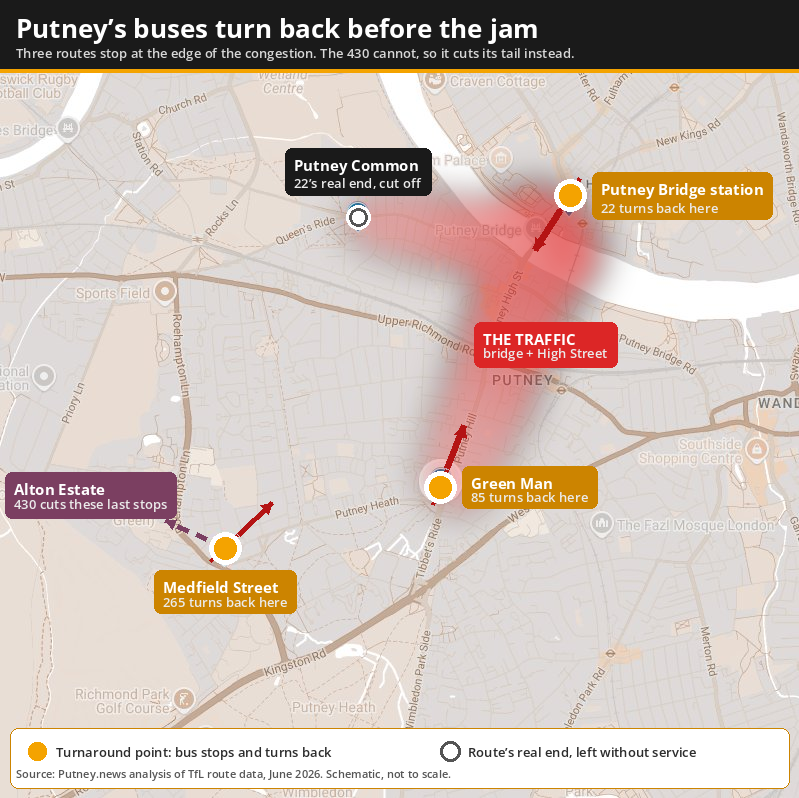
Rather than push through the junction, buses are turning back at the last point before they would hit it. The 22 turns round in Fulham rather than cross the bridge. The 85 turns at the Green Man rather than come down Putney Hill. The 265 turns in Roehampton rather than grind along Lower Richmond Road. Every one of them stops at the edge of the same jam.
Last week, we reported that the junction was back to square one. The buses have noticed.
What readers are seeing
The 22 runs from Putney Common across the bridge all the way to Oxford Circus. Coming back, it has been terminating on the Fulham side and turning round, rather than get caught in Putney traffic. The result is that St Mary’s Church, Putney Pier, Ruvigny Gardens, Festing Road and Putney Common all lose their service.
The 85 runs all the way from Putney Bridge to Kingston. The slow leg is the run in from the Green Man, down Putney Hill, along the High Street and over the bridge. Rather than attempt it late, drivers have been turning round at the Green Man, in some cases putting passengers off to walk down the hill.
The 265, which has the longest route all the way to Tolworth and also ends at Putney Bridge, does the same thing for the same reason, turning in Roehampton rather than take Lower Richmond Road towards the bridge.
Paul wrote to us about the 39 and 93, cut short to Putney Heath, and raised the worry that runs through every batch of tips we receive: that a temporary curtailment has a habit of quietly becoming permanent. His wife has mobility issues. The stops being skipped are not optional to her. Another reader reported the 93 ending at the Green Man every day for a week in late May, with TfL citing roadworks on the high street. That episode is now resolved, but it lasted seven days.
The 39 and 93 seem to running normally again. The 22, 85 and 265 and 430 are not.
Why the buses keep doing this
What’s actually happening was set out in full in our 2025 investigation, but the short version is this: when a bus turns back before its scheduled terminus, the journey drops out of TfL’s reliability measure. The official metric, Excess Waiting Time, is recorded only at designated timing points. A bus that never reaches the timing point is not counted as late, because as far as the data is concerned it was never really there.
This matters because operators earn a bonus when Excess Waiting Time stays below one minute and face a penalty when it rises above. A bus that turns back early helps the figure. TfL’s own data for Putney’s worst-affected routes had them running 41% above the borough average in the latest quarter, and that is the figure after the curtailed journeys have already vanished from it.
What TfL’s own data shows
The proof sits in TfL’s own records. Route 85 trip data for a 28-day period in summer 2025, released under Freedom of Information, shows that of 413 inbound curtailments in that period, 343 ended at the Green Man, and 94% were coded ‘Lost due to Traffic’. One in five scheduled 85s never reached Putney. Strip out two strike days and it is still around one in seven, so the shortfall was curtailment, not crew shortages.
The geography shows up in the figures. At Putney Heath, 8.7% of scheduled calls were lost. At the very next stop inward, the figure jumps to 19.3%. That is not a gradual decline. It is a turnback point written into the data.
There is a further wrinkle. In October 2025 TfL’s own correspondence confirmed that lower Excess Waiting Time had been achieved by lengthening scheduled journey times rather than by speeding journeys up. The timetable was slowed to match how long journeys were already taking, and the reliability figure improved on paper without anything improving on the road. As the operator’s own representative put it at a public meeting last year, if a bus terminates early, it does not count against the data.
A pattern in where they turn
There is one more thing in the route data worth noting, though it raises a question rather than answers one. The turnaround points are not scattered at random. On the routes we examined, buses curtail a strikingly consistent distance from the end of their journey.
The 22 turns seven stops short of its terminus, having run 26 of its 33 stops. The 85 turns seven short of 34. The 265 turns 13 short of 50. In each case the bus has completed roughly three-quarters of its route before giving up the rest, and the part it gives up is the part that runs through Putney.
The 430 is the exception that fits. It curtails only four stops from its end, sacrificing its final stops into the Alton Estate, because the only other place it can physically turn round sits halfway along its route, too early to use. It cannot curtail at the three-quarter mark, so it cuts the tail instead.
Each of these turnaround points is also a hub where several other routes meet, which means TfL can argue that stranded passengers have onward connections. That argument only holds if the connecting routes complete the leg the passenger has been turned off, and several of them are curtailing for the same reason. Putney.news has asked TfL whether any rule governs the point at which a journey may be curtailed, and these questions are set out below.
What you can do
If you see a bus turn back before its scheduled terminus, tell us. Note the route, the stop, the time and what you saw. We are building a reader picture of where and how often this is happening, and the vehicle number, shown on the front and back of the bus, makes any report easier to verify.
Cllr Daniel Hamilton holds the transport brief in Wandsworth’s new Conservative administration. His contact details are on the council’s councillor pages.
You can also make your own Freedom of Information request to TfL at whatdotheyknow.com for the trip-level data on the routes you use. We obtained this for the 85, and it is what proved the pattern. TfL holds the same records for every other route. Ask for “trip-level operated mileage and curtailment data for route [XX], broken down by journey and by stop, in spreadsheet format, for the last six months.” The words “trip-level” and “by stop” are what force the detail; without them you get a summary that hides the problem.


You don’t mention the 220 and 270 routes which both serve Putney Bridge Road, linking Putney to Wandsworth town centre. The 220 from Willesden Junction to Wandsworth Southside is frequently turned round at Putney Bridge Station while the 270 from Mitcham to Putney Bridge Station is turned round at Wandsworth Southside, in both cases to avoid the congestion at the Putney Bridge junction. As neither complete their route the bus is are not available to make the return journey either. At certain times this can lead to a virtual “bus desert” along Putney Bridge Road.
You have also failed to mention the no. 14 bus. Since TFL cancelled the no. 414, promising there would be more frequent no. 14 buses, the people living between Fulham High Street and Fulham Broadway and viceversa have been penalised. We have had huge problems: the waiting time for the no. 14 is atrocious, and when it finally appears, buses come in tandem. Once, when I had an appointment at the F&W Hospital, after a long wait I decided to walk from Fulham High Street. During my 40 minutes walk, not a single 14 bus appeared !