

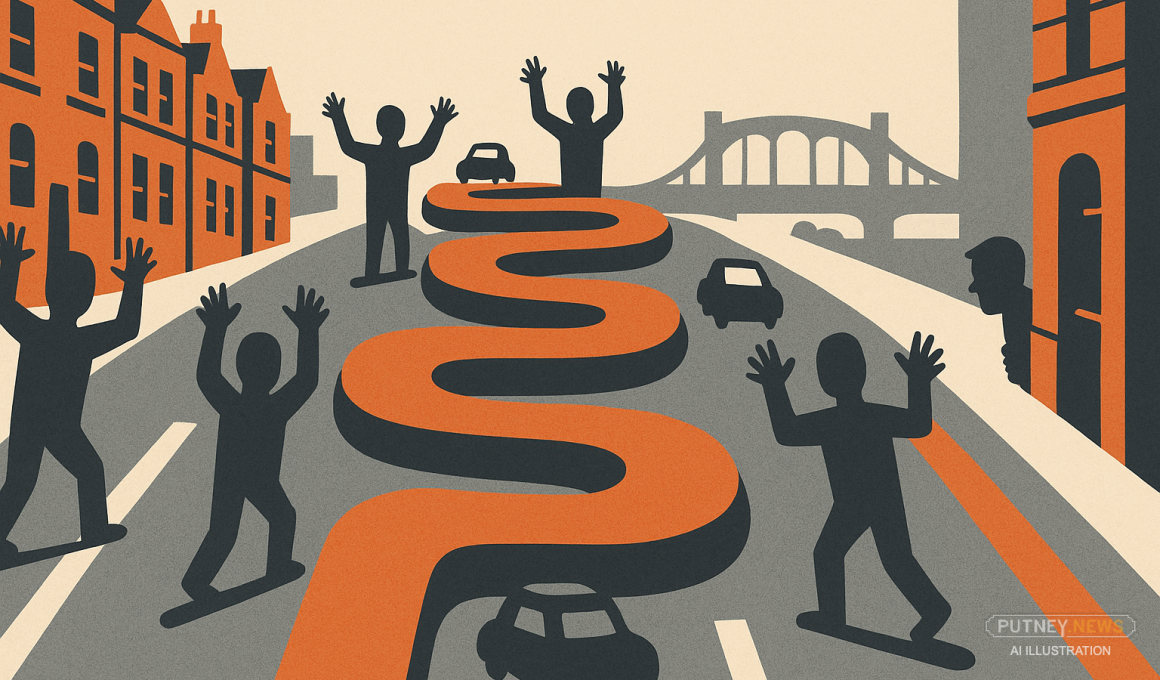
UPDATED Controversial plans to narrow Wandsworth Bridge Road – a scheme that would have pushed even more traffic toward already-gridlocked Putney – have been put on hold.
Transport for London (TfL) has stepped in to block construction that Hammersmith and Fulham Council (H&F) started without properly consulting the transport authority – or those impacted.
The intervention brings relief to Putney residents who rely on Wandsworth Bridge Road as a major route and feared the “meandering” design would displace yet more traffic onto an already-overwhelmed road network. A petition opposing the changes gathered 3,237 signatures, with Putney MP Fleur Anderson publicly urging constituents to sign it because of the “knock-on effects” here.
But the episode also exposes an uncomfortable irony: the same transport authority now blocking changes over bus performance concerns is the one whose rigid demands for bus priority at Putney Bridge junction helped create the traffic crisis in the first place.
What happened in Fulham
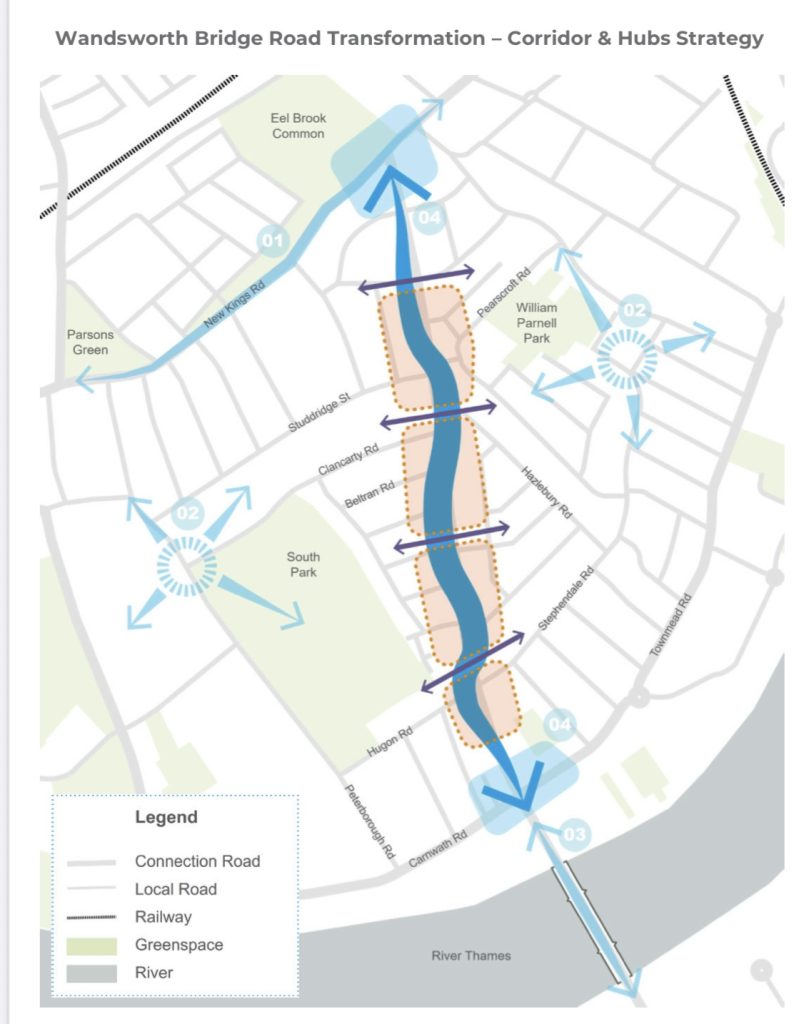
Documents reveal that H&F Council bypassed TfL entirely during the design phase of the changes to Wandsworth Bridge Road, which carries 37,000 vehicles per day and forms part of London’s Strategic Road Network.
The authority only learned of the detailed proposals in early September – months after the council had begun engaging residents and just weeks before construction was scheduled to begin.
In a letter dated 2 October, TfL told the council it was “unable to support the proposals in their current form due to the lack of data and information provided.”
The transport authority warned the scheme had “the potential to create further operational challenges on the Strategic Road Network” and that TfL buses had “raised concerns regarding existing bus performance” with “ongoing questions pertaining to the design and potential for further erosion of bus speeds.”
In other words, the design was going to create even more congestion on London’s already choked roads. And with Wandsworth Bridge the closest to Putney Bridge that meant even more problems with people trying to cross the river.
Construction started despite objections
Yet just four days after TfL’s letter, Hammersmith & Fulham Council’s contractors were due to begin works on the scheme anyway.
TfL was explicit: “At present TfL are not able to support the works moving forward until a full review of the scheme design is undertaken.”
The works would have replaced existing cycle space with pavement build-outs featuring seating and planters – creating what the council described as a “meandering” layout designed to discourage through traffic.
Opposition Councillor Liam Downer-Sanderson, Shadow Cabinet Member for Environment and Ecology, said the council had claimed its consultation went “way in excess of statutory requirements” yet had “failed to even speak to TfL, who in their own words are a ‘statutory body for consultation for any material change in layout’.”
“It is at least careless and at worst seriously incompetent to spend public money on contractors and preparatory work before TfL were even consulted,” he said. “This level of incompetence is deeply concerning.”
Cross-borough impact on Putney
The consultation failure is particularly significant for Putney residents, who would have been directly affected by the changes but had no voice in the Hammersmith & Fulham consultation process despite relying on Wandsworth Bridge Road as a major route.
A petition opposing the scheme has gathered 3,237 signatures, with organisers explicitly framing it as “Stop H&F Council clogging up SW London.” The petition notes that alternative routes including Imperial Road and Hurlingham Road are now restricted by Low Traffic Neighbourhoods, while Hammersmith Bridge remains closed and Putney’s road network already faces “greatly increased volumes of traffic.”
Putney MP Anderson publicly endorsed the petition, urging constituents at a ward meeting on 11 October to sign it. “They’ve got another consultation on the bridge on the other side of Wandsworth Bridge Road – they’re calling it a wandering or meandering but there’s a petition on that and I would advise that you join in with that petition because we’re saying to the council what you do there has a knock-on effect to us,” Anderson told residents.
The council’s statutory consultation received 290 responses across two notices, with only eight in support. However, the most controversial elements – replacing cycle space with pavement chicanes to create the “meandering” effect – were not included in the statutory notices, leading to accusations that residents were being told what would happen rather than being genuinely consulted.
Councillor Florian Chevoppe-Verdier, H&F’s Cabinet Member for Public Realm, accused the Conservatives of peddling “lies and falsehoods” about the scheme.
A Hammersmith and Fulham Council spokesperson said TfL had “asked for a review” as “part of the standard consultation process,” resulting in “a necessary delay.” The council is now “working with TfL buses to meet their specification and data requirements.”
The TfL irony
But while Putney residents can feel relieved that a scheme likely to worsen their congestion has been blocked, the intervention exposes an uncomfortable contradiction in TfL’s own role in the region’s traffic crisis.
TfL is now citing concerns about bus performance and Strategic Road Network impacts to block Hammersmith & Fulham’s scheme. Yet at Putney Bridge junction – less than a mile away – it was TfL’s rigid insistence on protecting bus journey times that forced Wandsworth Council to abandon safer, more effective junction designs, as Putney.news has previously documented.
Documents from Wandsworth Council’s Putney Bridge junction redesign reveal the extent of TfL’s veto power. In November 2021, a “Cyclops” junction design – described as “optimal for pedestrians and cycles” – was rejected because it “would cause gridlock in Putney and would never be accepted by TfL.”
In April 2022, a design featuring straight-through crossings was rejected due to “unacceptable capacity and journey time implications.” Single-stage crossings that would have been safer for pedestrians were deemed to have “a very detrimental effect on buses” and were “not acceptable by TFL.”
The result was a compromise design with staggered crossings – explicitly described in council documents as “the best that can be achieved given the clear balances and constraints” imposed by TfL. The junction redesign, which nine out of ten local residents said had failed, required new traffic light systems to manage the compromised layout.
The contradiction is stark: TfL’s bus-priority demands at Putney Bridge helped create a junction that now generates congestion overflowing onto surrounding routes, including Wandsworth Bridge Road. When Hammersmith & Fulham proposes changes that could worsen this displacement, TfL blocks the scheme… citing concerns about bus performance.
A systemic failure
Research shows that when road space is reduced or redesigned, overall traffic levels can actually fall rather than simply shift elsewhere. Studies led by Sally Cairns, Carmen Hass-Klau and Professor Phil Goodwin for the UK Department for Transport found that people tend to adapt in many ways: combining trips, changing travel times, choosing other routes or switching to walking, cycling or public transport.
Drawing on 70 case studies across 11 countries, their research found an average 11% reduction in total vehicle numbers, even on surrounding main roads. This pattern, known as traffic evaporation, reflects how travel decisions are shaped by human behaviour rather than fixed flows.
That said, it doesn’t make congestion vanish overnight. Where road capacity is cut faster than habits can change (or where good alternatives aren’t yet in place) local bottlenecks can still worsen. Significantly in the case of Putney. The real test for transport planners is to design changes that make greener travel easier without trapping essential journeys in queues.
TfL’s rejection of more ambitious designs at Putney Bridge helped push congestion onto other routes. Hammersmith & Fulham’s proposed narrowing of Wandsworth Bridge Road would have pushed traffic back toward Putney. And all the while, Hammersmith Bridge remains closed, Low Traffic Neighbourhoods restrict alternative routes, and Putney residents suffer the consequences.
The saga reveals a deeper problem: decisions affecting Putney are made by authorities residents can’t influence. Hammersmith & Fulham makes changes that displace traffic into Putney without local consultation. TfL wields veto power but carries no accountability for how its own rigid demands create the problems it warns against.
For now, the immediate threat has been averted. But who actually manages London’s road network in a way that protects Putney residents from neighbouring boroughs’ decisions? And how can local people hold authorities accountable when those affecting their daily commute are councils they didn’t elect and transport authorities they can’t vote out?
Hammersmith and Fulham Council must now present its revised plans to TfL’s Road Space Performance Group before any works can proceed. No timeline has been given for when this review might be completed.
A TfL spokesperson confirmed the authority was not consulted at the design stage but is now “working through the plans as quickly as possible.”
Editor’s note (31 October 2025): We’ve updated this article to reflect research on “traffic evaporation” by Professor Phil Goodwin and colleagues at UCL, which shows that traffic often reduces overall rather than simply moving elsewhere. An earlier version used a “water in a balloon” analogy – which turns out not to hold up to the evidence. Our thanks to reader Isaac Beevor, who works in climate and transport policy, for pointing this out and sharing the research.


Where/when exactly did Putney MP Fleur Anderson actually publicly urge constituents to sign the pointless petition by the South Fulham Tory proxies? That’s simply not true and the South Fulham group are being grossly misleading in claiming that she endorses their petition.
It says where and when in this article: “Putney MP Anderson publicly endorsed the petition, urging constituents at a ward meeting on 11 October to sign it…” with a link to a write-up of the meeting.
But it isn’t actually mentioned in the write-up of the meeting…..
Why would any MP ‘endorse’ a change.org petition? They are a GDPR crapshow and cannot be accepted by Councils or government, as the incompetent South Fulham group know only too well. Their previous failed petition had signatories from all over the UK, Ireland and Europe, most famously one from Montenegro….
Flo Anderson previousl had a post on X (now deleted) where she merely stated that a lot of people had written to her in support of this petition and that she shared their concerns, that’s not an endorsement or urging anyone to sign it…..
Go to the story on the meeting here: https://putney.news/2025/10/12/traffic-crisis-dominates-putney-meeting-as-residents-demand-action-not-promises/
There’s full recording at the very end. Go to 7 mins 25 seconds to hear exactly what Fleur Anderson said.
Fair enough, thanks for responding with the link and the heads up on the recording. Fleur referred to the South Fulham Clean Air Neighbourhoods, which she described as Low Traffic Neighbourhoods, mentioning that there is another petition against the proposed traffic speed/calming measures on Wandsworth Bridge Road, and advised people to ‘join in with that petition’. This is a very lazy & weak statement by the Putney MP, in the context of what seemed like quite an atmospheric public meeting.
She must be fully aware that Local authorities in the UK are governed by the Local Democracy, Economic Development and Construction Act 2009, which requires them to have a formal petitions scheme.
Change.org petitions don’t meet that formal standard, because they can be signed anonymously or from anywhere in the world, they don’t verify addresses, and Councils have no way to confirm that signatories are local or even UK residents.
National networks of, for example, anti-LTN campaigners frequently use social media to flood local petitions with support from people who have no stake in the area. This might create some publicity or media attention, but it lacks credibility in the eyes of councillors and officers.
Councils can’t (and don’t) take Change.org petitions at face value, because they can’t verify the local connection of signatories. Their impact is largely symbolic and political, rather than procedural. It’s disappointing that the local MP would loosely advise people to join in with a petition that she must have known has no status……