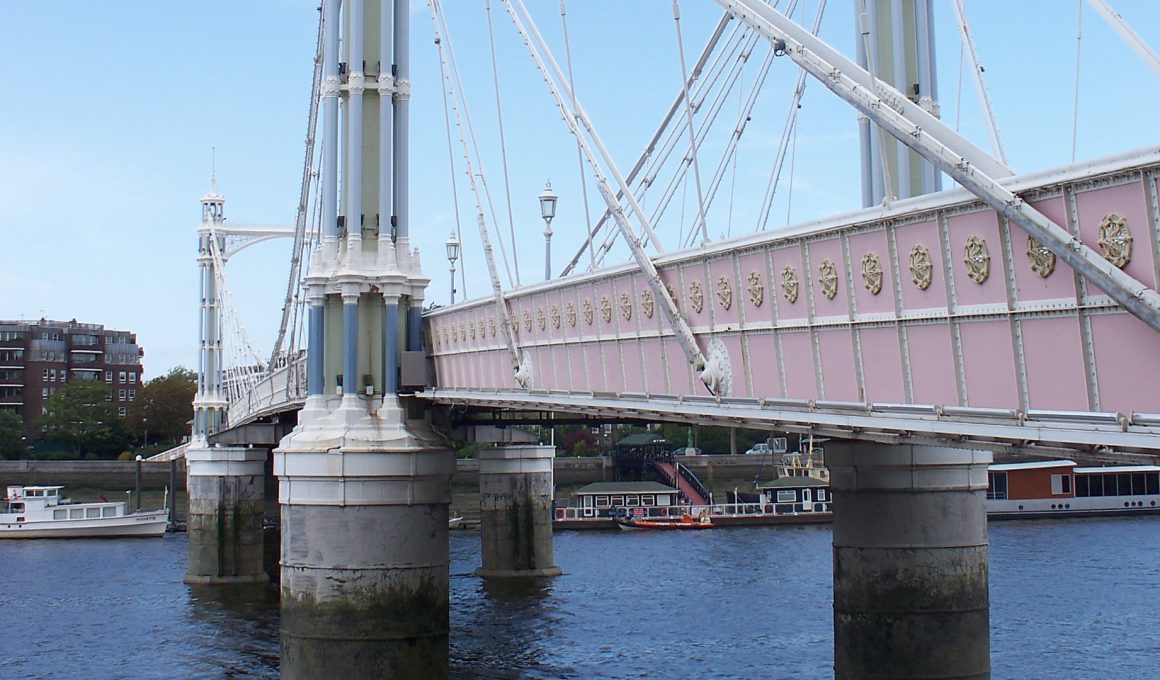
A temporary prop has been installed under Albert Bridge, keeping the crossing open to pedestrians and cyclists while the full repair gets under way. The bridge is not about to fall down. But Albert Bridge has been getting fixes described as temporary since 1884, and none has ever been removed.
Sir Joseph Bazalgette added steel chains and a new deck between 1884 and 1887, remedying a structure that had been declared unsound from the day it opened eleven years earlier. In 1957, when the London County Council proposed demolition, a protest led by John Betjeman talked them out of it. In 1973, the Greater London Council dropped two concrete piers into the Thames to hold up the central span.
The piers were described as a temporary measure. They were supposed to come out in 1978. They are still there, fifty-three years on. A year later, engineers assessed that the bridge had, at best, another thirty years left in it. That was fifty-two years ago.
When Albert Bridge closed to cars in February, Kensington and Chelsea Council hoped to find a temporary fix so motor traffic could return sooner. Its engineers said the bridge was too fragile and too complex for even that. So where a temporary fix would once have gone, the council has installed a prop: a single brace supporting a single weakened component.
The bigger fix is real. On 25 March, the council approved an £8.5 million repair programme expected to run twelve months, covering the cracked cast iron component, the seized joint blamed for the crack, a new road surface, refurbished tollbooths and replacement lighting. It is the most substantial work the bridge has had since the 1973 piers were wheeled into the Thames. The tollbooths are the only surviving bridge tollbooths in London: Albert Bridge was a commercial failure, the tolls were scrapped within six years of opening, and the booths have outlasted every other set.
Whether the £8.5 million programme fixes Albert Bridge for good, or 2026 takes its place alongside 1884, 1957 and 1973, is the open question. The pattern is not encouraging. The London Assembly warned in 2021 that the capital’s road bridges sit inside a patchwork of borough ownership with no central oversight and no shared budget. Albert Bridge shows what that looks like: every generation finds a way to keep it standing, and none gets round to making the fix permanent.
When the vehicle closure began in February, Cllr Johnny Thalassites, the council’s lead member for environment and planning, said he “certainly didn’t want this to be another Hammersmith Bridge.” The bridge closed to everyone two months later, after its sensors picked up unexpected movement on a 25-degree afternoon.
Putney.news has pending Freedom of Information requests with Kensington and Chelsea and Wandsworth, asking what each council knew about the condition of Albert Bridge and Putney Bridge, and when. Responses are due around 28 April. That is the story still to come. This one is about the prop, and the long queue of props it joins.