

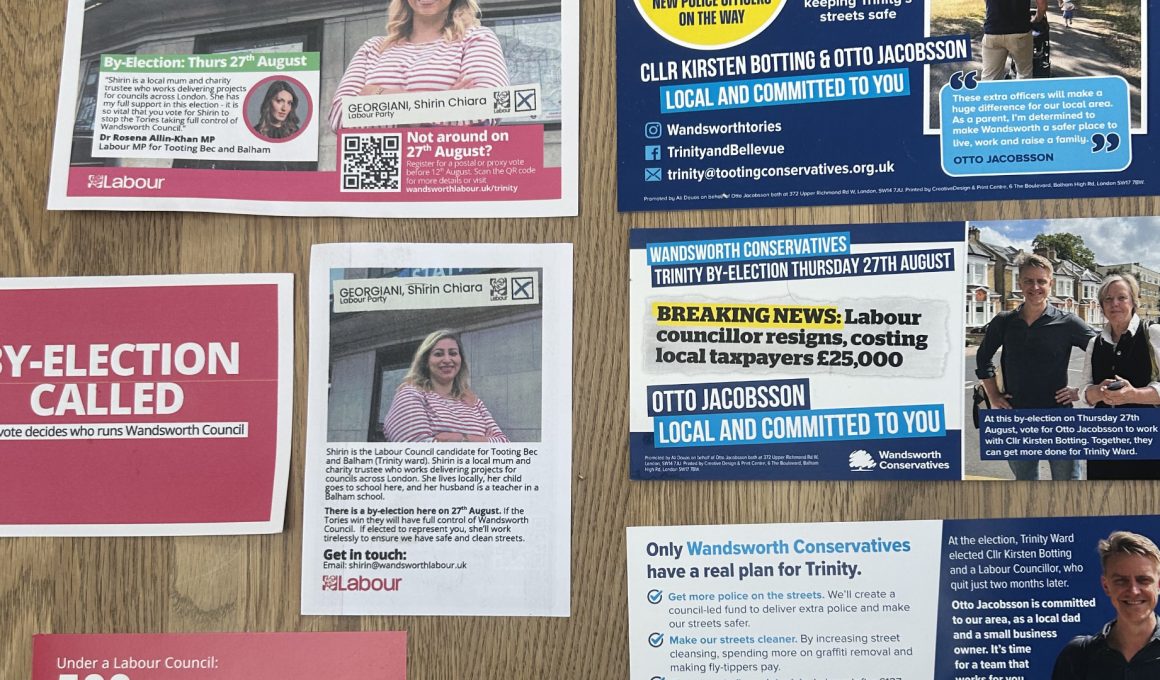
A Labour leaflet delivered through doors in Trinity ward this month was made to look like it came from the Conservatives.
Blue, headed “WANDSWORTH CONSERVATIVES”, with a real scratch panel under the words “COUNCIL TAX HIKE REVEAL”, it revealed “+160%, £800 more each year” and a line underneath: “For the same low Council Tax, vote Labour.”
Only on the back, in small type, does the imprint say who actually produced it: Cllr Sean Lawless, promoting it on behalf of Wandsworth Labour. Cllr Simon Hogg, the party’s local leader, posted a video of himself scratching the panel off.
The leaflet was the sharpest artefact in a summer-long fight over Wandsworth’s finances that ended, on Thursday, with Labour holding the seat by 127 votes. In the days since, we have gone through the documents both parties generated, and found each of them undercutting the story it told voters.
The offer on the front, the same low council tax if you vote Labour, was not one either party was in a position to make. We tested the leaflet’s central claim nine days before the poll and found 130 of the 160 percentage points is not something Wandsworth’s council, of whichever party, gets to choose. It follows from the government’s Fairer Funding Review settlement which will be imposed on whichever party runs the town hall. But even now, neither side can quite bring itself to be upfront and honest with residents.
Wandsworth Tories want to double your Council Tax.
— Simon Hogg (@CllrSimonHogg) August 21, 2026
Tell the Tories to scrap Britain’s biggest ever Council Tax rise.
🌹 Vote Labour on Thursday in Trinity Ward
[ 👀 Scratch our new leaflet to reveal their plans] pic.twitter.com/Pry20Vl28i
Thursday’s result left the council exactly where it was in May: 29 Conservatives, 28 Labour, one independent, one short of a majority. Both parties’ vote share actually rose, Labour to 47.5 per cent and the Conservatives to 43.6, but that was a result of massive focussed campaigns – neither gained a single vote in absolute terms, because turnout fell from 53.65 per cent in May to 39.56 per cent. Trinity voters tuned out.
The nearest measure of committed support, each party’s weaker candidate in May, shows Labour brought back 98 per cent of its vote and the Conservatives 94 per cent: four points, and the seat. What it doesn’t cover is the scale of what both sides spent chasing those four points: Conservative leader Kemi Badenoch canvassing in person, shadow cabinet members campaigning, three articles in the Daily Mail, GB News previewing the by-election as a route to a seventh Conservative London council. None of it moved a single vote in absolute terms.
The election also served to remind people of their representatives’ hypocrisy. It emerged that Cllr Hogg, when he was leader of the council, wrote to the Deputy Prime Minister and Minister for Local Government on 15 August 2025, a year before campaigning against “Tory cuts”, warning that the incoming funding settlement would mean “difficult decisions about services” whose impact “will be felt by all our residents, especially those on lower incomes”, and asking for a longer transition period “to prevent a cliff-edge… avoiding a scenario of radical service cuts”.
Cllr Peter Graham, the Conservative Deputy Leader and Cabinet Member for Finance, published the letter on X on 27 August, polling day, saying it had not been disclosed in response to a Freedom of Information request. Cllr Hogg had not disputed either the letter or the FOI claim as of Friday.
🚨UNPUBLISHED LABOUR LETTER🚨
— Peter Graham (@peter_graham) August 26, 2026
This is what @CllrSimonHogg sent to his own government last year, then failed to disclose under an FOI request.
Labour’s local plan, in the scenario that’s actually happened? “Radical service cuts” and “unintended impact” on your tax bill. pic.twitter.com/pCTYaj6IEJ
Cllr Graham is not a neutral source here: he is the Conservative cabinet member for finance, and chose polling day to put a Labour opponent’s correspondence into the public domain, timing that would not have changed a single vote in Trinity by then and reads more as a message to Conservative supporters than an attempt to sway anyone else.
What it exposes is Cllr Hogg’s own position: a Labour leader who told his government privately, a year earlier, that the cuts were coming, and then spent the summer campaigning against “Tory cuts”. The letter Graham published makes the same argument the Conservatives were making from the other side of the chamber a year later: that the settlement, not either local party, is doing most of the damage.
A Wandsworth Tory spokesman told the Evening Standard during the campaign that the previous Labour administration’s spending plans “would have used all our reserves and bankrupted the borough within 18 months”. The council’s own Corporate Risk Register, presented to Audit Committee on 30 July under the current Conservative administration, scores the Financial Stability risk at 12 out of 12 against a stated appetite of “Med – 10” (six of thirteen risks sit above the level the council says it can tolerate) and lists among the consequences a “s.114 Notice/need for exceptional financial support”. A Section 114 notice is better know as council bankruptcy. No comparable warning appears in the equivalent risk papers from 2022/23 through 2024/25.
The two campaigns spent the run-up to polling day logging each other’s every move and returning fire within the hour on social media. Cllr Hogg called the new Conservative administration “chaos”, “extreme and divided”; a Wandsworth Labour spokesperson said the Conservatives were “gripped by internal civil war”; the Conservative side hit back in kind.
Susan Hall, campaigning for the Conservatives, described their candidate on camera as a serving police officer, which he is not: a slip, seized on and amplified well beyond its weight. While the two parties monitored each other all summer, most of the ward was watching with boredom or mild distaste or just ignoring it altogether. Six in ten Trinity voters did not turn out at all.
Three weeks before polling day, Putney.news asked Trinity residents what they actually cared about. The answers were crime, housing, parking and green space, none of it what the campaign that followed was fought on.
The arithmetic is exactly where May left it. Cllr Malcolm Grimston, the independent whose confidence-and-supply agreement keeps the new Conservative administration in office, holds the same balance he held before a single vote was cast in Trinity. The two-year budget gap the council itself has published is still £137m. The council tax bill for April 2027, the number that would settle the argument both parties spent the summer having, still has not been published.
Update, 30 August: A reader points out that while turnout fell from May’s full borough election, 39.6 per cent is actually very high for a council by-election held on its own.
That’s true. Standalone Wandsworth by-elections over the past decade have ranged from 21.7 to 33.6 per cent; the only higher figures came when a by-election shared the day with a general or London-wide election.
Trinity’s turnout was not a collapse but a strong showing for a by-election, and it reflects how hard both parties worked to get their supporters out: that effort is exactly how Labour brought back 98 per cent of its May vote and the Conservatives 94 per cent. An earlier version of this article said turnout “collapsed”; we have changed it to “fell”.
What happens next. The council tax figure is now promised for September, alongside an update to the council’s medium-term financial strategy. Putney.news will report it.
If you want to put a question to the people who represent you, Trinity’s councillors are now Shirin Georgiani (Labour, cllr.s.georgiani@wandsworth.gov.uk) and Kirsten Botting (Conservative).
Paper 26-180, the risk register at the centre of this story, went to the Audit Committee, whose meetings are open to the public and take questions submitted in advance through the council’s democratic services team. Complaints about council conduct, including the use of official social media, can be raised with the council directly in the first instance and, if unresolved, with the Local Government and Social Care Ombudsman.



Special Council meeting called for September 15 which should clarify matters.