At least thirteen of the 48 Wandsworth council buildings confirmed to contain asbestos are used by children or young people, who are a higher-risk group than adults when it comes to the potentially lethal material.
The true number is almost certainly higher. As schools have moved out of council control over the years, into academy trusts and other bodies, many more buildings used by children every day likely contain asbestos too, but fall outside the council’s own list entirely. The National Education Union warns that some of the smaller trusts now responsible for these buildings may lack the experience to manage them well.
The council’s records, released to Putney.news this week after a decade of refusing to say which of its buildings contained asbestos, list only five of the 48 as “educational establishments”. We have counted what each building is actually used for, and by whom, rather than how the council categorises it; that takes the number to thirteen, almost triple the official figure.
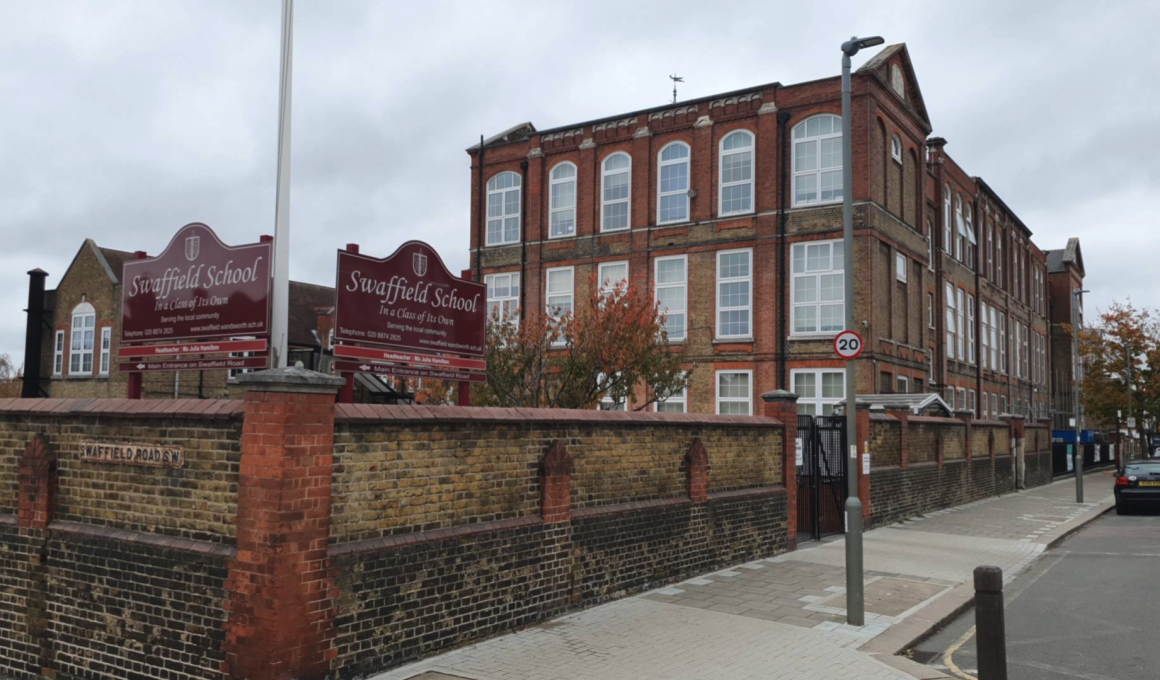
It’s worth saying plainly: asbestos left undisturbed and in good condition carries negligible risk. That is the official position of the Health and Safety Executive. But it also expects the condition to be re-checked every six to twelve months. Swaffield Primary School was last surveyed in November 2012.
The council provided data for all 48 buildings yesterday.
- Swaffield Primary School on St Ann’s Hill, November 2012.
- Two one o’clock centres for pre-school children, Bolingbroke and Heathbrook Park, October 2015; the third, Windmill, October 2022.
- Roehampton Youth Club, October 2015.
- Two pupil referral units, Francis Barber and 5 Westdean Close, March 2021; the third, Victoria Drive, April 2021.
- Alton Youth Centre, September 2024. Roehampton Base, the young people’s support centre on Danebury Avenue, August 2025.
- The ELAYS Community Hub, the former Heathbrook youth centre, September 2025.
- York Gardens Children’s Centre and Adventure Playground, October 2025.
- The Juvenile Justice Centre on Blackshaw Road, November 2025.
Nine of the thirteen have not been checked in the past twelve months. Seven have not been surveyed in more than five years. Four have not been surveyed since before August 2016.
For nine of the thirteen, the council’s central facilities team holds no asbestos management plan. Its records mark them “Not Managed by FM”, meaning the plan, if one exists, sits with a school, a leisure operator or another third party. Across all 48 buildings that applies to 32.
The council had previously told Putney.news its management plans had not been updated since 2022. It now says that answer was a misreading of the question, and that plans were updated in December 2025 for the sites it manages directly.
The mismatch is not just five against thirteen. The three pupil referral units alone are scattered across three different council headings: one educational, one civic and administrative, one “all other”. That is probably just a matter of which department looks after which building, rather than anything deliberate. But it means that there is not a consistent asbestos management system across schools in Wandsworth.
Around four in five schools in England contain asbestos, so presence in a pre-2000 building is normal and expected. But the government’s Committee on Carcinogenicity has found that, for a given exposure to asbestos fibres, a child first exposed at age five carries a lifetime risk of mesothelioma about 3.5 times greater than an adult first exposed at 25, mostly because a child has more life ahead of them for a slow-developing disease to appear.
That figure is about exposure, not presence, and nothing in the record shows any child in these buildings has been exposed. It is why, of everything on the council’s list, checking the children’s buildings matters most.
The scale of what’s missing
Wandsworth has 81 state-funded schools. The council is the legal asbestos dutyholder for 31 of them: the community primaries, the community special schools, the nursery schools and the pupil referral units.
For the other 50, 28 academies and free schools, and 22 voluntary-aided and foundation schools, mostly church schools, the legal duty sits with the academy trust or the school’s own governing body, not the council. Sixty-two per cent of the borough’s state schools are outside the council’s asbestos records entirely, and no equivalent public list exists for any of them.
The National Education Union’s warning is specific:
“When schools become academies, they lose the support of the local authority as duty holder,” its guidance says. “While some academy trusts will be experienced in asbestos management, many, especially small trusts, will not. This could lead to poor asbestos management practices.”
Putney.news plans to approach academy trusts operating in Wandsworth to ask whether they hold current management plans and survey dates.
The last time anyone asked
In 2016, a bereaved daughter named Lucie Stephens, whose mother, a teacher, died of mesothelioma, asked every council in England and Wales which of its schools contained asbestos. Wandsworth answered the question backwards, listing the schools that did not: “All schools may contain asbestos except for those which have been new built in recent years.”
When she asked for the actual list, the council refused, citing a legal exemption for information “reasonably accessible by other means”, and directed her to its schools directory, a list of every school in the borough that identifies none as containing asbestos. She did not pursue it. The list stayed unpublished for another ten years.
The 2016 response said each school had received a copy of its asbestos survey and “they would carry out a risk assessment and management plan themselves.” If school-level plans were devolved to individual schools a decade ago, the question of who holds them today, and who checks they are current, is live.
What a parent can do
Whoever runs your child’s school, the law gives the same answer: the dutyholder, council, trust or governing body, must hold an asbestos management plan and must give information about the material’s location and condition to anyone who could disturb it.
Any parent can ask the school two questions: may I see the asbestos management plan, and when was the last survey by an accredited external contractor? Those are not confrontational questions. They are the questions the law assumes someone is asking.