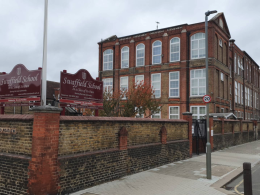
Wandsworth Council has named the 48 buildings it owns that contain asbestos, after refusing for a decade to say which they were. Putney Leisure Centre is on the list. So is Wandsworth Town Hall (three time), a primary school, three units for children excluded from mainstream school, and the one o’clock centres where pre-school children spend their mornings.
You can find a searchable map below. Four of the borough’s main leisure and recreation centres are on it: Balham, Latchmere, Putney and Wandle.
At least thirteen of the 48 are buildings children or young people use day to day, including that primary school, three pupil referral units, three one o’clock centres and the Juvenile Justice Centre. That is our count, made from what each building is rather than how the council files it, since its own paperwork records only five of the 48 as “educational.”
The gap between those two numbers, and what it may mean for the schools that never made this list at all, will be a second story in a series.
None of this means these buildings are dangerous. Any building put up or substantially refurbished before 2000 should be assumed to contain asbestos, and around four in five schools in England do. Two bans in 1985 and 1999 stopped anyone installing new asbestos but never required anyone to remove what was already there. The Health and Safety Executive’s position is that asbestos in good condition, left undisturbed, carries negligible risk, and should stay exactly where it is.
The catch is the word “managed.” The law makes it an active duty: the council has to know where the material is, check its condition at least every six to twelve months, keep a written management plan current, and survey before any work that might disturb it. Wandsworth’s asbestos management plans have not been updated since 2022.
When we asked, for every one of the 48 buildings, when it was last surveyed by an accredited external contractor, the council did not respond. We have followed up.
The 48 council buildings that contain asbestos
Every building Wandsworth Council controls that its own records show contains asbestos-containing materials, named for the first time in August 2026. Presence is normal and lawful in any pre-2000 building. What the council has not said is when each was last checked.
What a dot does not mean. A building on this list is not a building in danger. Asbestos was used in construction until it was banned in 1999, the ban did not require removal of what was already in place, and the Health and Safety Executive’s position is that material in good condition and left undisturbed carries negligible risk. The count of buildings used by children is ours, made from what each building is rather than how the council files it; the council’s own paperwork records five as “educational”.
Source: Wandsworth Borough Council response to WBC-FOI-13235, 3 August 2026, listing all 48 buildings with addresses; category counts corroborated against WBC-FOI-11804, 2 April 2026. Postcode coordinates from Ordnance Survey via postcodes.io. Basemap © OpenStreetMap contributors, © CARTO.
Wandsworth Town Hall appears three times on the list: the main building, its extension, and its civic suite, all at the same High Street address. Further down sit four cemeteries, a crematorium, park lodges, depots and day centres. Two entries, a cemetery and a crematorium the council runs jointly with neighbouring boroughs, are not even in Wandsworth.
It is worth noting that seven of the council’s eleven asbestos compensation claims since 2020 arose in the “civic and administrative” category, which the council has confirmed includes the Town Hall complex. That is as far as the record allows.
The claims data identifies categories, not individual buildings. The council’s own categories are inconsistent enough that the Town Hall itself is split across two of them, so no claim can be pinned to any specific address. The £1,017,415 the council has paid out, from records we extracted from the council, and what they do and do not explain, is the third story in this series.
Ten years to get here
We asked for these 48 names on 5 April. The legal deadline for a reply was 6 May. Nothing came. On 8 June, and again on 25 June, we asked the council to review its own failure to respond, as the law allows. Neither review happened. The request was added to a complaint to the Information Commissioner. The answer finally arrived on 3 August, 82 working days after it was filed and 62 working days late.
At no point in four months did the council claim any legal right to withhold the 48 names. In 2016, asked the same question about its schools, Wandsworth refused, pointing the requester at a directory that named every school in the borough and identified none of them as containing asbestos. This time, it did not even try that. It simply did not answer, for four months, a question it had no legal basis to withhold. How that happened, and what it says about the council’s handling of information requests more broadly, will be another story in this series.
We have contacted Wandsworth Council with a number of questions, including when each of the 48 buildings was last surveyed by an accredited external contractor, and who holds the legal duty for asbestos in the buildings it leases out or runs through its leisure company, Enable. We will update this story of it gets back.