


The fridges at the Sainsbury’s on Lower Richmond Road have stood empty for three days; the £3.95 meal deal sign the only thing on offer.
The chilled aisles for dairy, meat and fish, ready meals and drinks are all bare. A member of staff told us the units cannot hold their temperature in the heat, and repair attempts so far have failed to fix them.
It’s not just this Sainsbury’s; it is far worse than that. The same thing happened at Tesco, Sainsbury’s, Morrisons and M&S stores across the country in June, from Essex to Carlisle, when London had its first red heat alert in four years. And the next test arrives today: a fresh amber heat-health alert covers London from 9am this morning until 9am Thursday, with temperatures forecast to reach the mid-30s.
The empty shelves are a sign of the system protecting itself. Most fridges are designed to work in air temperatures up to about 32°C. Push past that and the compressors that do the cooling start to overheat, and shut themselves down before they are damaged. Staff then have to strip the shelves, because chilled food that cannot be kept cold cannot stay on sale. What failed in Putney this week is not one machine but a design assumption: that Britain would stay cool enough for the machines to cope.
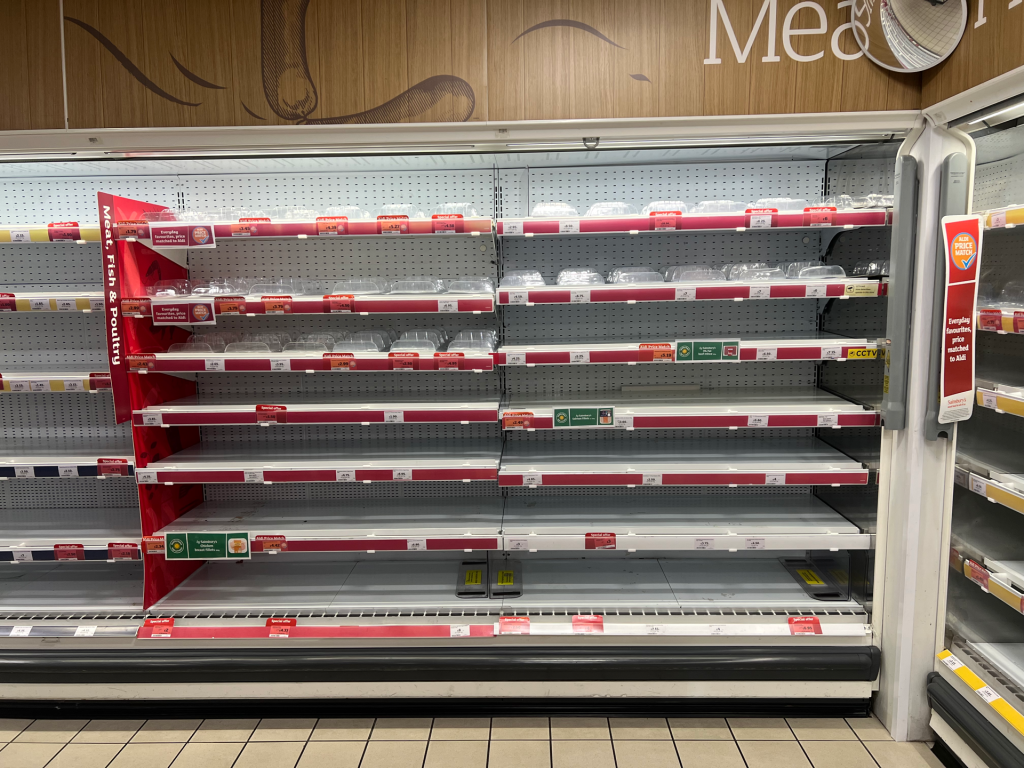
Britain’s version of this summer’s climate story is quieter than France’s, where wildfires around Bordeaux have driven hundreds of thousands of people from their homes this week. We’ll take a fridge that cannot hold its temperature, and a weekly shop with gaps in it, by comparison – but this is not an issue that is going away and will likely get worse.
Why does a whole bank of fridges go down at once? Because in most older supermarkets they are all plugged into the same cooling system. Rupert Ashby, chief executive of the British Frozen Food Federation, the industry’s trade body, says the stores that failed in this summer’s heat were generally the older ones, running on a remote compressor outside the building that controls a whole bank of units. If that one system goes down, every fridge and freezer attached to it goes down with it.
Those systems date back as much as 40 years, Ashby says, and were built to be efficient in a temperate climate. Britain in late July 2026, in a summer that has already produced three official heatwaves, is no longer that climate. Newer stores increasingly use individual plug-in units instead, so a failure takes out one cabinet rather than an aisle. One refrigeration manufacturer told trade magazine The Grocer that systems installed even 10 to 15 years ago were engineered for lower, more stable temperatures than the UK now gets.

The end of open fridges?
Part of the answer is the most mundane object in retail: a door. A closed door keeps cold air in. An open-fronted cabinet is left open so shoppers can grab products as they browse, and it relies instead on a curtain of chilled air, which is far more vulnerable to hot weather.
In 2021, Aldi and the Co-op became the only UK chains to commit to fitting doors on the chilled cabinets in all their new and refurbished stores. Aldi estimated the doors would cut a store’s electricity use by about 20 per cent. Tesco, Sainsbury’s, Morrisons, Waitrose and M&S all said at the time that they would use “air wall” technology on open displays instead. Five summers later, that choice was on display on Lower Richmond Road, in the form of shelves with nothing on them.
If summers keep arriving like this, the way we shop will change with them. Some of the change is visible already: doors on the chiller cabinets in Aldi and the Co-op, curtains pulled over Lidl’s fridges overnight. During north America’s record heat of 2021, stores went further, running sprinklers on their roofs and draping chilled aisles in plastic sheeting to keep the cold in. The open fridge you grab a pint from without breaking stride is a habit of a cooler climate, and it is on its way out.

The trade body has taken the problem to ministers. Ashby wrote to then Energy Secretary, Ed Miliband, proposing that the century-old minus 18°C standard for frozen food be raised by a few degrees, which the industry says would cut energy use and ease the strain on cooling systems in extreme heat, without compromising food safety. He has also said the government has become harder to reach on the issue: “The old food minister, Daniel Zeichner, would listen, but less so since.”
The underlying weakness is not new. Researchers documented one supermarket chain suffering refrigeration failures at 12 stores during the July 2022 heatwave, the summer the UK first passed 40°C. The same June heat this year that stopped the trains was quietly switching off supermarket fridges across the country. Four summers of warnings on, the hardware in most large stores is the same hardware.
Whether this store’s fridges hold through this week’s heat, and whether other stores in SW15 and Wandsworth fail during the amber alert, is something we will be watching. It joins the hosepipe ban as the second way this summer’s heat has reached into daily life in SW15, and it will not be the last. This is what the cost of climate change looks like on a Putney high street: not an abstract statistic, but an inability to buy milk, butter, cheese, chicken, bacon, sandwiches, sushi, cold drinks…





This is indeed concerning and a so far little noticed effect of the climate emergency.
Just a note: the refrigerated section in the LRR Sainsbury’s has been out for much longer than 3 days: two weeks, I think.