


Buying a house that backs onto a railway line is one of those decisions people agonise over. The noise, the vibration, the feeling of living on the edge of something industrial. But residents on the even-numbered side of Fawe Park Road have always had a secret: between their back garden fences and the nearest track, there is a huge strip of green space, dense with trees and scrub, alive with birds and insects, thick enough to muffle the sound of passing trains and rich enough to support the kind of wildlife most Londoners never see. Most have probably never thought much about why it is there.
The answer turns out to be remarkable. The green strip is the remains of a Victorian flying junction, built in 1889, whose track was ripped up more than 35 years ago. It already has formal nature conservation protection. And now Network Rail wants to turn it into a nature reserve.
The strip runs in a long curve from near East Putney station towards the main line at Putney, roughly 400 metres long and up to 50 metres wide at its broadest point. Laid out straight, it would stretch the length of four football pitches, tucked behind a residential street. It traces the route of a railway track that was ripped up more than 35 years ago. In those three and a half decades, nature has done what nature does when left alone. Secondary woodland has grown up on the old embankment. Dense scrub provides cover for nesting birds. The kind of undisturbed grassland margins that support invertebrates, slow-worms and hedgehogs have established themselves along the edges.
London’s disused railway corridors are some of the most ecologically valuable habitats in the city. The Zoological Society of London has deployed camera traps on Network Rail land in nearby Barnes, documenting the wildlife that thrives on railway margins. Foxes, badgers, bats and over 20 species of butterfly have been recorded on similar corridors elsewhere in the capital. The Fawe Park Road strip, left undisturbed for so long, will almost certainly hold the same kind of biodiversity, though no formal ecological survey has yet been carried out. That could change soon: the council’s borough-wide resurvey of designated wildlife sites is due to begin this year, and Network Rail’s own plans would likely require a survey of the land.
What makes this particular strip remarkable is that Wandsworth Council has already recognised its value. The corridor is designated a Borough Grade II Site of Importance for Nature Conservation, carried forward in the Local Plan adopted in July 2023. That designation gives the land formal planning protection. It means its wildlife value is officially acknowledged, even if most of the 381 residents on Fawe Park Road have no idea. The council’s Wild Wandsworth biodiversity plan, approved in February, commits to a full resurvey of all designated wildlife sites across the borough between 2026 and 2028. The Fawe Park Road corridor is one of them.
The designation was not uncontested. During the Local Plan examination in October 2022, a developer called Northport FPR Limited argued that the council had never physically inspected these railway sites and was applying a blanket approach. The inspector disagreed. The designation stands.

How it got here
The green strip exists because of a Victorian corporate rivalry. In 1889, the London and South Western Railway opened a connection between its main line at Point Pleasant Junction, near Wandsworth Town, and the new District Railway route to Wimbledon via East Putney. The engineers built a flying junction, with the eastbound track crossing over the main line on a viaduct. For a while, you could catch a train from Waterloo to Wimbledon this way, 12 services a day alongside the District’s own trains.
It did not last. Passenger numbers were poor from the start. The Southern Railway pulled the regular service on 4 May 1941 as a wartime economy measure. It was never reinstated. The route carried freight and empty trains for decades afterwards, but by the late 1980s the viaduct was in poor condition. Around 1987, engineers inspected the bridge and found it unfit for trains. The eastbound track was lifted and the viaduct deck demolished around 1990.

The brick piers of that viaduct are still standing. You can see them from Woodlands Bridge, the pedestrian footbridge near the western end of Fawe Park Road, with shrubs growing out of the brickwork. The curved strip of green behind the gardens is the old approach ramp, the route the track took as it climbed to cross the main line. British Rail sold the East Putney to Wimbledon line to London Underground for £1 in 1994, but the dismantled section was already out of use.
The connection itself is still there. South Western Railway runs around three empty trains through it every day, mostly before dawn, to keep drivers familiar with the route. If you have ever wondered about the ghost trains that pass through East Putney in the small hours, that is what they are.
How it has been done before
London has a rich history of turning abandoned railway land into nature reserves.
Gunnersbury Triangle, near Chiswick Park station, was the first site in a UK city where a public inquiry ruled in favour of nature conservation over commercial development. That was in 1983. Hounslow Council bought the land from British Rail and it is now managed by the London Wildlife Trust. Railway Fields in Haringey, barely a hectare in size, was declared a Local Nature Reserve in 1990 and now supports over 200 plant species and 21 species of butterfly. Parkland Walk, London’s longest Local Nature Reserve at 7.2 kilometres, follows a former railway through Haringey and Islington.
Perhaps the most instructive example is Garthorne Road in Lewisham, where the council manages a nature reserve on land it licences from Network Rail. The railway land remains in railway ownership, but functions as a community green space. This is essentially the model Network Rail is now proposing for Fawe Park Road.
If Network Rail’s plans go ahead, the next steps are well established. An ecological survey would confirm what is living there. A partnership with Wandsworth Council would provide the legal framework. Under the National Parks and Access to the Countryside Act 1949, the council can declare a Local Nature Reserve on any land in which it has a legal interest, after consulting Natural England. A community group, often a Friends of the site, typically forms alongside the process.
The policy environment supports exactly this kind of move. The London Plan identifies vegetated railway corridors as important urban habitats. Mandatory biodiversity net gain, in force since 2024, strengthens the case for preserving such sites. And Network Rail’s own biodiversity action plan commits to no net loss on its land, recognising its 53,000 hectares as a network of green corridors connecting fragmented habitats across the country.
Who actually owns the Fawe Park Road strip is a genuine question. The boundary between TfL’s land and Network Rail’s runs somewhere through the area where the connection diverges from the main line, but the exact division would need a Land Registry search to confirm.
What is clear is that Network Rail is already moving. Jack Wharton, the company’s Senior Public Affairs Manager for the Wessex Route, told the Wandsworth Passenger Transport Liaison Group this week that Network Rail was exploring the possibility of turning the land into a nature reserve site. There were a few hoops to go through internally, he said, but Network Rail planned to reach out to the council about a potential partnership in the coming months.
The wild green curve behind the garden fence is not neglected land waiting for something to happen to it. It is 137 years of railway history, 35 years of rewilding, a conservation designation that already exists, and now an infrastructure owner that wants to do something with it.

As a former trustee of Paradise Cooperative we engaged with Network Rail a few years back to look at this land as a potential community nature based project. We mapped all the potential access points, did an initial survey and looked at potential governance and partnership modeling. Covid stopped us in our tracks. Projects like these require lots of time to deliver. First you need to develop a shared vision with all the stakeholders and then the requisite due diligence. This required funding and devolving powers to communities. The recently published Wandsworth Diversity Plan is ambitious and welcomed and should be a catalyst for this project.
Taking on projects like this requires a clear understanding of what working in partnership means.
This would be a fantastic opportunity to build a long term sustainable partnership based on mutuality, trust and the common good.
Who was access intended for? A community nature project sounds good, but not all wildlife lives happily with human intrusion into its habitat. Would access be only for members of a local community engaged in wild habitat improvement , rather than the public having access for their dog walking?
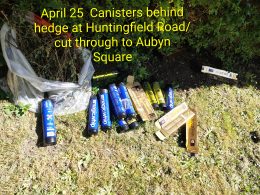
What a fascinating article, and interesting to read the thought-provoking comment above. As someone who always looks at the wildlife beyond the railings at railway stations while waiting for trains, I had already thought of adopting the one at West Brompton, but it looks as if things are under way there now. If only people would stop viewing these precious wildlife corridors as rubbish bins for their crisp packets and empty vapes.