Residents across Putney are reporting a growing problem with discarded nitrous oxide canisters in their streets and parks, and say nothing is being done about it.
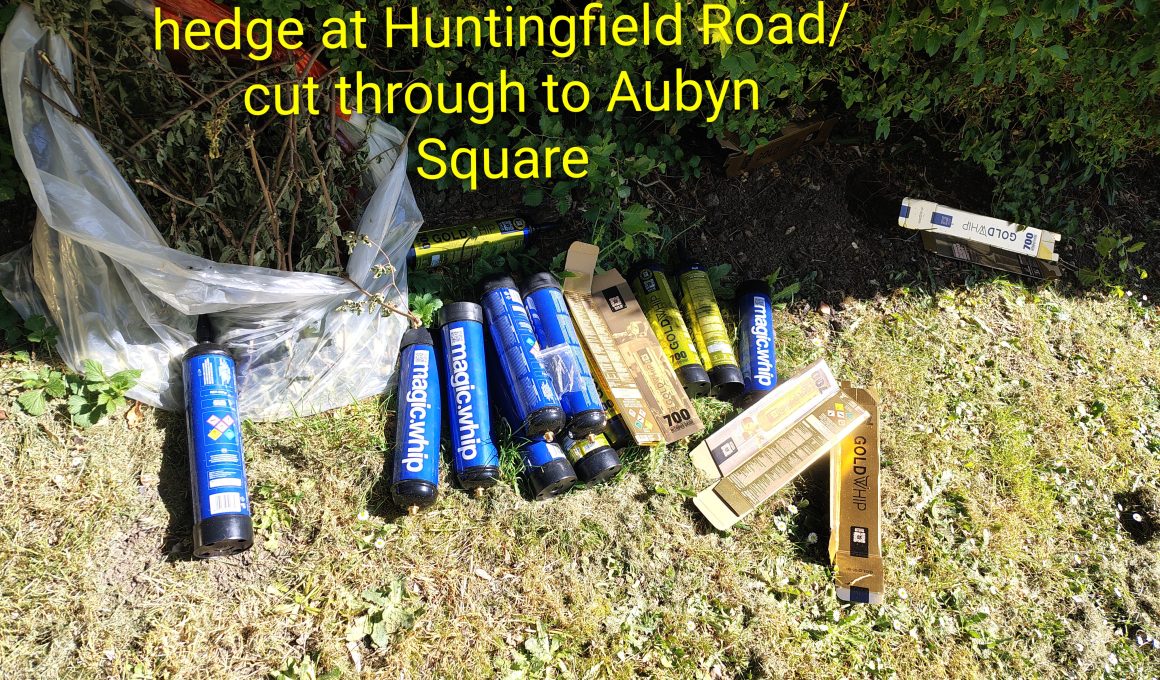
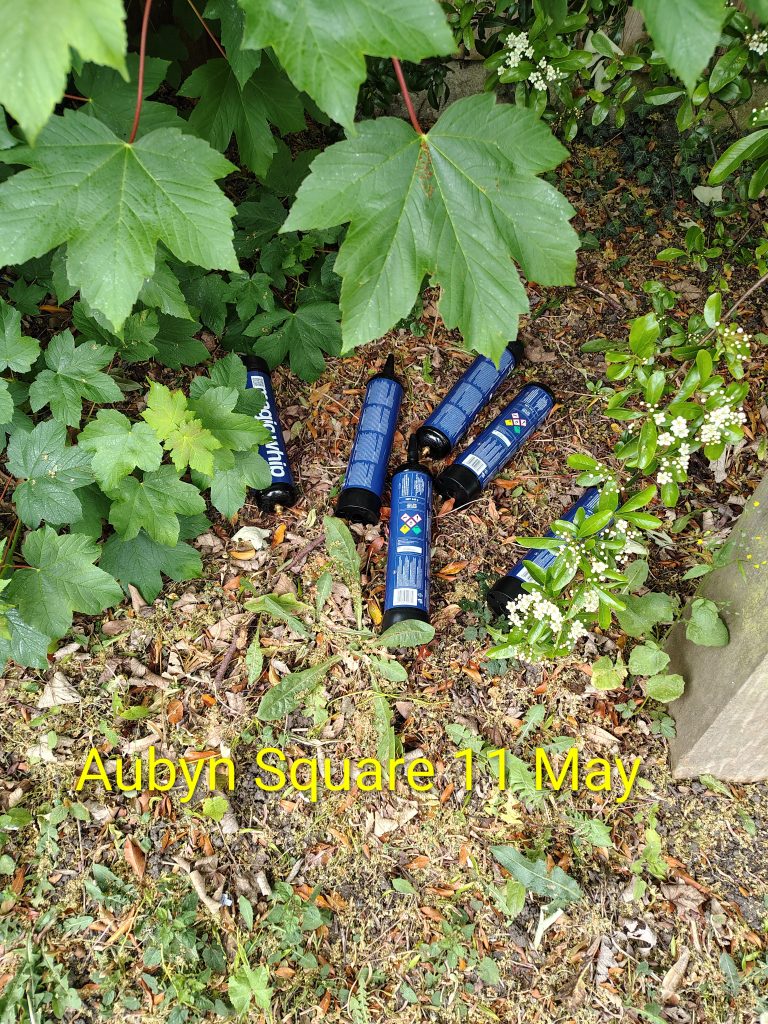
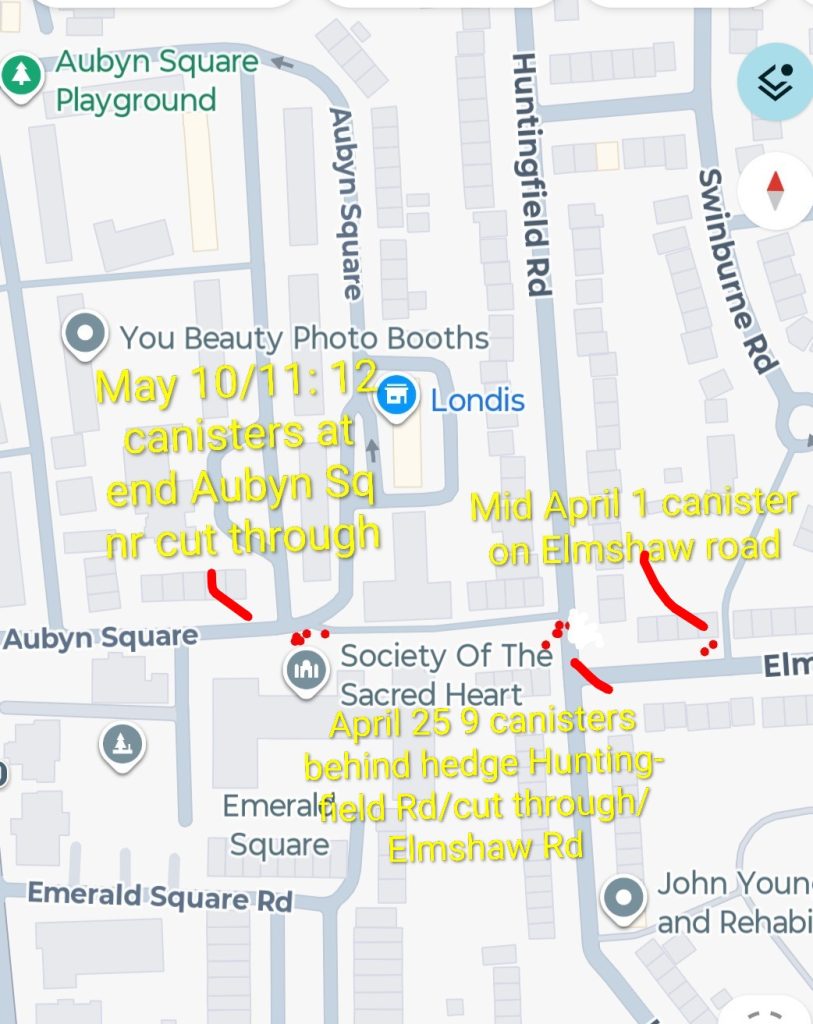
The evidence is mounting. One West Putney resident has photographed three separate dumps within yards of Aubyn Square Playground in the past four weeks: a single canister in mid-April, nine large branded cylinders behind a hedge on 25 April, and twelve more at the end of her street last Sunday morning.
That comes in addition to a number of reports of large canisters and balloons on Putney Lower Common in recent months. The Metropolitan Police’s own evidence to a licensing hearing in April cited “intimidating groups outside engaging in nitrous oxide use and suspected drug activity” beside the Angel pub in Roehampton.
The council was already told this was happening. In a public consultation last summer, over 70% of those who responded said they had encountered drug-paraphernalia litter in Wandsworth’s public spaces. It was the single most-reported behaviour of any kind in the consultation, ahead of street drinking and public drug use.
There is a ban in place and in force but only 16% of respondents thought the existing order has worked. A residents’ association on Putney Vale Estate told the council in writing that the order “had little to no impact” on their estate. The council renewed the order anyway, for another three years.
In the two-and-a-half years since the order has been in force, neither Wandsworth Council nor the Metropolitan Police has issued a single warning or fine for nitrous oxide possession or street drinking. Over the same period, the council issued 731 verbal warnings and 61 fixed penalty notices for dog-control breaches.
The law treats this seriously
Since 8 November 2023, nitrous oxide has been a Class C controlled drug under the Misuse of Drugs Act. Possession is punishable by up to two years in prison. Supply carries up to 14 years. Wandsworth’s borough-wide Public Space Protection Order, renewed by full council last October, adds a £100 on-the-spot fine for possession in any public place. A prosecution carries a £1,000 fine on conviction. None of these powers has been used in Wandsworth, not once, in two-and-a-half years.
Bar chart comparing enforcement under Wandsworth Council’s Public Space Protection Order across three categories over two-and-a-half years. Alcohol-related anti-social behaviour: zero warnings, zero fines. Drug possession including nitrous oxide: zero warnings, zero fines. Dog control: 731 warnings, 61 fines.
Resident photographs document the pattern in detail on a single residential street.
A canister appeared on Elmshaw Road in mid-April. Nine large branded cylinders were dumped behind a hedge at the Huntingfield Road cut-through on 25 April. Twelve more appeared at the end of Aubyn Square last Sunday morning. All three sites are within yards of Aubyn Square Playground. The pattern is escalating.
The canisters are commercial cylinders branded Magic Whip and GoldWhip. They carry QR-coded anti-counterfeit labels and chemical hazard pictograms. Each holds either 580 or 700 grammes of nitrous oxide, the equivalent of 70 to 80 of the small kitchen cream chargers the format imitates. Each sells online for tens of pounds.
The council’s argument
The Cabinet report that went to councillors before they voted to renew the order in October acknowledged the zero-enforcement figure directly. There had been “no warnings or Fixed Penalty Notices issued for Alcohol related ASB in a public place or for use/possession of novel psychoactive substances in a public place” since the order had been in place.
The justification, at paragraph 3.18 of the report, was that an order of this kind has a “deterrent effect” that cannot be measured by fines alone. The argument is that people comply when challenged by officers, even when no penalty is issued.
That argument is defensible in principle. It is harder to hold up against three documented dumps in four weeks on one Roehampton street, balloons and cylinders on Putney Lower Common, and the Met’s own observation of nitrous oxide use as the reason it wanted a pub closed. Putney.news reported in October on the contrast with the same period’s dog-control enforcement.
What the police told the council
The Metropolitan Police’s response to the consultation was one sentence long. The Met “made no observations other than to note that, if the proposals are approved, effective implementation will depend on the capacity to carry out enforcement activity.”
The renewal decision does not say where that capacity is coming from. Council officers issue fixed penalty notices for breaches of the order. Police involvement comes through the borough’s safer neighbourhood teams. Neither has issued one in two-and-a-half years.
The Mayor’s Office for Policing and Crime, which holds the Met to account in London, did not reply to the consultation at all.
The drug and its disposal
Magic Whip and GoldWhip are not products designed for inhalation. They are sold for catering use, to whip cream, and their packaging carries chemical hazard pictograms warning against misuse. Sale to under-18s is unlawful and most online sellers carry explicit notices on the Class C status, but the products are widely and cheaply available.
The health risks rise sharply with the cylinder format. Frequent use of nitrous oxide can cause numbness, weakness in the legs, nerve damage, and in severe cases paralysis. The British Medical Association has linked sustained use to spinal cord injury in young adults. The user group, according to the council’s own equality impact assessment, is “typically males under the age of 25.”
The cylinders are pressurised. They are not designed for household bins. When they reach a waste plant they can explode. A BBC investigation in 2024 documented more than two thousand explosions at a single Veolia recycling site, traced to nitrous oxide canisters in the general rubbish stream.
Residents who find canisters can report them on 020 8871 6000. Open drug use can be reported to the Metropolitan Police on 101, or via the Roehampton or Putney Heath safer neighbourhood teams. The safe disposal route is Smugglers Way Recycling Centre, SW18 1JS, not the brown bin.
What Roehampton’s councillors will do next
The political backdrop is that Wandsworth held council elections eight days ago. Three Labour councillors were elected in Roehampton, the ward where Aubyn Square sits: Graeme Henderson, Matthew Tiller and Jenny Yates.
Henderson was also the council’s Cabinet Member for Health and Community Safety. The order’s renewal was his portfolio. The Met’s case for closing the Angel pub, two minutes’ walk from Aubyn Square, named nitrous oxide as one reason. The same drug, the same ward, the same enforcement gap.
Residents who want to raise the matter directly can contact Cllr Henderson (cllr.g.henderson@wandsworth.gov.uk), Cllr Tiller (cllr.m.tiller@wandsworth.gov.uk) or Cllr Yates (cllr.j.yates@wandsworth.gov.uk).
The order runs until October 2028. A 12-month review is due in November. The council could change the enforcement record in those six months. On its own track record, there is no particular reason to expect it will.
Sources: Wandsworth Council Cabinet Report 25-324 (22 September 2025) and appendices, Full Council minutes 22 October 2025, Wandsworth Borough-Wide PSPO 2023 (as varied and extended 2025), Misuse of Drugs Act 1971 (as amended November 2023). Resident interview and photographs. Putney.news observation.