Putney MP Fleur Anderson has told constituents that “key funding decisions” on Hammersmith Bridge are “expected in the coming weeks”, despite the government-led taskforce responsible for the bridge not meeting for 13 months.
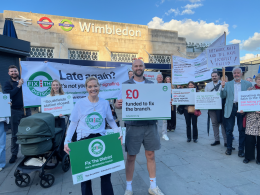
In an email sent yesterday following a protest event on 24 January, Anderson said there was “real momentum now” and shared a letter from Deputy Mayor for Transport Seb Dance stating the taskforce would be “reconvened imminently”. But the taskforce has not met since 30 January 2025, and no meeting date has been announced publicly.
The bridge has been closed to motor vehicles for nearly seven years, with repair costs estimated at £250 million and no funding agreement in place.
What the Deputy Mayor said, and when
The letter Anderson shared with constituents was written by Seb Dance, Deputy Mayor for Transport, on 22 January 2026, two days before the protest event. Dance wrote: “I have been advised that the Taskforce will be reconvened imminently and look forward to receiving an update on the funding situation at that time.”
That was 11 days ago. The taskforce website, last updated in February 2025, shows no scheduled meetings. The Department for Transport has made no public announcement about reconvening the group. No meeting agenda or date has been published.
Anderson’s email today stated: “There is real momentum now, and your presence at the event has helped to strengthen our campaign, with key funding decisions expected in the coming weeks.”
The optimism of “real momentum” is difficult to reconcile with the taskforce’s track record. Since its formation in September 2020, the group has met 17 times across five years. It paused for 38 months between November 2021 and January 2025. It has now been silent for 13 months since reconvening.
Sarah Olney, Liberal Democrat MP for Richmond Park, said at the protest event on 24 January that she has received “five versions of essentially the same letter over six months, each promising action without delivering it”. Dance’s letter to Anderson appears to follow this pattern: reassurances about the taskforce reconvening “imminently”, with no date provided and no meeting scheduled 11 days later.
The January 2025 meeting: three options, no follow-up
At the 30 January meeting last year, the taskforce reviewed six potential solutions for the bridge. Three were immediately ruled out: preserving it as an unopened monument, demolishing it entirely, or building a replacement bridge offline.
The three remaining options are a Foster-Cowi designed “double-decker” bridge with a new road deck above the current pedestrian level, reopening for active travel plus limited single-decker buses, or reopening for pedestrians and cyclists only.
Minutes from the meeting [pdf], obtained through Freedom of Information requests, show taskforce members acknowledged that permanently banning cars “could mean lower restoration costs and bring environmental benefits”, though they recognised this “may be a cost in terms of possible congestion in the surrounding areas and impact on bus routes”.
The taskforce agreed to explore these three options in detail. Officials were tasked with developing plans. A follow-up meeting would be scheduled “once officials develop detailed plans”.
Thirteen months later, no meeting has been announced. No timeline has been provided. No progress update has been published. Dance’s claim 11 days ago that the taskforce would reconvene “imminently” has not materialised. Anderson’s claim today of funding decisions “in the coming weeks” provides no specific date or source.
All stakeholders Labour-controlled, yet no meeting date
All parties involved in the taskforce are now controlled by Labour following the party’s general election victory in July 2024. Minister Simon Lightwood chairs the taskforce for the Department for Transport. Stephen Cowan leads Hammersmith and Fulham Council. Simon Hogg leads Wandsworth Council, which joined the taskforce in January 2025. Mayor Sadiq Khan oversees Transport for London and the Greater London Authority.
This removes the political blame-shifting that characterised the taskforce under Conservative government. Yet 13 months after reconvening under unified Labour control, the taskforce has not met again despite Dance’s assurance it would reconvene “imminently” and Anderson’s claim today of “real momentum”.
A three-year-old business case, still unapproved
Hammersmith and Fulham Council submitted a formal business case to the Department for Transport in December 2022, proposing how the bridge could be fully repaired and how costs could be split between the council, Transport for London, and central government.
The council has never received a formal response approving or rejecting the proposal. The business case was dropped from meeting agendas in 2023 and 2024. Its status remains unclear more than three years after submission.
Under a funding framework proposed in 2021, the repair bill would be split three ways. The Department for Transport would pay a third, Transport for London a third, and Hammersmith and Fulham Council a third. However, the council has said it can only raise its share through a road user charge or toll, measures that would require government approval.
The council has already spent £48 million on the bridge over six years, covering 85% of all costs to date. The Department for Transport has provided £13 million, and Transport for London £2.9 million.
“Talking shop” warnings proved accurate
When the taskforce was formed in September 2020, politicians across parties warned against it becoming ineffective. Their predictions have proved accurate.
“We must avoid an empty talking shop,” Stephen Cowan, leader of Hammersmith and Fulham Council, said at the taskforce’s launch. By June 2021, he was describing the “contempt this Government, and its absurdly named Taskforce, has” for residents.
Fleur Anderson herself called it “little task and no force” in April 2021. Three years later, she estimated the bridge will not reopen until 2035, a decade away. Andy Slaughter, Labour MP for Hammersmith, said in March 2021 there was “too much rather than too little chat”. Sarah Olney, Liberal Democrat MP for Richmond Park, described the taskforce as “painstakingly ineffective” the same month.
Even Mayor Sadiq Khan’s spokesman said in September 2020 that “Londoners need the Government to pay…they do not need another talking shop”.
The taskforce met 10 times between September and December 2020, then seven times between January and November 2021. It then paused for 38 months. It reconvened once in January 2025. It has now been silent for 13 months. In total, the taskforce has met 17 times across five years.
What happened to August’s “working to arrange next meeting”?
In August 2025, Anderson told constituents she was “working to arrange the next Hammersmith Bridge Taskforce meeting”. Six months later, no date has been announced. Her email today refers to Dance’s letter about the taskforce reconvening “imminently”, but provides no explanation for why this has not happened in the 11 days since Dance wrote that letter.
The taskforce website, last updated in February 2025, states its commitment to “transparency and regular communication with residents and stakeholders about the bridge’s future”. The 13-month silence contradicts this promise.
The wider funding picture
The Labour government announced a £1 billion Structures Fund in June 2025. Transport Secretary Heidi Alexander confirmed it “could be used to help reopen Hammersmith Bridge”. However, no specific allocation has been made, and the criteria for accessing the fund remain undefined.
Dance’s letter to Anderson stated: “I have made direct representations to the Secretary of State about the imperative for London to have access to the Structures Fund to support the repair of ageing assets like Hammersmith Bridge. I and TfL will continue to make the case to government about the need to confirm a solution for the bridge as soon as possible.”
The letter provides no indication that access to the Structures Fund has been secured or that any specific funding decision is imminent. Anderson’s claim today that “key funding decisions” are “expected in the coming weeks” goes beyond what Dance’s letter states.
The taskforce has no statutory powers, no legal authority, and no budget allocation powers. Its participation is voluntary, as demonstrated by the 38-month pause when no meetings were held. Legal responsibility for the bridge remains with Hammersmith and Fulham Council under Section 41(1) of the Highways Act 1980.
How residents can take action
Residents affected by the bridge closure can contact their representatives directly to demand clarity on when the taskforce will meet:
Minister Simon Lightwood MP (Taskforce Chair)
Department for Transport, Great Minster House, 33 Horseferry Road, London SW1P 4DR
Email: simon.lightwood.mp@parliament.uk
Fleur Anderson MP (Putney)
Email: fleur.anderson.mp@parliament.uk
Phone: 020 8780 4490
Cllr Simon Hogg (Leader, Wandsworth Council)
Email: cllr.s.hogg@wandsworth.gov.uk
Cllr Stephen Cowan (Leader, Hammersmith & Fulham Council)
Email: stephen.cowan@lbhf.gov.uk
Seb Dance (Deputy Mayor for Transport)
Greater London Authority, City Hall, Kamal Chunchie Way, London E16 1ZE
Email: seb.dance@london.gov.uk
Mayor Sadiq Khan (Greater London Authority)
Email: mayor@london.gov.uk
Residents can also request information about taskforce activities through Freedom of Information requests to the Department for Transport. The government is legally required to respond within 20 working days.
A template FOI request: “Please provide all minutes, agendas, and correspondence relating to Hammersmith Bridge Taskforce meetings scheduled or held since 30 January 2025, including any dates proposed for reconvening the taskforce and updates on the three repair options discussed at that meeting.”
Send FOI requests to: foi.request@dft.gov.uk
For guidance on writing effective FOI requests, see the Information Commissioner’s Office guidance at: https://ico.org.uk/your-data-matters/official-information/
Background
The Hammersmith Bridge Taskforce was established on 9 September 2020 by then-Transport Secretary Grant Shapps. The bridge had been closed to motor vehicles since April 2019 following the discovery of cracks in its cast iron pedestals.
The taskforce initially met weekly, then shifted to meetings every six to eight weeks. Its last meeting under Conservative government was on 25 November 2021. It was paused with no meetings for 38 months.
The taskforce reconvened under Labour government on 30 January 2025, with Wandsworth Council joining for the first time. The meeting lasted 90 minutes. No further meetings have been scheduled.
The bridge remains open to pedestrians and cyclists. Work to resurface the central carriageway, allowing cyclists to ride rather than dismount, is expected to complete in spring 2025.
The bridge’s closure affects bus routes connecting Barnes, Mortlake, and East Sheen to Hammersmith, with passengers facing diversions via Putney Bridge that can add up to an hour to journeys.
Wandsworth Council’s investigation found that motor vehicle traffic on Putney Bridge increased by 16% between 2020 and 2023, rising from 32,083 to 37,239 vehicles daily. The council attributes much of this increase to Hammersmith Bridge’s closure pushing traffic onto alternative routes.
The bridge was built in 1887 and is Grade II-listed. It closed to vehicles in April 2019 after safety assessments revealed micro fractures in critical structural elements. Pedestrians and cyclists were also barred in 2020 due to cracking in the cast iron pedestals during a heatwave, with engineers warning of potential “catastrophic” failure. The bridge reopened to pedestrians, cyclists, and river traffic in July 2021 after stabilisation works.
The estimated timeline for a full repair programme, if approved and funded, is 10 years. Anderson’s estimate of 2035 for vehicle reopening appears realistic given the lack of funding agreement and the 13-month taskforce silence since its last meeting.