


Putney MP Fleur Anderson and Wandsworth Council leader Simon Hogg are mobilising residents for a public action on 24 January, six days before the Hammersmith Bridge Taskforce reconvenes for its annual closed-door meeting that looks set to produce the same result as the last one: warm words, no decisions, no funding, no timeline.
The bridge has been closed for six years. Traffic through Wandsworth has increased 25 per cent during morning peak hours. Transport for London is removing bus route 424 from Putney High Street entirely because congestion has made the service unreliable. Residents sit in gridlock daily while their council leader and MP organise photo opportunities and attend Christmas parties at Number 10.
The pattern is established. January brings a taskforce meeting where options are discussed, concerns are noted, and representatives agree to “work together” on solutions. A year passes. Nothing happens. January comes around again. Another meeting is scheduled. Residents are mobilised for another public action to demand the progress that was promised at the last public action.
Meanwhile, people trying to get to work, school, and medical appointments sit in traffic that has worsened every single year since 2019.
What the council claims it has done

Following last year’s meeting, Wandsworth Council published a press release titled “Urgent action needed on Hammersmith Bridge, say Wandsworth residents.” The headline was accurate. The content that followed was not.
“We stand firmly with our residents,” Hogg declared, before listing achievements that amount to rearranging deck chairs: part-funding a shuttle bus to Roehampton (which closed in July having cost £200,000), successfully campaigning for one additional bus on the 85 route and two on the 170.
One bus. Two buses. This is the sum total of concrete action after a year of having “a stakeholder seat” at the taskforce that the council “successfully campaigned” to obtain.
The same press release promises “increased transparency and urgency in the Hammersmith Bridge Taskforce.” The taskforce meetings remain closed. Freedom of Information requests for detailed notes are refused under Section 35 exemptions. Urgency is measured in annual intervals between meetings that produce no decisions.
The council has “collated its own data” showing traffic increases of 16 per cent overall and 25 per cent during morning peaks. Excellent. What did they do with this evidence? They used it to write more press releases calling for other people to act.
What they could have done but didn’t

Wandsworth Council has legal tools it chooses not to use.
Under Section 14 of the Road Traffic Regulation Act 1984, the council can impose Emergency Traffic Orders within 5 to 21 days, requiring no permission from Transport for London. It could implement trial restrictions on Putney or Wandsworth Bridge to demonstrate impact and build evidence for permanent solutions.
It could seek judicial review of a year of taskforce inaction, forcing either concrete progress or transparent explanation of why promises made in January 2025 were not delivered. Cost: £10,000 to £20,000, a rounding error in council legal budgets.
It could coordinate with Richmond and Hammersmith & Fulham councils and affected residents for joint legal action, creating genuine cross-borough pressure instead of individual council leaders making separate appeals that are safely ignored.
It could publicly threaten to petition for withholding Transport for London’s portion of council tax precepts until concrete bridge progress is demonstrated, a move requiring coordination but creating real political leverage.
Instead, the strategy is to request meetings, publish press releases about those meetings, organise public actions before those meetings, attend those meetings, achieve nothing at those meetings, wait a year, and repeat.
The diplomatic offensive

Anderson’s claim to have raised the closure with the Prime Minister refers to a 17 December Christmas reception at 10 Downing Street. Her social media post described “mulled wine, carols, prayers” and included a photo outside Number 10.
Six years of bridge closure, mounting traffic chaos affecting hundreds of thousands of residents across multiple boroughs, and the level of engagement secured from the highest levels of government is a chat at a Christmas party.
The ministerial letter Anderson received promising that a taskforce meeting “will be held” is notable mainly for what it does not promise: a date, a decision, funding, or any concrete deliverable beyond the meeting itself.
What last year’s meeting promised
Freedom of Information documents reveal what the January 2025 taskforce actually agreed to do.
Transport for London was tasked with coordinating “different traffic data presented by stakeholders around Hammersmith Bridge and the surrounding areas, into a single agreed representation.” There is currently no evidence this coordination has been completed.
Taskforce representatives were supposed to “work together to further develop options” for active travel configurations as alternatives to full restoration. There has been no announcement or indication that this development has been completed.
These were the prerequisites for informed decision-making at “the next meeting.” That next meeting, now scheduled for 30 January 2026, will apparently proceed without any sign of the foundational work that was supposed to enable meaningful decisions.
The wider context they ignore
The bridge closure is not Wandsworth Council’s responsibility to fix. The engineering challenges and funding requirements are substantial and genuinely complicated. Nobody disputes this.
What is within the council’s control is how aggressively it uses its political and legal leverage to force progress, how transparently it operates, and whether it deploys the tools available to local authorities facing sustained institutional failure from higher levels of government.
By these measures, the council’s performance is inadequate. It has a seat at the taskforce but no apparent strategy beyond attendance. It has evidence of traffic impacts but no concrete plan beyond citing that evidence in press releases. It has legal powers to implement emergency measures but prefers to wait for others to act.
Meanwhile, Transport for London is making operational decisions based on Wandsworth’s traffic chaos. The 424 bus is being removed from Putney High Street because congestion has made reliable service impossible. This is TfL’s solution to the problem that Hogg and Anderson cannot solve: withdraw the service.
Transport for London is also making the bridge closure permanent in its planning. A consultation on Barnes bus services states that “as it is unlikely that the bridge will reopen in the near future,” TfL wants to “formalise arrangements” by making temporary routes introduced in 2019 permanent fixtures of the network.
While Anderson and Hogg mobilise residents to demand the bridge reopen, the transport authority responsible for London’s buses is planning on the assumption it will not.
Residents lose direct bus connections. Hogg issues another press release expressing concern. Anderson organises another photo opportunity. The taskforce schedules another meeting. The bridge remains closed.
What success would require
The 24 January public action and 30 January taskforce meeting will succeed if they produce concrete, enforceable commitments with specific deadlines and identified funding sources.
Success means publishing the traffic data coordination that was promised a year ago. It means completing the options development that was meant to inform decisions. It means a cost comparison of remaining viable options with transparent funding allocation.
Most critically, it means a timeline with actual dates, not references to future meetings. It means interim measures deployed while permanent solutions are developed. It means accountability mechanisms that create consequences for further delay.
Without these deliverables, the January cycle becomes what it has been for six years: political theatre performed annually for residents who deserve solutions, not performances.
The council can stand firmly with residents, as Hogg promises, or it can stand in yet another photo opportunity achieving nothing while traffic worsens and services are withdrawn. It cannot do both.
The photo opportunity schedule
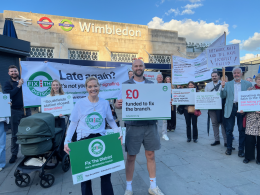
The public action takes place at 2pm on 24 January at the Barnes side of Hammersmith Bridge, though the Eventbrite listing instructs attendees to “arrive promptly at 12pm for a big photo” before noting the event runs 2pm to 3pm.
Free tickets are available through Eventbrite, using the same system that previously showed events as “sold out” while seats remained empty.
The taskforce meets on 30 January, behind closed doors, where it will discuss options, note concerns, and agree to work together on solutions to be developed before the next meeting.
And then a year will pass.

What is the evidence for the claim that “Traffic through Wandsworth has increased 25 per cent during morning peak hours” ?
Good question – you should ask Simon Hogg / Fleur Anderson at their photo-op later this month. Actually, we should FOI it. Thanks Richard