

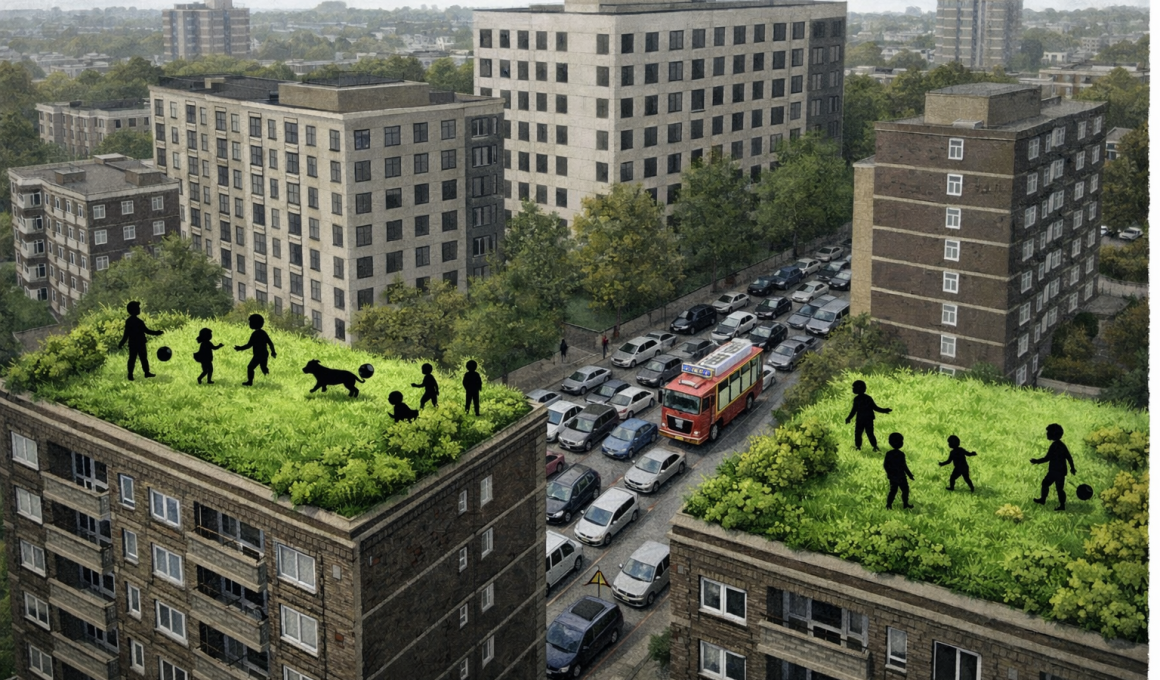
A Roehampton housing development will destroy more than half its grassland habitat, replacing it with green roofs and rain gardens that residents cannot access, according to planning documents analysed by Putney.news.
The Lennox Estate scheme claims a 20 per cent “biodiversity net gain” overall by counting all habitat types together. But the official DEFRA metric reveals that ground-level grassland will shrink from 0.63 hectares to 0.29 hectares, a 54 per cent reduction. The new accessible green space created amounts to just 0.036 hectares, roughly the size of a tennis court.
Wandsworth Council, which is both the developer and decision-maker on the 81-home application, argues the technical calculation shows net environmental benefit. The scheme proposes new trees, biodiverse green roofs on the new 14-storey tower, meadow planting, and rain gardens to achieve compliance.
The council’s own heritage advisors have already recommended refusal of the tower on other grounds.
The numbers don’t add up
The DEFRA Biodiversity Metric 4.0 calculator, submitted as part of the planning application, shows the following changes:
| Habitat type | Before | After |
|---|---|---|
| Modified grassland | 0.63 ha | 0.29 ha |
| Biodiverse green roof | 0 ha | 0.047 ha |
| Rain gardens | 0 ha | 0.047 ha |
| Urban trees | 0.65 ha | 0.54 ha |
The calculations show an overall gain of 20.43 per cent in habitat units and the “trading rules” are marked as “satisfied” in the spreadsheet. But this headline figure obscures what is actually happening on the ground, and in at least one key area the development fails to meet legal requirements at all.
Beverley Brook: the failure they can’t hide
Running along the western edge of the site is Beverley Brook, a small stream that feeds into the Thames. The council’s own ecological consultants assessed it as being in “Fairly Poor” condition, with eroded banks, silted-up channels, and concrete reinforcement degrading the habitat.
Under the Environment Act 2021, developments must achieve at least a 10 per cent improvement in biodiversity for every type of habitat, not just an overall average. For watercourses like Beverley Brook, the Lennox Estate scheme achieves precisely zero improvement. The brook will simply be left as it is.
This means the application fails to meet mandatory legal requirements. The consultants acknowledge this in their report, noting a “deficit” that “should be conditioned as part of the planning permission”. In plain English: they know they haven’t met the legal standard, they have no concrete plan to fix it, and they’re asking the council to approve it anyway on the promise that someone will sort it out later.
The irony is that improving the brook would have been one way to genuinely boost biodiversity on the site. Instead, the developers chose to do nothing to the watercourse while claiming overall environmental benefit through green roofs that residents will never set foot on.
Surveys that found reasons not to look
The ecological assessment raises further questions about how thoroughly wildlife impacts were investigated.
Four species of bat were recorded flying across the site during surveys, and one tree marked for retention contains features that could house a bat roost. Another tree that had two potential roost features was removed before the application was submitted, attributed to “health and safety reasons”. Yet the consultants conducted only a single bat survey of the building to be demolished, when industry guidelines typically recommend two or three surveys for demolition projects.
Stag beetles, a species protected under European law, have been recorded on the Lennox Estate itself. The consultants acknowledge that the banks of Beverley Brook “could support some deadwood” habitat for them, but note it is “overgrown and difficult to access”. No survey was conducted. The species was simply dismissed from further consideration.
Similarly, great crested newts have been recorded just over a kilometre away, within their typical range, and Beverley Brook could serve as a corridor for them. But because no ponds exist within 250 metres of the site, no newt survey was carried out.
The pattern is consistent: where access was difficult or results might complicate the application, the consultants found reasons not to look too closely.
How biodiversity trading works
Biodiversity Net Gain became mandatory for major developments in February 2024, requiring at least a 10 per cent improvement in habitat value. The system uses a points-based calculation that assigns different values to different habitat types based on their ecological importance and condition.
Modified grassland, the type found on the Lennox Estate, is classified as “low distinctiveness” in the metric. This means it can be “traded” for other habitat types of equal or higher value. The development does this by creating biodiverse green roof on top of the 14-storey tower, rain gardens as sustainable drainage features, small ponds, and replacement trees, though overall tree coverage actually decreases slightly from 0.65 to 0.54 hectares.
Seven trees will be removed in total, including the one with bat roost potential that was cut down before the application was submitted.
What residents actually lose
The technical compliance masks a significant change in how residents will experience the estate. The current grassland, however “ecologically ordinary” the metric considers it, is accessible recreational space. Children can play on it. Residents can sit on it. Dogs can run on it.
A green roof on the 14th floor of a tower block is not a substitute for that experience, however many biodiversity points it scores.
The Ecology Partnership, the applicant’s consultants, acknowledges in their assessment that “the site was dominated by hardstanding and modified grassland which have limited ecological value”. But “limited ecological value” to a biodiversity calculator is not the same as “limited value to residents”.
The estate has a long history of residents fighting to protect its green spaces from development.
Design panel noted the trade-off
The council’s own Design Review Panel, in their Stage 3 assessment in October 2025, acknowledged the tension: “Panel recognise the trade-off between loss of open space, wider townscape impacts and the delivery of new homes.”
The panel noted the development achieves 20 per cent biodiversity net gain and was “impressed” with the landscape proposals. But the trade-off language confirms that something is being lost, even if the metric says otherwise.
The wider picture
The Lennox Estate case illustrates a recurring tension in the biodiversity net gain system. The metric was designed to ensure development leaves nature better off than it found it. But critics argue it can be gamed, replacing accessible, if unremarkable, green space with features that score well on paper but deliver less for people who actually live there.
When a development can claim 20 per cent biodiversity gain while losing half its grassland, doing nothing to improve a degraded stream, and conducting minimal surveys for protected species, it raises questions about whether the system is working as intended.
Have your say: Do you use the green spaces on Lennox Estate? What would losing them mean for you? Contact Putney.news and tell us.




Vast swaths of the public in London and the UK are far more intelligent and switched on, than many politicians! Which is why you get crazy ideas like this.