


London has been named the world’s slowest capital city for the third year running, with Putney at the centre of a bus network that one operator says is performing at its worst level in 40 years.
The TomTom Traffic Index, released this week, found that a typical six-mile journey in London now takes 35 minutes at an average speed of just over 10mph. Only Barranquilla in Colombia was slower among the 500 cities surveyed worldwide.
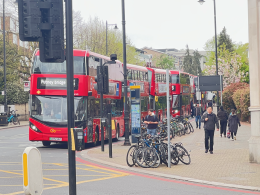
For Putney residents, the data confirms what daily commuters already know. The Route 14, which starts at Putney Heath and travels through Putney High Street to central London, is now the slowest bus in the entire TfL network, averaging just 5.7mph in 2025. That is down from 6.9mph in 2020, when empty pandemic streets allowed buses to move freely.
The 14 is not alone. Three of the five most complained-about bus routes in London serve Putney: the 14 itself, the 265 between Putney Bridge and Tolworth (previously labelled a “ghost bus” for its tendency not to show up), and the 93 running from Putney Bridge Station to North Cheam.
Slowest in 40 years
The London Assembly’s Transport Committee heard evidence in December that conditions are the worst in four decades. Paul Lynch, managing director of Stagecoach London, told the committee that “endless traffic” is driving passengers away.
The numbers support this. Average bus speeds across London have fallen from 10.27mph in 2020/21 to 9.17mph in 2024/25. Passenger numbers dropped for the first time since the pandemic last year, from 1.87 billion journeys to 1.84 billion.
TfL’s own analysis shows that every one per cent drop in journey times leads to a 0.6 per cent fall in passenger numbers. London TravelWatch estimates that if buses increased their average speed by just 1mph, it could save £200 million annually and generate £85 million in additional fare revenue.
Putney’s compounding problems
The TomTom findings arrive as Putney faces an escalating transport crisis. TfL is already consulting on changes to the 424 bus route that would remove direct service through Putney High Street, explicitly citing “reliability issues due to congestion.”
That decision directly contradicts Wandsworth Council’s claim that buses are running “slightly faster” since the controversial Putney Bridge junction redesign, which nine out of ten residents said had made things worse.
A Putney.news survey of 763 residents found 92 per cent of bus users reported worse journeys since the junction changes. Our investigation into the causes identified eight overlapping failures, from signal timing errors to bus driver changeovers blocking traffic for up to 27 minutes at a time.
Why London is slow but not most congested
TomTom’s data reveals a counterintuitive finding: London ranks only 150th globally for congestion, yet remains the slowest capital. The difference matters.
Congestion measures how much slower traffic moves compared to free-flowing conditions. Speed measures absolute journey times regardless of conditions.
London is slow even when traffic flows freely because of what TomTom calls “static factors”: widespread 20mph zones, Victorian street layouts, and infrastructure that was never designed for modern traffic volumes. Congestion then adds delay on top of an already constrained baseline.
Andy Marchant, TomTom’s traffic expert, said average speeds are “heavily shaped by static factors such as the widespread 20mph limits, street design that doesn’t match today’s needs, and consistently high traffic volumes, which means journeys can be slow even when roads are flowing.”
For Putney, this means the junction redesign added new constraints onto already-constrained streets. And rather than fix the problem, TfL’s response has been to withdraw bus services entirely.


Doesn’t this strike anyone as odd? Could it be that TomTom don’t have good globally sourced data?
I’ve been stuck in traffic getting from New Jersey to New York City; from Noida into New Delhi; from Gujarat into Mumbai – each of those much worse than anything I’ve experienced in London.
I’d love to see their data but my gut is telling me that their data is bad.
Thanks for the question. TomTom’s data (458 billion miles from 600 million devices) is independently corroborated by INRIX, their main competitor, who also consistently ranks London as Europe’s slowest/most congested city using different data sources.
Your experience is valid – you’re measuring congestion (traffic relative to free-flow), while the headline measures absolute speed. Mumbai ranks 3rd globally for congestion (61.5%), but London is 5th slowest for actual travel time (11.2mph average). Even Mumbai’s free-flow traffic is faster than London’s due to infrastructure – 20mph zones, Victorian streets.
New York doesn’t rank in the top 30 slowest cities globally despite high congestion – and yes, that does seem odd – I have family in New York and the I-95 (South) is a nightmare, as is the I-278, but congestion pricing has worked (for now) and outside rush hour, it’s actually pretty good. Well, considering it’s New York.
Only Barranquilla, Colombia (10.3mph) was slower among 500 cities. Three Indian cities were in the top 5 slowest.