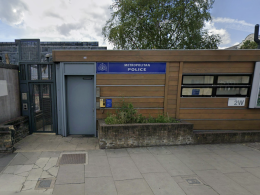
The Met promised in October to keep the only public police desk in Wandsworth open – but two months later won’t confirm whether the Lavender Hill police station closure is still planned.
This week, London’s police force outlined a new neighbourhood policing plan that promised officers will be available within a 20-minute walk of every London community, and talked about the creation of 40 new policing hubs.
But even before the ink was dry, the plan was dead. The Met’s estate strategy is short £1.7 billion having secured only 30% of the money it needs, and the funding gap raises serious questions about what can actually be delivered.
It means the Met must prioritise basic maintenance over improvements. As a result, better victim spaces, enhanced training facilities, and a new emergency response base for southwest London have been delayed.
The Lavender Hill police station closure question
In October, Superintendent Gani Rajan told the Wandsworth Safer Neighbourhood Board the station was “earmarked for closure” as part of a Met plan to shut 18 of 38 front counters across London. He said the “proposal is not yet finalised.”
Eleven days later, after an outcry from both the public and political representatives, we reported the Met chief confirmed the station would in fact stay open. But this week, the Met’s estate strategy makes no mention of Lavender Hill.
It does list buildings confirmed for disposal: Notting Hill, Enfield, Teddington, Kings Cross Road, Holloway and Stratford – and the good news is that Lavender Hill is not among them. But it does not confirm Lavender Hill is saved either.
Instead, there is general language about front counters and, notably, that the force is “still working through the detailed design for the new Front Counter model.” In his own remarks to the December Wandsworth Safer Neighbourhood Board, Superintendent Rajan used the same terminology: carefully avoided saying one way or another whether the police station would remain open to the public.
If the Lavender Hill police station closure goes ahead, residents must travel to Kingston or Lambeth for the nearest police station. Kingston operates on reduced hours. The Met offers alternatives: external phones for 101/999, video appointments, and “diary car” visits.
The station building would remain open for police use, with response teams operating from Wimbledon, and safer neighbourhood teams based in Earlsfield. For Putney in particular, it’s a policing desert.
Mixed crime picture across borough
Crime in Wandsworth has gone up in some areas and down in others [pdf]. Between August and October 2025, burglary fell 13% year-on-year to 448 offences, and Wandsworth ranked 10th among London boroughs.
But violence against the person increased 3.3% to 1,928 incidents, sexual offences rose 23.7% to 210 cases, and theft from motor vehicles jumped 28.7% month-on-month to 514 offences despite a 12% annual decrease.
Superintendent Rajan attributed the violence increase to shoplifting and phone theft in Nine Elms, violence in King George’s Park, and motor vehicle crime. He reported shoplifting had fallen 25% in the four weeks prior to the October board meeting following targeted operations.
Ward panel chairs across Wandsworth meanwhile have raised concerns about police visibility and resource pressures affecting local policing. West Putney recorded 37 shifts lost to 21 abstractions between July and the October meeting. Southfields is running with just one PC and one PCSO, both managing medical issues.
Independent review questions reform progress
Meanwhile, an independent reviewer will assess whether the Met has reformed. Baroness Casey’s 2023 report found institutional racism, misogyny, and homophobia.
Dr Gillian Fairfield will examine progress against Casey’s recommendations and report in summer 2026. Her appointment, announced last week, came one day before the estate strategy publication.
Mayor Sadiq Khan is behind part of the drive and noted that “recent Panorama and Dr Daniels’ Report highlighted still long way to go” despite the Met’s claims of progress. He wants the force to “accelerate pace of reform.”
The Met says it has removed 1,500 officers for misconduct. Internal reports have tripled from 400 to 1,400. Vetting refusal rates have doubled since 2020-21. Surveys show 74% of Londoners trust the Met, up from 72%.
But the gap between progress claims and the need for independent verification mirrors the contradiction over Lavender Hill: official assurances undermined by continuing uncertainty in practice.
The Fairfield Review will call for evidence in January 2026. Victims, officers, staff, community groups, and the public can share experiences confidentially. Dr Fairfield promised a review “without fear or favour” that will be “ruthless in its approach.”
Baroness Casey’s original review included a warning that if insufficient progress is made, “more radical, structural options, such as dividing up the Met into national, specialist and London responsibilities, should be considered.”
What the funding gap means
The £1.7 billion funding gap affects many Met operations. The force has cut buildings from 620 in 2010 to 200 today. This generated £1 billion in receipts and £70 million in annual savings. The money was reinvested in officer numbers.
Half of remaining buildings are below acceptable standards. The Estate Strategy [pdf] notes that government spending per square metre on Civil Service offices is nearly double what the Met receives for its facilities.
The 40 neighbourhood policing hubs promised within three years would use existing buildings, and the Met plans to partner with councils and the Greater London Authority. But only 30% of capital funding has been secured and so it remains unclear how many hubs will be delivered.
The strategy lists continuing disposals including Notting Hill, Enfield, Teddington, and Kings Cross Road (all closed since 2017 but only recently decommissioned), plus future sales of Holloway and Stratford once replacement facilities complete at Forest Gate and Kentish Town.
The Met describes the strategy as delivering a “realistic, achievable plan” within current funding constraints, with more ambitious improvements dependent on securing additional resources that have not yet been committed.
For Wandsworth residents, the situation is confusing. Funding is uncertain. Crime is mixed but rising. The station’s status is unclear. The Casey review will examine whether neighbourhood policing reforms are real or just promises.
And serving as a symbol of the whole uncertainty around police services, and what is going to happen sits our only police station with a front counter. The Lavender Hill police station closure question remains unresolved despite October’s assurances, with the Met making no mention of the station’s status in its December estate strategy publication. We don’t know, the Met doesn’t know, who does know?