


After over a year of severe congestion thanks to the redesigned junction at Putney Bridge – a situation that has resulted in a wide range of meetings, letters, reviews and reports – here are five practical ways identified within current council documents, with a clear evidence base, that would improve the situation.
We cover each, plus who has the power to do it, and what is blocking progress, complete with questions that the council’s transport committee should be asking at its meeting later this week. The list is not comprehensive – it doesn’t, for example, address the lengthy bus and cycle lane on Putney Bridge Road that is a contributor to the many reasons why Putney is suffering such severe congestion – but it is clear next steps that should be obvious to the council and TfL from their own investigations.
SOLUTION 1:
Complete the signal timing restoration
TfL made partial improvements to signal timings following council pressure in October. For each traffic cycle, Lower Richmond Road gained 6 seconds in the morning peak, 3 seconds in the evening. Putney Bridge Road gained 2 seconds in both peaks.
Council documents state: “The recent changes are being monitored closely by both TfL and the council.”
What still needs doing
Complete the restoration to the model (LMAP5) that the junction’s main designers (AECOM) developed and which TfL approved.
The numbers show how far there is to go despite a number of changes last month (October changes):
Lower Richmond Road going into the junction (morning peak):
- Lost 10 seconds compared to approved model
- October gave back 6 seconds
- Still missing: 4 seconds
Lower Richmond Road going into the junction (evening peak):
- Lost 12 seconds compared to approved model
- October gave back 3 seconds
- Still missing: 9 seconds
Putney Bridge Road going into the junction (morning peak):
- Lost 21 seconds compared to approved model
- October gave back 2 seconds
- Still missing: 19 seconds
Putney Bridge Road going into the junction (evening peak):
- Lost 12 seconds compared to approved model
- October gave back 2 seconds
- Still missing: 10 seconds
AECOM’s modelling suggests completing the restoration would reduce queue lengths by 30-40% during peak hours.
Who has the power
TfL has complete control. Only it can authorise signal changes. Only TfL engineers can access the SCOOT system that controls the lights.
The council can request changes but cannot compel them. Council documents show they have been “pressing TfL to make changes.”
What’s blocking completion
Council documents state “further changes are also planned” but provide no timeline or specifics. The documents don’t explain why TfL stopped partway through the restoration when AECOM’s report confirms the approved model works.
Questions for Thursday’s meeting of the Wandsworth Council transport committee:
- What are the “further changes” mentioned in the documents?
- When will they be implemented?
- Will they complete the restoration to LMAP5, or stop partway again?
- What prevents completing the restoration immediately?
SOLUTION 2:
Relocate bus driver changeovers
TfL moved some bus stops in part thanks to MP Fleur Anderson’s intervention. Anderson set up regular meetings with TfL to track progress on improvements, including relocating bus changeover points.
Council documents confirm: “The trial relocation of Bus Stop P is working well, with reduced queues back to Putney High Street during the PM peak in particular.”
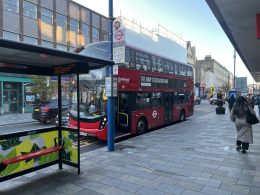
But Bus Stop P is on Lower Richmond Road next to Kenilworth Court. Footage sent to Putney.news by a reader suggests that the change is not as effective as the council claims, or, more accurately, would be more effective if the stop was changed more substantially. The buses are still stopping in virtually the same spot, still blocking traffic.
What still needs doing
Stop using Putney’s congested bus routes as driver changeover points entirely. Move the changeovers to Putney Common, bus depots, or off-peak hours at Putney Exchange.
Currently, three locations are used for extended driver changeovers: Putney Pier (Stop Q), Putney Bridge (Stop FE), and Putney Exchange (Stop M). These stops are used by routes 14, 22, 39, 74, 85, 93, 220, 265, 270, 378, 424, 430 and others – affecting the majority of Putney’s bus services.
The scale of the problem
AECOM’s review documented one bus remaining at Putney Bridge stop for 27 minutes during the evening peak, causing “significant congestion for buses” as following buses had to wait for gaps in southbound traffic to overtake.
At Putney Exchange during the morning peak, buses dwelled for a combined 31 minutes between 9-10am due to multiple driver changes.
The problem affects all routes using these stops. AECOM’s analysis found that routes 22, 265, and 378 – which also use these changeover locations – experienced increased journey times when starting from Lower Richmond Road and Putney Bridge Road. Meanwhile, service frequency on routes 22 and 378 has been cut by 29% and 49% respectively since 2021, meaning fewer buses trying to serve the same passenger demand while still experiencing the same changeover delays.
Why location matters more than enforcement
Bus drivers are people doing a safety-critical job. When they change shifts, they need a moment to chat with the outgoing driver, adjust their seat, settle in before driving a 40-passenger vehicle through London traffic. These transitions take time – sometimes 90 seconds, sometimes 5 minutes, occasionally longer when complications arise.
You cannot eliminate this human element. Nor should you try – rushing drivers through changeovers could compromise safety.
When these inevitable, unpredictable delays happen on Putney Common or at a depot, they inconvenience nobody. When they happen on Lower Richmond Road or outside Putney Exchange, they trigger gridlock affecting thousands.
The solution isn’t timing drivers with stopwatches. It’s choosing locations where normal human behaviour doesn’t cascade into crisis.
The bureaucratic blocker
TfL has contracts with bus companies that specify changeover routes. TfL doesn’t want to reopen these contracts – so the problem gets stuck in bureaucracy.
But there’s evidence TfL can act when it chooses. A new toilet facility – solely for bus drivers with their own lock – has been installed at Putney Common. If TfL can coordinate new driver facilities at Putney Common, it can relocate changeovers there.
This needs a political push for common sense to prevail.
Who has the power
TfL. It has sole authority over bus routing and driver scheduling. The council can request changes but cannot compel them.
What’s blocking this?
Contract bureaucracy. Anderson has been pressing TfL on this topic through regular meetings. But moving bus stops a few yards isn’t the same as relocating changeover points.
Questions for Thursday’s committee:
- Did TfL actually relocate driver changeover points, or just move bus stops?
- If changeovers continue at congested locations, why?
- What prevents using Putney Common for changeovers when TfL has installed driver facilities there?
- Will TfL provide data on current changeover locations and dwell times?
SOLUTION 3:
Fix the Lower Richmond Road approach
The physical problem
Lower Richmond Road approaching Putney Bridge used to widen from one lane to two approach lanes for the final 20 metres before the junction. This gave stacking space for 4-8 extra vehicles waiting to turn left onto the bridge.
The new layout removed this widening. Now it’s one lane all the way.
The real constraint is Putney Bridge itself – only one general traffic lane northbound. Even with two approach lanes, vehicles had to merge into single file to get onto the bridge. But the old layout at least gave more stacking space, reducing queues backing up along Lower Richmond Road.
The council tried to compensate by “remarking the lanes on Lower Richmond Road,” but the queues during peak hours show this hasn’t solved the problem, and the marked bus stop only makes matters worse.

TfL’s island requirement
TfL insists there must be a splitter island separating left-turn and right-turn traffic on Lower Richmond Road. The council’s paper states: “The current splitter island between the left and right turn lane was a requirement by TfL when the design was reviewed as the movements operate independently at times.”
This island requirement forces the approach into one lane. But TfL adjusts its rules when it wants to all the time. As just one example, it agreed to let cyclists use bus lanes on Putney Bridge Road. This is one point where it needs to show more flexibility.
The bus stop question
Stakeholder meeting minutes from November 2022 reference the “pavement above Watermans Green where the bus shelter is located” being “quite narrow.” Council officers explained a separate consultation was underway “looking at whether widening the pavement is feasible and how much carriageway would be left.”
That was three years ago. The pavement gets wider as you move away from the junction toward Watermans Green.
Who has the power
This requires both council and TfL agreement. The council owns the pavement. TfL controls the road. Any changes would require:
- Council approval for pavement or junction alterations
- TfL traffic modeling and approval
- Coordination with ongoing High Street improvements
What’s blocking this?
The documents mention a consultation “looking at whether widening the pavement is feasible” from November 2022. That was three years ago.
Questions for Thursday’s committee:
- What happened to the pavement widening consultation mentioned in November 2022?
- What did it conclude?
- Why not move the bus stop to the wider Watermans Green entry?
- Can TfL show flexibility on the island requirement like it did for Putney Bridge Road cycle lanes?
SOLUTION 4:
Smarter crossing and cycle gate timing
The technical problem
There’s a pedestrian crossing on Putney Bridge. Every time someone presses the button to cross, the traffic lights have to go through an extra sequence. This takes time away from the green light that lets traffic turn left from Lower Richmond Road onto the bridge.
AECOM identified this problem: “When there is a higher demand for pedestrian crossing ‘I’, the time allowed for the Lower Richmond Road left turn decreases.”
The same thing happens with the cycle gate – the special traffic light phase that holds all other traffic while cyclists cross.
Here’s the issue: the current system can’t tell if anyone is actually waiting. Press the button and walk away? The crossing sequence still runs. Cyclist approaches but decides not to use the cycle gate? The signal still triggers. The lights waste time on empty crossings while cars sit in queues.
The solution exists
AECOM suggests improved detection could reduce the impact: “Smart pedestrian detection could help mitigate this.” Similarly for cycle gates: “Smart detection of whether there are bicycles in the cycle gate prior to calling the all-red could help to optimise the signal operation.” The technology exists. Other cities use it. The question is whether anyone has asked TfL to install it.
Who has the power
TfL. These are TfL-controlled signals. Only TfL can approve and install upgraded detection systems.
What’s blocking this?
Council documents don’t explain. The solution was identified in AECOM’s report presented to the council. Whether TfL has been asked to implement it, or declined, is not documented.
Questions for Thursday’s committee:
- Has the council formally requested smart detection installation from TfL?
- If requested, what was TfL’s response?
- If not requested, why not when AECOM identified this as a solution?
- What timeline would TfL provide for implementation?
SOLUTION 5:
Proper junction modelling and modern traffic management
What AECOM said
AECOM’s post-implementation review states clearly: “It should be noted that this is only an indicative assessment and is not based on a fully calibrated and validated LinSig base model. A robust modelling process would be required to confirm the optimal operation of the junctions.”
Translation: The improvements they’ve suggested might work, but nobody has actually built the detailed model needed to be sure. They’ve done back-of-envelope calculations. What’s needed is full engineering analysis.
What other cities are doing
While TfL manually prints and installs chips to change Putney’s traffic lights, cities around the world are using AI systems that adapt in real-time:
Pittsburgh’s SURTRAC system (deployed since 2012) has cut travel times by 40% and emissions by 21%. The system learns from traffic patterns and adjusts within minutes when unusual queues develop.
Los Angeles operates 4,850 adaptive traffic signals that adjust based on real-time sensor data. The system has reduced intersection delays by 32% and cut travel times by 12%.
San Jose, California implemented AI signal priority for buses in 2024, reducing delays and achieving a 15% increase in bus ridership.
A 2025 study of 100 highly congested cities found AI-driven adaptive traffic lights cut peak-hour travel times by 11% on average.
The technology gap
In September 2025, TRL Software launched SCOOT 8 AI – an AI-powered urban traffic control system. It predicts congestion 30 minutes in advance, identifies disruptions 40% faster than traditional systems, and delivers journey-time reductions up to 15%.
The system is deployed in over 350 cities globally. It’s hardware-agnostic – works with existing infrastructure. So where is it in London?
TfL has been running the old SCOOT system for over 30 years. In June 2024, they completed migration to a cloud-based platform (RTO), but this was infrastructure modernisation, not the AI upgrade.
TfL developed their own AI system called FUSION with Siemens. It started trialing at “living laboratory” sites in 2020. The promise: revolutionize London’s traffic management using data from connected vehicles, optimizing for all road users.
It’s now 2025. FUSION is still in trials at select sites across London.
Putney is not one of them.
The perfect testbed ignored
Think about what Putney offers:
- Documented crisis with comprehensive baseline data from AECOM
- Clear problems identified: signal timing errors, bus changeovers, bottlenecks
- Active community engagement through surveys and committee scrutiny
- Real-world complexity: multiple junctions, diverse traffic modes, genuine constraints
This is exactly what a “living laboratory” should look like. Test the AI where the problems are documented, where success would be measurable, where the community is watching.
Instead, TfL keeps Putney on the 30-year-old system, physically installing chips to make timing changes, while AI trials happen elsewhere.
Questions for Thursday’s committee:
- Why isn’t Putney a FUSION trial site when it’s an ideal testbed?
- When will FUSION be deployed beyond trial sites?
- Has TfL considered SCOOT 8 AI, the latest system deployed in 350+ cities?
- Why does TfL continue manual chip installation when real-time AI systems exist?
The innovation question
What would be truly innovative is if TfL showed some creative thinking about how to solve Putney’s problems differently.
There are other options beyond trying to squeeze as much as possible out of a physically constrained space. Rather than myopically prioritising pedestrians and bikes in ways that disadvantage cars – which still make up over 80% of junction users – where’s the creative thinking about alternative routes for pedestrians and cyclists?
Where’s the boldness about testing new approaches? Where’s the willingness to use Putney as a genuine “living laboratory” instead of a dumping ground for partially-implemented fixes?
Who has the power
This is a joint decision. The council would commission and pay for comprehensive modeling. TfL would need to cooperate by providing data and potentially agreeing to Putney as a FUSION trial site.
What’s blocking this?
The documents don’t explain whether comprehensive modeling has been budgeted or whether Putney has been proposed as a FUSION trial site.
Questions for Thursday’s committee:
- Has the council budgeted for comprehensive junction modeling?
- Has TfL agreed to cooperate and implement the results?
- Why isn’t Putney a FUSION trial site given the documented problems?
- What prevents testing AI-driven adaptive signals here?
The Accountability Matrix
| Solution | Who Has Power | What’s Been Done | What’s Still Missing | Status |
|---|---|---|---|---|
| Complete signal timing restoration | TfL (sole authority) | Partial improvements in October | 4-19 seconds still missing | Incomplete |
| Relocate driver changeovers | TfL (sole authority) | Bus stops moved a few yards | Changeover points unchanged | Cosmetic fix only |
| Fix Lower Richmond Road bottleneck | Council + TfL (joint) | Consultation mentioned 2022 | No visible progress; obvious alternatives unaddressed | Stalled |
| Smart detection systems | TfL (sole authority) | Not addressed | Not requested? | No action |
| Modern traffic management | Council + TfL (joint) | Not commissioned; FUSION not trialed here | AECOM says modeling needed; Putney not innovation testbed | Not started |
What Thursday’s committee can do
The Transport Overview and Scrutiny Committee meets Thursday at 7:30pm. They have the power to demand answers and timelines, not vague promises.
Specific actions the committee should take:
On signal timings: Demand a written commitment from TfL on when the full LMAP5 restoration will be completed. “Further changes are planned” isn’t good enough. Get dates. Get specifics. Get accountability.
On bus changeovers: Require TfL to provide data on current changeover locations and dwell times. Ask whether changeovers were actually relocated or just bus stops moved. Demand a timeline for moving changeovers to Putney Common where driver facilities already exist.
On Lower Richmond Road: Get answers on the 2022 pavement consultation – what happened to it? Why hasn’t the bus stop been moved to the wider Watermans Green area? Challenge TfL’s island requirement – if they bent rules for Putney Bridge Road cycle lanes, why not here?
On smart detection: Ask whether the council has formally requested smart pedestrian and cycle detection from TfL. If yes, what was TfL’s response? If no, why not when AECOM identified this as a solution?
On modern technology: Demand to know why Putney isn’t a FUSION trial site. Get a timeline for when FUSION moves beyond trials. Ask whether TfL has assessed SCOOT 8 AI. Make TfL explain why manual chip installation continues when 350+ cities use real-time AI systems.
Most importantly: Don’t accept “we’re monitoring” or “under review” or “being considered.” Demand specific dates, named accountability, and measurable commitments.
The changes made last month proved TfL responds to pressure. Thursday’s committee needs to apply it.
What you can do
Before Thursday’s meeting:
Fill out our survey: Putney.news is collecting resident experiences. Your responses give the committee hard data they can’t dismiss. The more residents respond, the harder it is for the council to ignore the scale of this problem.
Contact committee members: Email them these five solutions. Tell them what you expect them to demand on Thursday. Be specific: “I expect you to get a written commitment from TfL on when the full signal timing restoration will be completed, not vague promises about ‘further changes.'”
Show up in person: The meeting is public. Thursday, 7:30pm. Nothing demonstrates resident interest like people in the room. Empty public galleries let politicians off the hook. Full galleries create accountability.
After the meeting:
Keep pushing: One meeting won’t solve this. Make it clear you’re watching. Tell the council and TfL you see what’s going on. Ask for updates. Demand progress reports. Don’t let them hope this fades from attention.
Follow Putney.news: We’ll continue investigating this story, tracking committee responses, monitoring TfL’s actions, and holding both authorities accountable. Sign up to stay informed.
The authorities respond to pressure. Sustained, visible, informed pressure. That’s what changes things.
If you have evidence of specific gridlock incidents, blocked emergency vehicles, or missed appointments due to Putney traffic, contact us at news@putney.news.


You are doing a great job Kieren. Thank you.
There’s also another fix that would drastically reduce the traffic in Putney… And quite an obvious one. Fix Hammersmith Bridge.
Either put the money into fixing it, or demolish it (It’s national critical infrastructure, not a pretty bridge) then build a modern replacement in its place for half the stability cost plan.