

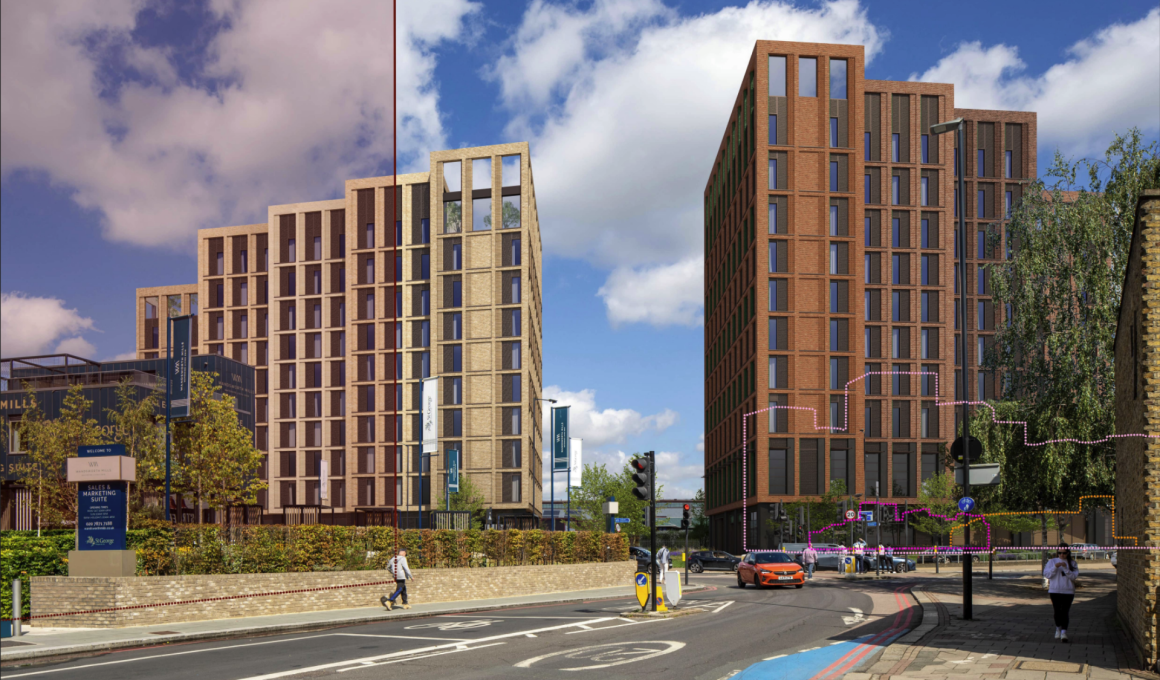
Wandsworth councillors waved through a controversial 434-bed student accommodation scheme at 2 Armoury Way last week in a split vote, despite overwhelming resident opposition, unanswered questions about demand, and a mysterious halving of the money promised for local arts and culture.
The decision – seven councillors in favour, two against – followed a pattern critics say is becoming all too familiar: officers massaging evidence, developers getting their way, and councillors left to approve complex deals with last-minute changes on the night. On this occasion, the sudden disappearance of £200,000 served as a pointer to behind-the-scenes deal-making.
The deal’s Section 106 legal agreement – a standard community benefit extracted from large developments – listed an unusually high contribution of £360,100 for “Arts & Culture”. But just hours before the meeting, a supplementary paper was slipped onto councillors’ desks announcing that the true figure was actually £174,000. The higher number, officers claimed, had been “reported in error.”
No explanation was offered for how a discrepancy of nearly £200,000 arose. The correction was taken at face value, with no debate.
Other last-minute changes included building layout adjustments, two additional objections from Barchard Street residents, and extensive amendments to over twenty planning conditions.
Demand that doesn’t exist
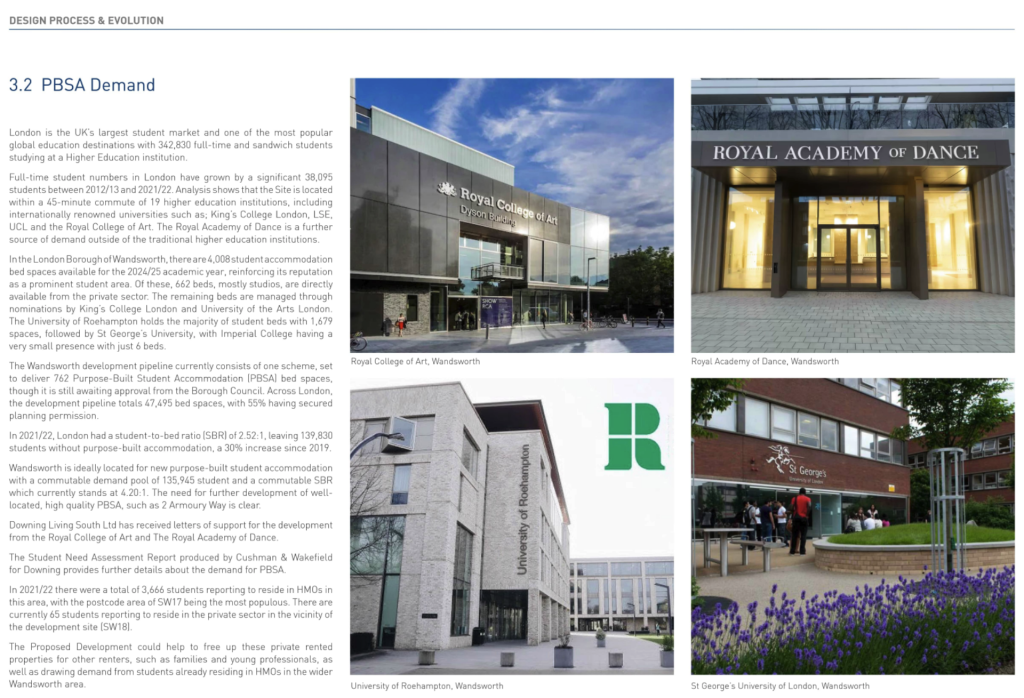
Officers justified the scheme (2024/3497) on the basis of “local demand,” telling councillors that they had received supportive letters from both the Royal Academy of Dance (RAD) and the Royal College of Art (RCA). The RCA was also cited in documentation provided by the developer justifying the proposal.
But in fact, the planning portal shows only two letters of support: one from the RAD [pdf], and a cursory note from a nearby individual. There is no RCA letter on the record.
The RAD’s letter makes clear why it backed the scheme: as a small specialist college without its own halls, it wanted nomination rights to ensure its students got priority access to the affordable beds. The letter specifically urged planners to “ensure that the most local higher education providers without their own accommodation are going to be given priority.”
The RCA, by contrast, has been amply served by a wave of new student blocks closer to its Battersea campus and already has deals with some of those developments. Its absence from the file suggests it pulled out of any behind-the-scenes arrangement with the developer. Yet officers still cited “letters from RCA and RAD” in the committee debate to bolster their case.
The developer notes in its application that it has a plan for converting any unused student flats into conventional flats raising concerns that the development is being approved and justified under one set of criteria but with a different goal – market-rate flats – in mind.
Councillors uncertain
Several councillors were unconvinced, even if none dug into the sudden drop in arts funding. Cllr Stephen Worrall questioned why Wandsworth needed another vast student block when new schemes were already rising at Battersea Dogs’ Home and the Booker site.
“It feels then that we are actually building two blocks for two actual institutions, one the Academy and another institution, rather than the general principle about student accommodation as a whole. That feels wrong,” he told officers.
His scepticism cut to the heart of the issue: by citing letters – in reality just one letter – officers had patched over a planning requirement to show genuine local demand.
In response, civil officers cited comparative data showing Wandsworth has less student accommodation than inner London boroughs like Lambeth and Tower Hamlets. They also argued that the application meets National Planning Policy Framework requirements for mixed tenure sites.
Other councillors wrestled with fundamental concerns about the development. Transport and accessibility sparked particular controversy, with members expressing dismay that just two disabled parking spaces would serve hundreds of residents.
Councillor Ayres called the 16-square-meter rooms “embarrassing” and “minute,” questioning whether the council should approve such cramped living conditions. Despite 24 resident objections citing concerns about the 10-storey height breaching the Wandle Delta Masterplan’s 4-8 storey guidelines, officers dismissed these as “acceptable,” insisting the development met policy requirements.
The viability arguments proved especially complex, with affordable housing reduced from 50% to 35% due to claimed site contamination costs – figures that had been independently reviewed by the Greater London Authority but left councillors balancing community benefits against developer economics in a scheme that many felt pushed the boundaries of acceptable planning practice.
In each case, however, officers provided extensive technical justifications based on planning law.
Objections ignored
Residents were far less equivocal. The planning portal’s 24 objections came against just two supports, and cited loss of light, breach of the Wandle Delta Masterplan, and a poor consultation process.
Neighbours on Barchard Street repeatedly raised privacy and right-to-light concerns, but these concerns were also brushed aside by council officers as “acceptable.” Both the Wandsworth Society and Putney Society were strongly opposed to the development.
Hand-in-glove with developers?
The picture that emerges is of a council machine working closely with developers, relying on a lack of expert knowledge from councillors, and exhibiting a bias to get development of this space in the heart of Wandsworth through despite clear flags and both community and councillor concerns.
In this case, the council has:
- Overstated support to justify need: there is no evidence that the RCA still wants the student rooms despite what the planning documents say.
- Quietly halved community benefits at the last minute with a highly questionable explanation.
- Ignored explicit local policy to allow a 10-storey block in an area where the masterplan calls for 4–8 storeys.
The result: another out-of-scale tower, weaker community payback, and a planning process that looks increasingly opaque and subject to manipulation.
The wider pattern
This decision follows other controversial approvals in Wandsworth, including the 29-storey gasworks tower earlier this year.
There have also been a series of recent “mistakes” noted at the last minute by council officers, including mixing up “east” with “west” and “north” with “south”. And, more ridiculously, changing the word “sympathetic” to its complete opposite meaning – “unsympathetic” – when describing how an organisation viewed a controversial application at Wandsworth Common.
In this case, and the previous gasworks application very close to the Armoury Way student accommodation, residents have been left asking a bigger question: what’s the point of approved masterplans and community consultations if the council is willing to bend its own rules whenever it fancies?
As one objector put it: “There is no point in having the Wandle Delta Masterplan if planning applications which do not follow it are granted permission.”



1 comment