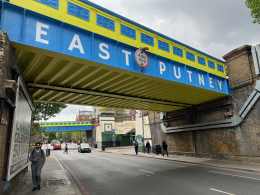
For six years, Putney residents have been assured that East Putney station — used over six million times a year — is “on the shortlist” or being “fast-tracked” for step-free access; part of a wider promise to make the Tube system more accessible for wheelchair users, parents with prams, those with big bags, the elderly, and injured passengers.
The claim of progress simply by being on this list has featured in Commons speeches, council newsletters and photo-ops. And yet nobody outside Transport for London (TfL) has actually seen it—until now.
A Freedom of Information request by Putney.news has revealed the full list and far from being a pipeline of imminent works, it comprises a 30-station “consideration list” that functions more like a holding room. Half the stations on it, including East Putney, were fully assessed years ago. They are not next in line; they are simply in situ.
A list that moves only when new money turns up
TfL says than this October, it will whittle the 30 down to 15 in October and announce “further feasibility work” for the chosen few. Which sounds like progress until you dig into the detail. Fifteen stations on the list have already had full feasibility studies—some as far back as 2005.
East Putney’s own study, completed in 2019, is one of the newest. Which suggests that the October shortlist may simply be made up of the other 15 stations, because they are the only ones without any engineering paperwork.
Despite years of claims otherwise, East Putney – and the other 29 stations – aren’t a queue; they’re in a holding cell. Stations aren’t ranked or prioritised, and being on it offers no guarantee of progress. TfL currently lacks the funding to move ahead with construction, and some stations—like Willesden Green and South Ruislip—have sat in limbo for nearly 20 years while others have turned up, been approved, had the work done, and left again.
East Putney, despite completing its own feasibility study in 2019, could remain in this state indefinitely.
Six years of campaigning—on paper
This new information puts a spotlight on the way East Putney has been handled politically. Since her election in 2019, Labour MP Fleur Anderson has made step-free access at the station a flagship local issue. She secured an adjournment debate in Parliament, launched petitions that gathered more than 3,000 signatures, staged photo-ops with supportive councillors and celebrated each fresh mention of East Putney on TfL’s list as a triumph – with the most recent just a month ago.
Yet no funding deal, no business case and no construction timetable have followed. The pattern echoes the saga of Hammersmith Bridge, where six years of petitions and closed-door meetings have delivered nothing. In both cases our political representatives appear stuck in the role of commentators, ready to claim credit if someone else signs a cheque but unwilling, or incapable, of doing the hard work that gets the cheque signed in the first place.
Why other stations leapfrog ahead
The London Mayor’s target is bold: by 2030, half of all Tube stations to be step-free. Sadiq Khan’s office points to a string of recent successes—Knightsbridge in April, Bank’s new lift in 2023, Sudbury Hill and Wimbledon Park the year before—as evidence the plan is working. Putney residents, watching the lift shafts rise elsewhere, can be forgiven for asking: what did those campaigns do that ours did not?
To answer that, last month Putney.news analysed each Tube station that has gone step-free since 2015 and the campaigns behind them. We found five common factors:
- Third-Party Funding is Essential
Stations that secure outside funding—like £13.5m from Barnet for Colindale or £9m from Waltham Forest for Leyton—are far more likely to succeed. - Integration with Housing Development
Linking step-free upgrades to nearby housing growth helps justify funding and aligns with broader regeneration goals. - Engagement with Disability Organizations
Support from groups like Transport for All adds credibility and pressure, helping TfL prioritise stations with clear access gaps. - Innovation to Reduce Costs
Greenford’s inclined lift cut expected costs from £10m to £2.2m. Creative solutions can make projects financially viable. - Passenger Numbers Make a Strong Case
High-traffic stations show better value for money; strong usage data can tip the balance in funding bids.
East Putney’s campaign, by contrast, has covered only one of those five factors – passenger numbers – and has rested instead on signatures, email addresses and sympathetic statements. Wandsworth Council has not earmarked any its development pot for the station – the total cost of which is expected to be around £7m (the average cost of making a Tube station step-free has been £10m).
The 2019 feasibility study has not been published, and it’s unclear if cheaper options such as converting the redundant western staircase into an inclined lift shaft have been reviewed. Disability charities support the goal in principle but are not formal partners in the lobbying effort. With no cash, no engineered savings and no powerful allies, East Putney drifts—to the detriment of thousands of passengers every day.
A faint glimmer of funding
Labour’s inaugural Spending Review proved disappointing for Putney – we gave it a four-out-of-ten – but Treasury officials hinted that new capital may flow to TfL for accessibility as part of a wider London transport package later this year. If that pot materialises, East Putney could seize its chance—but only if local leaders arrive with a costed, part-funded proposal in hand.
That is what successful boroughs did at Colindale and Leyton, securing more than £40 million from the Levelling Up Fund after local councils stumped up match-funding. It is how Knightsbridge leapfrogged dozens of older cases this spring. Without equivalent groundwork, East Putney will remain in TfL’s waiting-room while other stations stride past.
Here’s what our local representatives could and should be doing to ensure Easy Putney doesn’t miss out again when it comes to making East Putney step-free:
- Secure a Wandsworth Council funding pledge (even seed money) to prove local commitment.
- Publish the 2019 feasibility study and commission an updated cost-saving option (look at the unused west stairwell for an inclined lift).
- Formally partner with Transport for All and Age UK London to raise the station’s profile at City Hall.
- Use the recent Spending Review to press Chancellor Rachel Reeves for a ring-fenced accessibility package – then hold the Mayor to matching funds.
- Stop celebrating “being on the list” and demand timelines, budgets and contract milestones.
Here’s what our FOI request revealed. We asked TfL for a full list of London Underground stations that are currently on Transport for London’s secondary or “consideration” list for future step-free access upgrades, along with any relevant details such as whether a feasibility study has been completed, any projected cost estimates, and whether the station has been subject to third-party or borough funding offers.
Here’s what we discovered, broken out by those that have had feasibility studies and those that haven’t, and then further broken down by year and listed alphabetically.
The 30-station “consideration list” (TfL FOI release)
Stations with completed feasibility studies
(ordered by study year, then A–Z)
| Year | Station | Line(s) |
|---|---|---|
| 2005 | Grange Hill | Central |
| South Ruislip | Central | |
| Willesden Green | Jubilee | |
| 2006 | Kentish Town | Northern |
| 2015 | Brent Cross | Northern |
| 2017 | Canons Park | Jubilee |
| Plaistow | District / H&C | |
| Preston Road | Metropolitan | |
| Putney Bridge | District | |
| Queensbury | Jubilee | |
| Rickmansworth | Metropolitan | |
| Ruislip | Metropolitan / Piccadilly | |
| Snaresbrook | Central | |
| South Harrow | Piccadilly | |
| 2018 | Theydon Bois | Central |
| 2019 | East Putney | District |
| 2025 | Edgware Road (Circle & District) | Circle / District / H&C |
Stations with no or only partial studies
(“draft” or “pre-feasibility” noted; A-Z)
- Barkingside (Central)
- Becontree (District)
- Blackhorse Road (Victoria)
- Chigwell – draft 2017 (Central)
- Dagenham East (District)
- Hatton Cross (Piccadilly)
- Hornchurch (District)
- Moor Park (Metropolitan)
- Northwood Hills (Metropolitan)
- Ruislip Manor (Metropolitan / Piccadilly)
- South Ruislip – pre-feasibility 2005 (Central)
- Totteridge & Whetstone – draft 2017 (Northern)
- Upton Park – draft 2017 (District / H&C)
- Wood Green (Piccadilly)
(Total: 30 stations)