

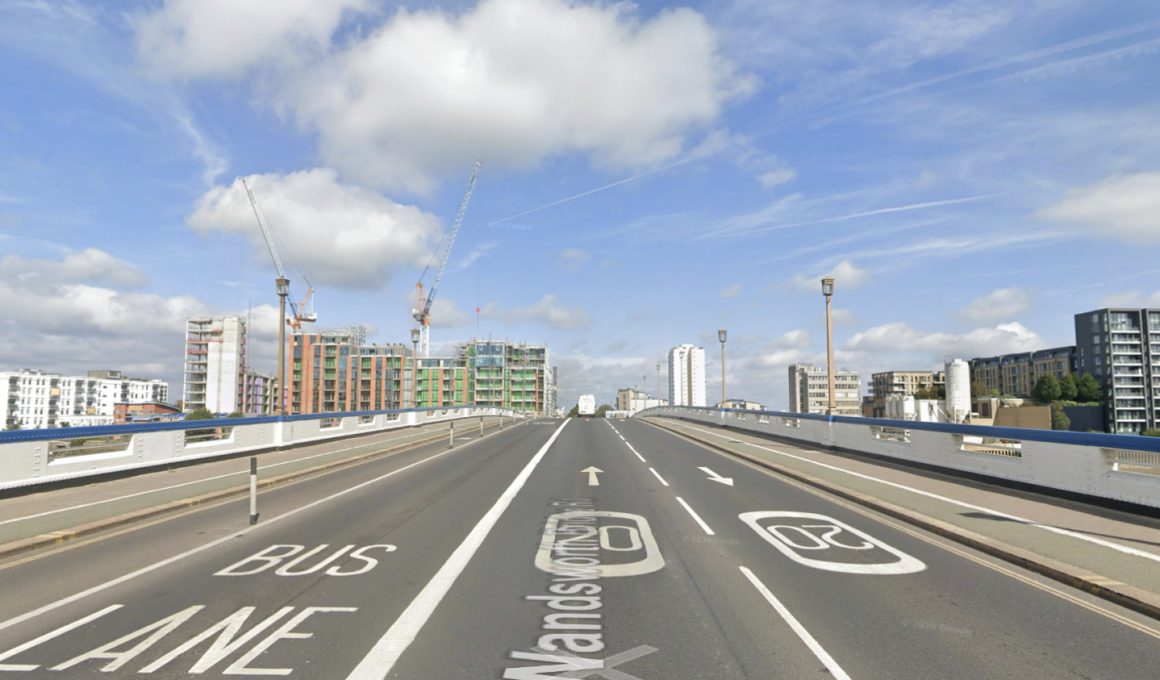
Wandsworth Bridge loses lanes from Tuesday 26 May through autumn 2026 for a £2.35m scheme that makes the bus and segregated cycle lane permanent, narrows car lanes, rebuilds structural waterproofing beneath the footways that was left undone in earlier phases, and widens the pavements on both sides of the crossing.
Residents received the council’s first formal letter about the works this week, signed by Henry Cheung, Assistant Director of Engineering. It comes over a month since we first reported the works, having obtained the information from FOI documents on a separate issue rather than through any council announcement.
The works are certain to add even more congestion to an already overly congested Putney and come as Wandsworth Council faces questions over its lack of maintenance and budget of its bridges, including Putney Bridge, which scores below a level where engineers require work to be done.
What is actually being built
The scheme has five components: a stepped cycle track on both sides of the bridge; widened and resurfaced footways; essential maintenance to the bridge deck; improvements to the Jews Row junction and Bridgend Road bus stops; and a full carriageway resurfacing at the end of the programme, which will require a one-week overnight closure between 9pm and 5am.
Two-way motor vehicle traffic will be maintained throughout the main works. The northbound bus and cycle lanes will be suspended while contractors are on the bridge. Pedestrian access is maintained, though routes may change.
The contractor is FM Conway, which will handle day-to-day works management. Once the works finish, the permanent layout will keep the northbound bus lane and one general traffic lane in each direction, with segregated cycling facilities on both sides and widened footways.
The 2021 trial that is now permanent
The bus lane and segregated cycle lane were introduced under a temporary traffic order in 2021, following refurbishment works on the bridge. A monitoring review conducted with TfL and the London Borough of Hammersmith and Fulham found that cycling levels increased by over 25%, while bus and road network performance remained stable, according to their figures.
A report presented to Wandsworth’s Transport Overview and Scrutiny Committee on 11 February 2026 confirmed: “The changes and associated traffic order have been made permanent.” That decision was on the public record three months before the current works were announced.
The £2.35m cost is split, according to figures circulated by the three Thamesfield ward councillors – through which more displaced traffic is now expected to flow – as £1.45m from the council’s capital budget and £900,000 from the Community Infrastructure Levy, paid by developers. The council has not yet confirmed those figures. What is confirmed, through Cllr Ethan Brooks’s own account from officers, is that the bulk of the cost is not for the bus lane or cycle track changes but for something deferred from an earlier phase: “structural and waterproofing works beneath the existing footways which were purposely omitted under phase 1 and 2 of the bridge remedial works.”
In other words, the repairs Phases 1 and 2 did not do are now the most expensive part of Phase 3. The pattern is familiar. Putney Bridge’s structural condition has been below the national threshold for action since at least December 2023, with the council aware of the problem throughout.
The disruption picture
From 26 May, three of south-west London’s four river crossings will be impaired simultaneously. Albert Bridge has been fully closed since February, following an inspector’s warning. Hammersmith Bridge has been closed since 2019. Meanwhile, Putney Bridge junction remains unremedied after the botched redesign 18 months ago. Wandsworth Bridge will add lane restrictions to that list from the end of the month.
What the councillors said
The lack of communication has impacted both residents and councillors alike, leading to significant confusion. In the same week as Cheung’s letter, the three Thamesfield Conservative councillors published a leaflet that described the scheme in a way that differed from the council on three significant points.
On the bus lane, the leaflet stated: “The separate bus lane will be removed and there will be one lane of traffic running north and south.” The council’s letter says the opposite: the northbound bus lane is being made permanent. The Transport Committee paper confirmed that decision publicly in February.
On the pavements, the leaflet described the existing provision as “a combined 3-metre pavement and cycle lane” being replaced with “a 2-metre pavement and a 2-metre cycleway.” The implication was of narrowing. Cllr Brooks subsequently clarified, relaying officers’ confirmation: “No pavement narrowing. The existing pavement width on each side is 1.5m footway + 1.5m cycleway. The new width will be 2m + 2m.” The only practical explanation for that is that the car lanes with be narrowed further.
On the cost, the leaflet placed the £2.35m figure under the question “How much is all this costing?” immediately after its description of the bus lane removal, framing the cost as covering the lane changes. Brooks corrected that interpretation the morning after distribution: the cost is driven by the deferred structural waterproofing, rather than £2.35m being the cost of the bus lane removal.
Councillors are due to be briefed on the scheme this coming Monday, with the approvals and approach seemingly decided by officers during the election period.
The pattern
The communication failures around this scheme are not isolated. The council held onto the works for six weeks before formally writing to residents. The first formal letter arrived less than two weeks before the works start. The ward councillors’ written description of their own constituency’s biggest transport change of the summer got the headline facts wrong.
The wider picture that Wandsworth Bridge now joins is one of deferred maintenance accumulating across multiple crossings simultaneously. We have documented the pattern across all four crossings: structural problems identified, repairs postponed, costs rising when the bill eventually arrives. Wandsworth Bridge’s Phase 3 is the latest and most visible instalment.



Putting it bluntly, that will teach you for voting for Labour!
Quite unbelievable I said it at the time when they closed Wandsworth Bridge that they were incompetents. Apparently they were going to do the waterproofing. WHY DID THEY DIG UP THE ROADWAY AND NOT SPRAY WATERPROOFING BEFOR THEY RELAID IT. …so that they could make more money five years later. All the asphalt does not have to be replaced every five years , yes the surface is often plained and then a paver lays a new layer but to remove it all is an outrageous waste of money. … It took over six weeks of closure before they actually managed to jack up the bridge and remove the old bearings.
Putney bridge was a disaster too the bride was resurfaced and the messed around for 3 week relaying the pavement with a few men without any machines There was very limited weekend working The contractors would have got no star reviews. It seem that the council have an aversion to using specialist Bridge Repair Contractors …… Why are they using Conway again a general contractor not a bridge specialist …. the proposed layout Wandsworth Bridge is totally daft. If North bound cars are turning right then the whole of the traffic is snarled up ….. Why do we put up with Council incompetence
So the council think residents / the public are stupid and will fall for this jargon of rubbish? They clearly failed to either adequately finish work that was already paid for under the previous bridge works or have realised failures and these smoke and mirrors is simply a cover. The major traffic related consequences to an already congested route have been massively glazed over! There is no through road to kings road via lots road for normal vehicles. The old shortcut to new kings road was closed down. Cars cannot drive between residential houses. So all the pressure is placed on 1 road to Fulham? The biggest concern here is for people trying to reach chelsea and westminster hospital. There is a very real and serious human implication to this incompetence.