

Somewhere in the part of Putney near the river on Thursday, on one street, perhaps in one block of flats, there were 25 people who voted Conservative on Thursday who might just as easily have voted Lib Dem.
Had they had decided differently, the shape of Wandsworth politics for the next four years would look entirely different. The exact same scenario played out in Tooting Broadway with the Greens. Two streets. Two dozen people among thousands. Two radically different outcomes.
Based on the results across the UK yesterday, it’s now undeniable that we have entered a period of multi-party politics. Green party leader Zack Polanski captured the mood: “Two party politics is not just dying, it is dead and it is buried,” he said in widely quoted remarks.
Wandsworth has never done multi-party. And this week was no exception. But it came very close and the tension has meant we’ve ended up in the perverse position where one man, standing on his own in West Hill can effectively decide how 300,000 people are governed.
This is about what nearly happened.
The vote that counted for nothing
The final count was Conservative 29, Labour 28, one independent. No party has a majority. Everything Wandsworth Council decides for the next four years passes through Graham Grimston, the independent councillor who topped the West Hill poll with more than double the votes of his nearest rival. The balance of power turned on fewer people than fill a Putney café on a Saturday morning.
Conservatives won 29 seats on 31.2% of the vote. The Greens won 17.3% of votes and hold no seats. The combined third-party vote (33.7%) exceeds the Conservative total, yet only Conservative and Labour candidates were elected.
Third parties took more than a third of all votes cast across the borough. The Greens won 17.3%, nearly double their 8.9% in 2022. The Liberal Democrats took 9.1%. Reform UK, absent entirely in 2022, added 7.3%. Together: 33.7% of the vote, zero seats.
The Conservatives won 29 seats on 31.2% of the vote. A party that received fewer votes than the combined third-party total controls the largest single bloc on the council.
That is not an argument for any particular voting system. It is the arithmetic fact that makes the near-misses matter. In a council balanced this finely, one or two third-party seats would not have been decorative. They would have held a veto over every decision either main party wanted to make.
Three wards (Thamesfield, Tooting Broadway, West Hill) account for nine of the ten nearest misses. Two parties, two very different stories of why they came so close and fell short.
The black line marks the last elected candidate’s vote total. Each bar shows how far the third-party candidate reached. Gap shown in votes.
Vote share in key wards, 2022 vs 2026.
Tooting Broadway: a swing of 26
The Green surge in Wandsworth was borough-wide, but it concentrated hardest in Tooting Broadway. The party took 5.8% there in 2022. On Thursday it took 35%, a rise of more than 29 percentage points in a single cycle. Three Green candidates combined for 5,373 votes.
The last Labour seat went to Rex Osborn with 1,956 votes. Michael Bankole, the leading Green candidate, polled 1,905. Fifty-one votes separated them.
Had Bankole taken that seat, Labour’s position on the council would have shifted. The party would have held 27 seats, not 28. The Greens would have held one. With Grimston’s independent seat already the balance point, a Green councillor would have added a second veto, a position from which either the Greens or Grimston, or both acting together, could block anything either main party proposed.
What drove the surge? The Greens ran a broad, positive campaign: borough-wide social media, heavy use of video, consistent presence. We fact-checked their manifesto and rated it A: an honest rundown of the issues Wandsworth faces and what their plans were to fix them. Labour’s was rated C. The Conservatives came in between. Roughly 80% of the Green gain came from voters who had backed Labour in 2022: for every Green vote taken from the Conservatives, 4.4 came from Labour.
The campaign earned those votes. A swing of 26 more would have converted them.
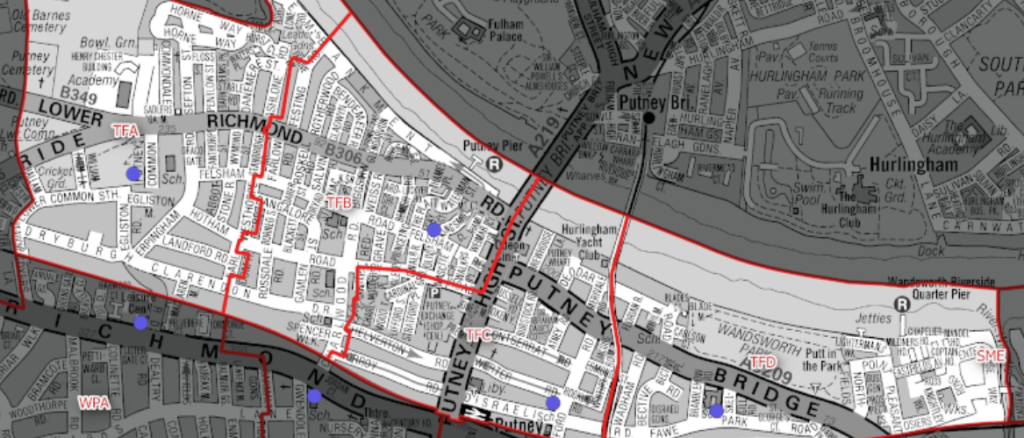
Thamesfield: a swing of 25
The closer miss, by a single vote on the raw count, was not in Tooting Broadway but in Thamesfield. And it reveals a strategic error that will occupy Lib Dem thinking for a while.
In 2022, the lowest Conservative winner in Thamesfield polled 2,212 votes. The strongest Lib Dem candidate polled 744. The gap was 1,468 votes. In a single cycle, the Lib Dems closed that to 50. Josh Hughes finished with 2,033; the last Conservative winner held on with 2,083.
The Lib Dems had two target seats in Putney: Thamesfield and Southfields. Thamesfield was not just the closer fight, it was the better fight by every measure. All three Lib Dem candidates there needed smaller swings than the next closest Lib Dem candidate, Sue Wixley running in Southfields. The party could have won all three Thamesfield seats before a single Southfields candidate got home; a concentration of resources would have changed the entire political course of Wandsworth.
Incredibly, the Lib Dems make the same mistake four years ago when they concentrated all their resources behind the same candidate in Nine Elms, a newly created ward at the opposite end of the borough, well away from their core support. She came sixth out of eight candidates with 212 votes. Four years on, the same pattern: resources following a candidacy rather than the numbers, into a ward where the maths showed it was a bad bet.
Reform: the campaign that fought itself
The national Reform story in May 2026 is over 300 new councillors and a vote share above 27%. In Wandsworth, the party took 7.3% of the vote and won nothing, but the numbers are not the whole story.
Reform’s Wandsworth campaign was marked by public discord. Candidates criticised other candidates in front of voters; arguments that should have been internal spilled into the public campaign. The energy that might have reached a wider electorate went elsewhere.
The contrast with the Greens is instructive. Both parties were running in Wandsworth for the first time at scale. One built a coherent, positive campaign that nearly broke through. One fought internally. The Greens took 17.3% and came within a swing of 26 votes of a seat; Reform took 7.3% and was not competitive in any ward. Third-party politics requires internal coherence before it can convert votes into seats. The Greens demonstrated this. Reform demonstrated the alternative.
Reform’s strongest wards were the most deprived: Roehampton 15%, Shaftesbury and Queenstown 11.3%, Falconbrook 10.2%. Its weakest were the most affluent: Northcote 4.4%, Balham 4.3%. A more disciplined campaign in those deprived wards, where the message had genuine traction, might have produced different arithmetic.
There is a parallel version of Thursday’s result that requires no near-misses, no favourable swings, no strategic errors corrected. It just requires a different voting system.
Under proportional representation, whichever of the main variants you apply, the 2026 Wandsworth result would have seen a split of votes across parties.
The three main PR methods used in British elections (D’Hondt, used for the London Assembly; Sainte-Laguë, used across Scandinavia; and the Hare Largest Remainder system) produce almost identical outcomes here. That consistency matters: it means the numbers below are not a product of method-selection. They are what the votes actually represent.
Under any of them, the Greens win 10 seats. The Lib Dems win five. Reform wins four. Labour and the Conservatives each lose roughly ten seats compared to Thursday’s result.
The coalition arithmetic changes entirely. Under first-past-the-post, Malcolm Grimston is the kingmaker: one independent councillor decides everything.
Under PR, Labour cannot reach a majority without the Greens: Labour plus Green is exactly 30, the bare threshold. The Conservatives cannot reach 30 with Reform (22 seats combined), with the Lib Dems (23 or 24), or even with the Greens (28 or 29). To govern at all, either main party would need to negotiate seriously with the parties that, on Thursday, won a third of the votes and not a single seat.
This is not an argument for changing the system. It is the illustration of what the system does: it translates the same votes into two entirely different councils, and two entirely different balances of power.
What a swing of 25 actually means
The two closest seats needed a swing of 25 and 26 votes respectively, in wards where thousands of ballots were cast. A swing at that scale is not a tide. It is a street. A good canvassing session. A well-placed leaflet drop in the right two hundred houses.
Scale up slightly and the picture changes further. A swing of 87 votes in West Hill adds a third third-party seat. A swing of 121 takes Tooting Bec. By a swing of around 165 votes across six wards simultaneously, Wandsworth Council has seven fewer Conservative and Labour councillors and seven more Greens and Lib Dems. At that point neither main party can pass anything without negotiating with people who are not from either party, alongside Grimston.
The balance of power now rests with Grimston alone. He got there partly because parties that could have shared it came 25 votes short in one ward and 26 in another. Whether they draw the right lessons from Thursday will determine whether 2030 looks different. The swing exists. It is smaller than a street.

Thank you for this analysis: its really good. I’d disagree with only one thing: your statement that “This is not an argument for changing the system.” But it is, Kieren, it is! Whichever PR system you choose (apart from the Alternative Vote, which produces very little difference) it’s the only way to make people’s votes properly count. However you look at it, its a travesty that nearly a third of votes are simply unrepresented. The argument used to be that FPTP produced stability, but in this new age of no longer having two ‘main’ parties it just doesn’t work. Now, with their huge majority in parliament, Labour could make the change to a fully representive system, but they, under Starmer, are just too timid. What an opportunity wadted!
Surely this analysis is indeed an argument for PR. At national level we have an increasingly unpopular government that won a huge majority on about a third of the popular vote. If we believe the polls we might get a Reform UK government next time on about 30% of the vote. Not a welcome prospect for most of the 70%!