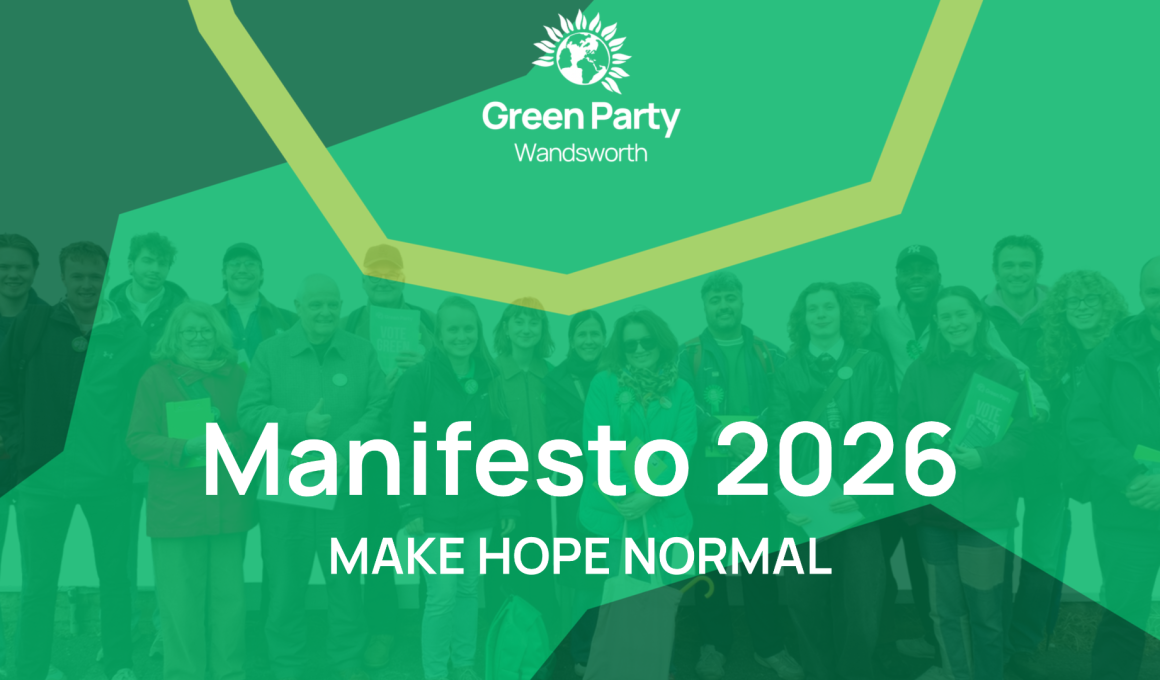
The third manifesto through our election fact-check pipeline is also the most rigorous one. The Wandsworth Green Party’s 2026 document, “Make Hope Normal,” makes a bold financial claim on its centre pages: that the Institute for Fiscal Studies says council tax in the borough would have to rise by 75 per cent to meet the assumptions in the new funding settlement. The IFS itself confirms it, in those exact terms.
Putney.news tested every verifiable claim in the 29-page manifesto, promoted by Green candidate James Couper, against primary evidence: Wandsworth Council’s own published documents, IFS analysis, ONS data, the Tenant Satisfaction Measures dataset, the council’s news archive and our own investigations. We extracted 24 testable factual claims and 18 forward pledges.
Eleven claims rated fully accurate. Six are mostly accurate. Five need context. One is misleading. None are flatly false. The financial diagnosis is sourced. The climate evidence base is sourced. The proposal to cut the council’s 10,000-signature petition threshold is supported by the data on what other London boroughs require.
By comparison, the Conservative manifesto received a B in our 13 April fact-check, and the Labour manifesto received a C on 19 April. Identical methodology has been applied to all three.
A manifesto is not an essay. It is the document on which voters are asked to make a decision. Whether a party is being honest with the evidence is the precondition for evaluating whether their policies are good ones. The Conservatives’ manifesto contradicted the council’s own Root Cause Analysis on housing. Labour’s flagship 500-homes claim was contradicted by the council’s own monitoring report. The Greens’ manifesto, on the available evidence, gives readers a usable baseline of truth from which to assess what they are being asked to support.
Wandsworth Green Party Manifesto 2026
“Make Hope Normal” — every verifiable claim, tested against the evidence
Every checkable factual claim in the manifesto was tested against primary sources — Wandsworth Council’s own published documents, IFS analysis, ONS data, and the Tenant Satisfaction Measures dataset. Each verdict has been through the Party-Swap Test: would we apply the same standard to a Conservative or Labour candidate making this claim? The Greens’ 18 forward pledges are assessed in a companion widget below — they are categorised by feasibility within council powers, not rated A–E, because pledges are proposals rather than facts.
Document: Wandsworth Green Party Manifesto 2026 (29pp). Analysis: 4 May 2026. Polling day: 7 May 2026. Same methodology applied to Conservative manifesto (B, 13 April 2026) and Labour manifesto (C, April 2026). Right of reply outstanding.
The financial diagnosis the Greens got right
The Greens’ headline financial claim is that the IFS says Wandsworth’s council tax would have to rise by 75 per cent to meet the government’s assumptions in the new funding settlement. The IFS itself, in a 19 January 2026 publication, says exactly this: “around 75 per cent in the case of Wandsworth and Westminster.”
Wandsworth has been granted a two-year exemption from the referendum requirement on council tax. Both major parties have spent the campaign minimising what that means. The Conservatives’ manifesto called it a “stealth tax” without showing the IFS modelling. Labour declined to use the unlimited tax-raising powers “for now,” a qualifier it omitted from its election materials. The Greens have stated the IFS conclusion accurately and prominently. We have separately reported that the council’s own papers project a council tax doubling by the end of the decade, and the UK Statistics Authority has already rebuked the council over the freeze-claim framing. This is the strongest financial claim in any of the three manifestos through our pipeline. We rate it A: accurate.
A second financial claim, that the funding cut is “equivalent to 20 per cent of the entire Wandsworth budget,” is true for the worst-case scenario. The IFS impact range is £19m to £85m, and funding floors phase the impact over years rather than landing it all at once. The £85m upper-bound, set against a roughly £400m net revenue budget, gets you to about 20 per cent. The Greens have presented the upper bound as if it were the central estimate. We rate it C: needs context.
What the ’16 per cent’ figure actually means
The Greens’ Awaab’s Law section opens with “current resident satisfaction at a dismal 16 per cent.” Wandsworth’s published Tenant Satisfaction Measures data shows overall tenant satisfaction (TP01) at 65 per cent in 2024/25, up from 64 per cent the year before. The 16 per cent figure is one specific sub-measure (TP09, complaints handling) for 2023/24, which has since risen to 22 per cent.
Both the Regulator of Social Housing and Wandsworth Council itself note that complaints handling is routinely the lowest-scoring TSM measure across all social landlords. Wandsworth’s score is below the sector median, but the figure is not what the manifesto says it is.
This is a real figure used in a misleading way, not an invented one. The underlying point, that housing complaints handling at Wandsworth has been poor, is supported. The framing presents a sub-measure as if it were headline satisfaction. The same standard would apply to any party citing TP09 as overall satisfaction. The Conservatives, who admitted the council had ignored Grenfell reforms for years, took the same scrutiny in our 13 April fact-check; Labour took it on the Fox House fire and the council homes count in our 19 April piece. We rate the 16 per cent claim D: misleading.
‘Led the council to declare a Climate Emergency’
The manifesto opens with “Since we led the council to declare a Climate Emergency, progress has been made.” The 2019 declaration was made on 17 July 2019 by a Conservative-led council, with the motion supported jointly by Conservative and Labour councillors. The Greens did not have, and have never had, a Wandsworth council seat.
Their role in the declaration was, however, real and substantive. The petition that triggered the Full Council debate was launched in April 2019 by Wandsworth resident Glyn Goodwin and the Wandsworth Green Party. It cleared the 10,000-signature threshold the Greens are now proposing to cut. “Catalysed” or “led the campaign for” would be defensible. “Led the council” implies an authority the party did not possess. We rate it C: needs context.
The petition threshold
The Greens propose cutting the council’s 10,000-signature threshold for triggering a Full Council debate to 3,000. Constitution Society research published in 2025 surveyed London boroughs and found Wandsworth’s threshold to be the highest of any council it identified. The current threshold is in the council’s own Constitution. Both elements of the testable claim are verified. We rate it A: accurate.
What the Greens are promising
18 forward pledges from “Make Hope Normal” — assessed for feasibility within Wandsworth Council’s powers
Forward pledges are not factual claims — they are commitments. They are not rated A–E because there is no fact to test against, only a forward proposal. Instead, each pledge is assessed for feasibility within the powers and budget of Wandsworth Council. The same standard has been applied to the Conservative and Labour manifestos in this series.
Document: Wandsworth Green Party Manifesto 2026 (29pp). Analysis: 4 May 2026. Polling day: 7 May 2026. Companion widget: green-manifesto-scorecard (24 testable claims, overall grade A).
Looking ahead
Eighteen forward pledges sit alongside the 24 testable factual claims. We have not rated them A to E because pledges are not facts, they are proposals. We have, instead, categorised them by feasibility within Wandsworth Council’s powers and budget, applying the same lens used in the Conservative and Labour pledge assessments.
Ten of the 18 pledges are credible at council level if a Green administration were elected: Local Climate Bonds via a council-owned vehicle (already used by 18-plus UK councils), regular Ward Citizen Assemblies, Participatory Budgeting via the Neighbourhood Community Infrastructure Levy, the petition threshold cut, a Wandsworth Pension Fund divestment audit, a Refugee Navigation Hub, a workplace parking levy, a borough-wide cycle network, and others. Two are qualified. One, the Wandsworth Future Fund, is vague: it conflates the unverified £13 billion “investable wealth” claim with the bond and special-purpose-vehicle structures.
Five pledges sit outside the council’s powers entirely. Living Rent at 35 per cent of median pay, the abolition of leasehold, rent controls, fare-free London transit and the restoration of pre-2010 central government funding all require Parliamentary or Mayoral action. The manifesto acknowledges this in places (“falls outside the council’s direct remit”) and disguises it in others. A reader trying to work out what the Greens would actually do at the town hall would benefit from the manifesto being clearer on this distinction throughout.
What this is, and what it is not
The Greens stand on the ballot in all 22 Wandsworth wards on Thursday. They received 11.3 per cent borough-wide in 2022 and have never held a Wandsworth council seat. They share that position, on this ballot, with the Liberal Democrats and Reform UK. There is no governing record to test, so all testable claims fall at the level of manifesto credibility. That is a structural feature of opposition fact-checking, not a methodological asymmetry, and we have applied the same Party-Swap Test we applied to the other two parties: would a Conservative or Labour candidate citing TP09 as overall satisfaction be assessed the same way? Yes. Would a different party claiming to have “led the council” without holding a seat be assessed the same way? Yes.
This is the third and final manifesto through our fact-check pipeline. Identical methodology has been applied to the Conservative, Labour and Green manifestos. The Greens’ A grade reflects the most rigorous evidence base of the three, not methodological leniency: the headline claims hold up, the financial diagnosis is sourced, and where the document overreaches, it overreaches on framing rather than on invented facts.
Wandsworth Green Party are invited to respond to any of these findings. Any response received will be published in full as an update to this article.
Wandsworth goes to the polls on 7 May.