

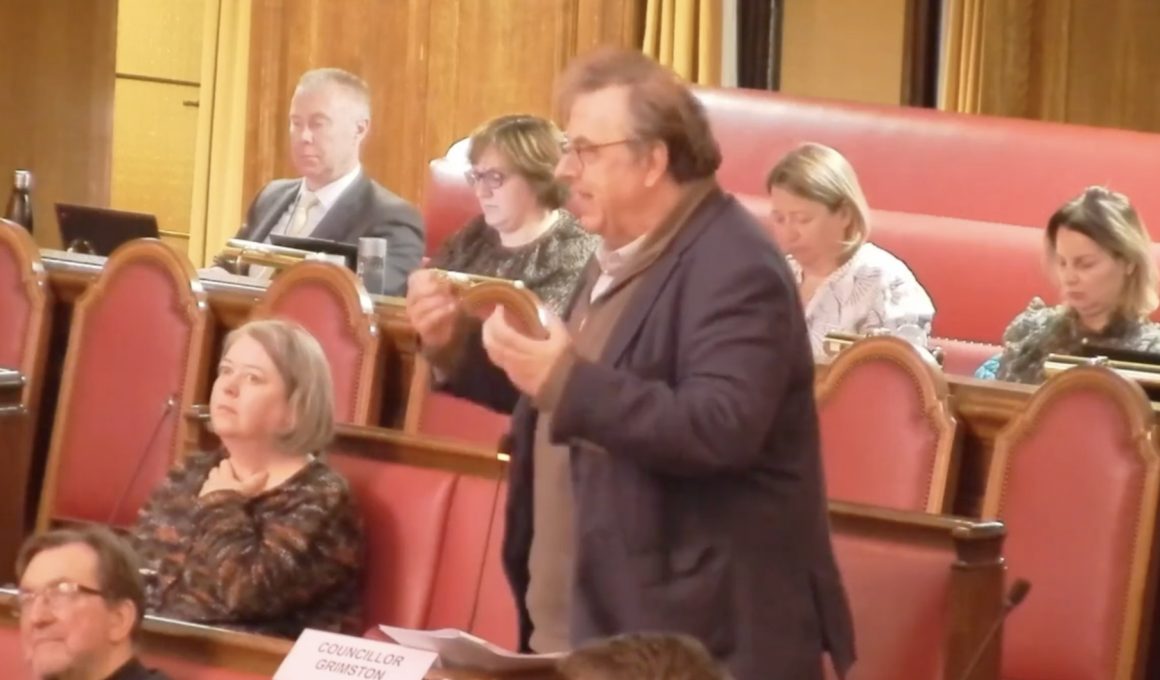
Malcolm Grimston had just got back from his swim when we called him at 3.30pm. West Hill was the last ward to declare, at 6am that morning. He had stayed up through the night for it, got home at 7am, slept until 1pm, and gone for a swim.
The election had produced a highly unusual result and one that had put him in a political spotlight: Conservatives: 29 seats. Labour: 28. Malcolm Grimston: 1.
That left the councillor for West Hill since 1994 and the only independent on a council of 58, as the person both parties needed most.
He is leaning toward supporting the Conservatives on a confidence and supply basis. Not joining their cabinet, not accepting a formal role, but providing enough backing for them to form an administration, conditional on specific commitments.
He is more than aware that he could have positioned himself as the second most powerful person on Wandsworth Council by doing the opposite. Later that afternoon, Simon Hogg, the leader of Wandsworth Council, came to his house to persuade him to do exactly that.
Grimston’s daily routine, when politics is not breaking around him, involves door-knocking. Not the election-campaign kind., but going round the ward and talking to residents because he finds it rewarding, because there are people he has got to know over the years, because it is where the job actually happens.
He sends a monthly bulletin to over 8,000 people in West Hill and the surrounding area. Each year, he completes over 1,000 pieces of casework, a figure he uses to explain to other councillors across the UK that it is possible to provided that level of service if you treat it as a priority. Away from the ward, he is an honorary fellow at Imperial College’s Centre for Energy Policy and Technology, one of the UK’s foremost voices on nuclear power.
He resigned the Conservative whip in September 2014. The administration was discussing closing out-of-centre libraries, including Southfields Library in his ward. He opposed it and ran a campaign. He has stood as an independent at every election since. The library’s still open more than a decade later.
What Labour did
Grimston’s conditions for supporting the Conservatives are not abstract demands. They are a response to specific things the previous administration did to him.
“I’ve been very unhappy with a number of the ways that the Labour Group and the Labour Council has sought to make it much more difficult to challenge them and to get engaged in debates in the chamber and outside the chamber,” he told Putney.news. “It’s acting like an elected dictatorship. They’re big words for what we’re talking about, but that’s in effect what’s been happening.”
We have covered this issue in detail. In early 2025 the council rewrote its standing orders in a way that prevented councillors without a Group Whip from raising matters at Full Council. Grimston, as an independent, has no whip. The council has acknowledged the problem – and declined to fix it. When he attempted to raise questions about a surge in complaints against the council, the mayor ruled him out of order.
Then there was the procedural mechanism that he says was the last straw: “They used the ‘matter now be put’ mechanism, which is in the constitution to stop filibustering, but it was introduced after three speeches in a properly constituted council debate where people were waiting to make their contribution.” The Labour-run council didn’t want to hear criticism, especially in public, and so it used its control of the council chamber to simply silence it.
Grimston had already been challenging the council finances for months. In March 2025 at Full Council he called the council tax freeze claim “ridiculous” and “untrue.” He was not an irritant looking for grievances. He was making substantive arguments, being obstructed from making them, and eventually formally prevented from speaking at the council he had represented for more than thirty years.
He told us what he wants from the Conservatives in return for his support: “The sticking points are around more honesty on the budget, on changing the constitution to make challenge more easy for people, and if possible some things around a members’ charter of behaviour or something of that nature that is actively policed by the two group leaders.” He would not join their cabinet. He has proposed that the scrutiny committee might benefit from independent chairing.
On why it is the Conservatives rather than the alternative, he was precise: “The Tories have earned the right, I think, to govern, albeit only by fifteen, sixteen votes in the tightest seat, but that’s the way our democracy works at the moment.” The Conservatives had won more seats, and the shift was away from one party (Labour) and toward another (Conservative). He also notes that “being more confident that the Tories will take the financial situation seriously,” is a key consideration.
The option he turned down
The most striking element of our conversation is not what Grimston decided, but what he decided against.
The electoral maths gave him a second option, and it would have given him considerably more power. If he voted with Labour on every issue, the council would lock at 29-29. The outgoing mayor, Jeremy Ambache, a Labour figure who stood down at this election, remains Mayor until the annual meeting.
Under Grimston’s reading of the Local Government Act 1972, Ambache could, in a tied vote at the annual meeting, use a casting vote to elect a new Labour mayor. With a Labour mayor in place, every subsequent 29-29 tie would fall to that mayor. Grimston would be able to swing any contested decision in either direction: he could vote Conservative and it would pass; he could vote Labour and it would pass. He could withhold his vote and it would fail. He would possess an ultimate veto. He could also collapse the administration whenever he chose.
He looked at that option and turned it down.
“That would be deeply undemocratic for what’s just happened. And it would go against my feeling of where we are on the policy agenda. I like to think of myself as a fairly responsible member of the council. That sort of behaviour would just mess up the whole thing in ridiculous ways.”
He is precise, too, about the limits of what he does have: “Although I’m in an interesting position, the fact still remains I’m only one of fifty-eight councillors. And any of the other fifty-seven potentially could be in a similar position. I’m in a very interesting position, but I’m not omnipotent by any means.”
He describes a possible role beyond the formal arithmetic. “There is a possibility, depending on how it works, that I can be in some way a go-between the two groups – which I was to an extent in the last council until things got really, really down.” He described a cycle he has seen in other councils he works with through his LGA regional peer role: when both sides assume mistakes are mistakes rather than deliberate acts, trust builds; governance improves; residents benefit. When it goes the other way, suspicion compounds. He thinks he may be able to interrupt the spiral.
We asked him directly whether his ward would see something more tangible from his new position. “I really don’t want to abuse the position that I’ve been put in by basically all of Wandsworth to unfairly divert things into West Hill. So it’ll be a balance between making sure that West Hill gets its fair share, but not wanting to go beyond that.”
His vote in yesterday’s election was 4,081. The highest individual total of any councillor in London. In a ward of roughly 12,000 people. Running as an independent against both main parties. Across three elections as an independent, his vote has reached its highest point yet.
Why does he do any of it? “It’s not uncommon that you can draw a direct line between someone raising something with you, you taking it up with the council, and it ending up with a good outcome for the residents. And that’s enormously rewarding when you feel that actually it was worth getting up today because someone’s life has got a little bit better.”
We are just getting into the minutiae of the Ackroydon sunken garden, Tibbet’s Ride underpass and school playgrounds when the doorbell rings.
“I think that’s the leader of the council at my door, so I’d better go and talk to him.”
Correction: In an earlier version, we noted that Malcolm Grimston was a senior research fellow at Chatham House. He left that role a number of years ago. The article has been updated to reflect that.


A very interesting and illuminating piece, thank you Kieren.
We need more people like Malcolm Grimston.
Interesting that he fell out with then Tory administration over threats to close local libraries. I remember him for leading the Tory council effort to close Wandsworth Museum. That delightful local museum was in the currently empty old court house in Garratt Lane and survived only because the campaign by local citizens that I was involved in was so successful that it began to embarrass the Leader of the Opposition at the time, one David Cameron. The museum did close (thanks Malcolm!) but thanks to a remarkable donation of £2 million by Michael Hintze, a wealthy supporter of the Tory party, it reopened at West Hill. It closed in 2016 after the council declined to extend the peppercorn rent deal. A sorry tale indeed. I was a trustee of the Museum during its West Hill years.
He should run for higher office U.K. needs a leader like him
If we’re talking democracy, it’s ironic that Labour (who are bemoaning the effect of the Green vote on their chances) got more of the vote than the Tories, but fewer councillors, so something their party hasn’t done nationally, proportional representation, would have given them control of the council, albeit only with Green support. I suppose one could argue that Malcolm shouldn’t just look at the number of councillors when making his calculation as to who to support, but also at the proportion of votes cast for each party. As he says, though, we have the system we have, which means that a large proportion of the population in Wandsworth are not really represented in any meaningful way.