Housing chief makes his case for re-election. We test it against the documents.

Cllr Aydin Dikerdem gave CJI an hour. Here is what he said, and what the records show.

This article is developed from an article and interview on Clapham Junction Insider, published on 2 May 2026. We encourage readers to read the original interview in full. We approached Cllr Dikerdem with specific questions. He did not respond.


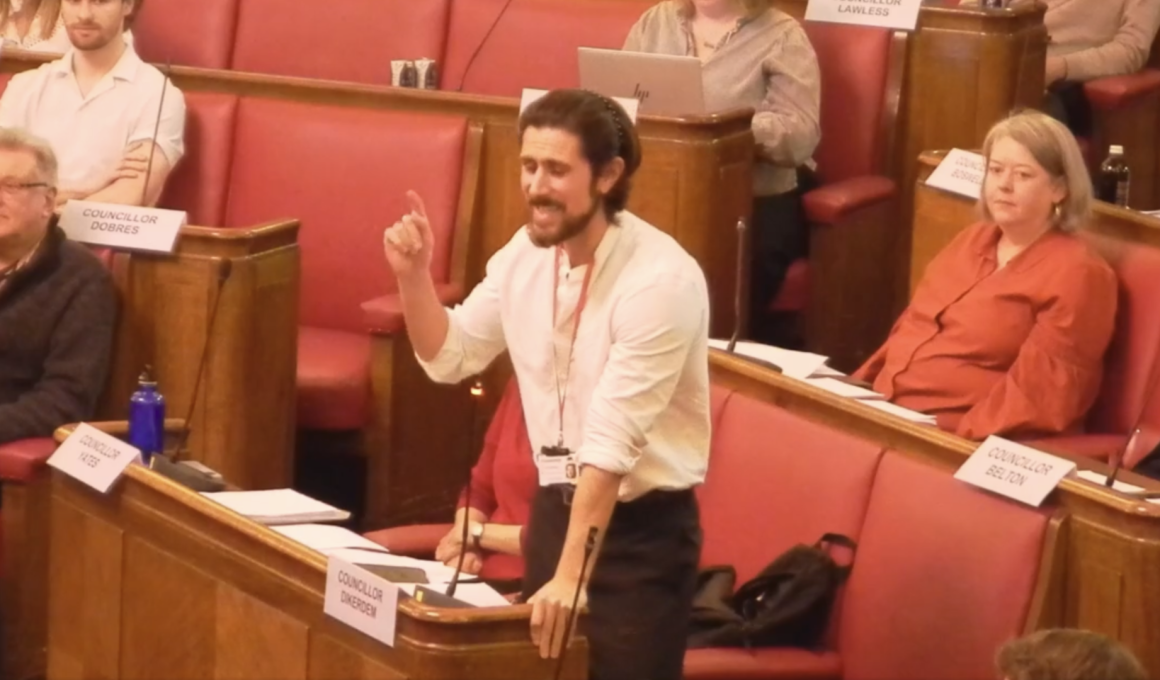
Two days before polling, the man who has run housing in Wandsworth for the past four years sat down at the Battersea Arts Centre for an hour-long interview with local outlet, Clapham Junction Insider. It is the most candid public account of his record he has given.

Some of what he told CJI is honest and reflective. Much of it cannot be reconciled with the council’s own documents.

Cllr Dikerdem has run the borough’s housing crisis. He is asking voters to put him back in charge of it. Here is what he said, and what the records show.

The Aydin Dikerdem who emerges from the CJI interview is a politician genuinely steeped in his brief. He grew up in Wandsworth. He talks about Falcon Road Bridge (a piece of local infrastructure he says he has wanted to see improved for years) with the easy familiarity of someone who actually walks past it.

He talks with feeling about what it is like to be a Muslim councillor in the current political climate, about hostility on the doorstep when people sometimes say things not knowing he is Muslim, and about why local government still matters when national politics turns ugly. He talks about the casework (a family moving into a new home, a private renter who finally won a 12-month rent repayment order after a year of mistreatment by an unlicensed landlord) as the part of the job that keeps him going.

Asked what was most difficult about the past four years, he names the regulator’s C3 verdict on the council’s housing department: a finding of serious failings requiring substantial improvement, published in February 2025. He does not deny the result. He frames it as inheriting “a 44-year-old machine” that he is “in the process of transforming.”

“I think it’s probably the most rewarding job in the world,” he tells CJI. By the end of the hour, you understand why he means it.

Overall verdict
D
😬 Misleading
He is candid about some failures and offers genuine reflection. But on the substance — what he built, what it cost, what the inspector said — the case he makes does not survive contact with the council’s own papers.
3
A
Accurate
2
B
Mostly true
8
C
Needs context
8
D
Misleading
2
E
Not accurate
3
U
Unverifiable
26 testable claims tested against the council’s own documents, the Local Plan inspector’s report, national statistical returns, and our own published reporting. The same methodology used on the Conservative and Labour manifestos.
What the documents show
The council’s Authority Monitoring Report 2024/25 records 366 homes built or started under the 1,000 homes programme. The Local Authority Housing Statistics return records 90 net additions over Labour’s term — and 70 of those, in 2024/25 alone, were homelessness acquisitions of existing properties under the LAHF programme, not newly built homes. The 2024/25 capital outturn (Paper 25-250 Appendix D) records a £10.387 million underspend on New Build Schemes attributed to “delays due to the extension of consultation.”
Sources: Wandsworth AMR 2024/25; LAHS national return; Paper 25-250 Appendix D; Putney.news, “Built 500 brand new council homes — or 366, or 90?”, 19 April 2026.
What the documents show
Putney.news reported in April 2026 that the council’s Platt Estate scheme in Putney cost £489,000 per unit to deliver — more than the open-market rate of £385,000 to £470,000. Cllr Dikerdem’s claim that costs are “falling drastically” is forward-looking, referring to the new MHCLG Accelerated Funding Programme. But on empirical evidence from the council’s own delivery, the per-unit cost is higher than the market, not falling.
Source: Putney.news, “Wandsworth’s housing crisis has the same cause. Both parties helped create it.”, 24 April 2026.
What the documents show
The Local Plan Partial Review inspector recommended non-adoption of the plan as submitted, and required 21 mandatory modifications (MM1 to MM21) before the plan could be adopted. The inspector found the proposed 45% affordable housing threshold was “not justified and would be counterproductive, materially impacting on the delivery of much needed homes.” Modification MM6 specifically deleted from the adopted plan the council’s claim that its evidence justified a different threshold to the London Plan. The net result: a 35% threshold — the same figure that was in place before the review began.
Sources: Local Plan Partial Review Inspector’s Report; Putney.news, “Wandsworth’s housing chief delivered nothing then told Cabinet it was a win”, 25 February 2026.
What the documents show
Council tax accounts for 32% of Wandsworth’s service revenue budgets, according to Budget Paper 26-63 and noted directly in CJI’s own footnote to the published interview. This is one of the largest single revenue lines in the council’s budget. The framing also matters because it is what underpins the “for now” position on using the unlimited council tax flexibility powers granted in December 2025: a council whose council tax is a third of its service revenue cannot, mathematically, sustain its current spending profile without significant rises.
Sources: Budget Paper 26-63; CJI, in-line footnote to Dikerdem interview, 2 May 2026; Putney.news, “Fact-check: the claims in Wandsworth’s council tax leaflet”, 16 March 2026.
What the documents show
Budget Paper 26-63 projects council tax rising from £525 (2026/27) to £701 (2027/28, a 34% rise) and £930 (2029/30, an 86% cumulative rise) under the unlimited council tax flexibility powers granted to Wandsworth in December 2025. Council Leader Hogg’s December 2025 refusal to use those powers was qualified explicitly with “for now”. The lowest-council-tax pledge is credible only for the year 2026/27.
Sources: Budget Paper 26-63; Putney.news, “Government gives Wandsworth unlimited tax powers”, 18 December 2025; Putney.news, “Your council tax must rise 34% next year or Wandsworth runs out of money”, 24 February 2026.
What the documents show
Wandsworth Council’s December 2025 press release confirmed that selective licensing covers Furzedown, South Balham, Tooting Bec and Tooting Broadway — four wards. The April 2026 extension brought in East Putney, West Putney and Northcote — three wards, not two. Cllr Dikerdem named only Tooting Broadway as the existing area and omitted West Putney from the expansion. The policy itself is real and the direction of travel is accurately described; the details are incomplete.
Source: Wandsworth Council press release, “Wandsworth Council extends scheme to crack down on unsafe rentals”, 15 December 2025.
What the documents show
CJI’s own report on the Hub at 12 March 2026 stated that the facility was operating at 30% capacity — three to four appointments per day against a maximum of ten. The first person had moved in on 17 February. Three people had passed through by mid-March. Cllr Dikerdem’s figure of nine people by late April is plausible given six weeks of additional operation, but the framing of “going in the right direction” sits uneasily with the council’s own absence of monitoring data on the related Private Rented Sector access scheme — confirmed via FOI in February 2026 — and with capacity utilisation that remains below half of the design intent.
Sources: CJI, “One month in: A massive innovation in progress for the new Rough Sleepers Hub”, 21 March 2026; Putney.news, “Cabinet member claims homelessness scheme success but council holds no data”, 9 February 2026.
What the documents show
The council will deliver 203 homes on Plot RS6a at Battersea Power Station under an £81.8 million deal — £65 million of which is borrowed and £16.8 million from a Greater London Authority grant. Battersea Power Station Limited holds the freehold; the council is “a long-term leaseholder into the hundreds of years,” in officer Paul Moore’s words at scrutiny. Cabinet approved the deal on 1 December 2025 using urgent powers. Contracts were exchanged before Christmas. Scrutiny members did not see the papers until 21 January 2026 — three weeks after contracts were legally binding. The financial details, including service charges and the revenue model, were considered in private session, with the public excluded.
Source: Putney.news, “Public excluded as council discusses Battersea land deal in secret”, 22 January 2026.
What the documents show
Wandsworth’s useable General Fund reserves stood at £199.4m in 2021/22 and peaked at £206.6m in 2022/23, the year Labour took over. They have fallen each year since: £204.2m (2023/24), £194.0m (2024/25), and £166.7m for the current year (2025/26). Budget Paper 26-63 projects a further fall to £116.3m for 2026/27. At a 22 September 2025 Cabinet meeting that approved a £424 million capital programme, Cllr Dikerdem himself argued that “it doesn’t make sense to sit on reserves without improving the foundational infrastructure” — at the same meeting, his own department was £15.7 million overspent on the HRA. So while the £200m figure roughly describes the inherited position, the current useable reserves are nearer £167m, and on the council’s own projections will be £116m within 14 months.
Sources: Budget and Council Tax Setting 2026/27 (Paper 26-63); Cabinet meeting 22 September 2025; Putney.news, “Council won’t evict tenants who don’t pay rent, but borrows £429m assuming they will”, 18 February 2026.
“Over 10,000 households on waiting lists, more than 4,500 in temporary accommodation”: confirmed by the council’s own Cabinet papers.
😇A
“32,000 properties, 17,000 of which are tenanted”: confirmed by the council’s own statement on the C3 rating.
😇A
“All our borrowing has been internally funded so far”: confirmed by the HRA Business Plan Update.
😇A
“All our schemes are inherited from the Conservatives”: broadly true, though the £24.5m Winstanley exit and the £81.8m Battersea deal are decisions of this administration.
🙂B
“Conservatives sold off 20,000 council homes”: right order of magnitude. Cllr Dikerdem’s own previous figure (Novara, 2022) was at least 24,000.
🙂B
“At 45% affordable, 70% of large sites remained viable”: the inspector explicitly rejected the evidence base for this finding, not just the conclusion drawn from it. Modification MM6 deleted the claim from the adopted plan.
😬D
“24% of completions includes legacy build-outs”: permissions trend improving but 2024/25 completions are the lowest on record.
😐C
Conservatives “hoarded reserves” and that’s “partly why grant is being cut”: broadly defensible on reserves growth (boosted by late-period Nine Elms developer receipts); the specific mechanism claim about how that affects grant settlement is contestable.
😐C
“It never occurred to us this council tax framing would be controversial”: CJI itself reported it was controversial from March 2023.
😐C
On the C3 rating, “we inherited a 44-year-old machine”: some structural issues pre-date 2022; specific Regulator findings are about failures during this term.
😐C
“450 bike hangars” delivered: the council has confirmed 346 are actually installed, with 116 still in consultation. He said “delivered” but the others have not been built — the recurring conflation of internal approval with completion.
😬D
“It was always a two-term programme”: no public statement before October 2025 has been found describing the 1,000-homes target as a two-term programme.
😬D
“Not one newspaper, journalist or resident raised it”: CJI did flag the Conservative use of the framing, but it never reached the saturation it has under Labour (no equivalent of the pink council-tax-freeze postcards or video campaigns). His underlying point about the asymmetry of scrutiny has merit — even if he overstates it.
😐C
“Lowest debts and highest reserves in the entire country”: true at takeover only on the General Fund. £884m of HRA borrowing is planned over the decade.
😬D
On the Conservative split for the original 1,000 homes (“around 400 council, 600 sale”): contemporaneous sources conflict. The Wandsworth Labour campaign launch (February 2022) said 442 social rent. The council’s own pre-election press release (March 2022) said 501 social rent, 482 sale-or-shared-ownership. The original Conservative cabinet papers would settle it; we have not been able to locate them.
Conservatives “lost money to inflation on that reserve strategy”: treasury management strategy reports for 2018–22 not located.
A council-led tribunal-support service launching on 1 May 2026 to help private renters challenge rent increases: no council press release announces such a service. The council’s existing private renting page on wandsworth.gov.uk has not been updated. The Tenants’ Champion function exists but predates the Renters’ Rights Act and is not the service Cllr Dikerdem described.

What he gets right

Some of what Cllr Dikerdem said checks out cleanly against the documents.

The figures he gives for the scale of Wandsworth’s housing crisis (over 10,000 households on waiting lists, more than 4,500 of them in temporary accommodation) match the council’s own most recent Cabinet paper on its housing finances, almost word-for-word. The figures he gives for the council’s housing stock (around 32,000 properties, of which 17,000 are tenanted by social rent residents) match the council’s own statement to its tenants on the regulator finding.

That regulator finding is the C3 verdict, the second-lowest grade the Regulator of Social Housing can issue, published in February 2025 with findings of serious failings requiring substantial improvement. It is the lowest assessment the Wandsworth’s housing department has ever received. Cllr Dikerdem does not contest it (at least not this time). He says, to CJI’s editor Cyril Richert that it was the most difficult thing of his four years in the job. That admission, on tape, is closer to genuine accountability than the council’s official communications about the result, which framed it largely as the consequence of decisions taken before Labour took office.

He is also candid, in places, about the scale of what has not been fixed. The Homelessness Hub (the pop-in centre for rough sleepers his administration opened in 2024 after a bruising consultation row) has, he tells CJI, helped nine people through to accommodation. He acknowledges the figure is small. CJI’s reporting puts the Hub’s running utilisation at well below capacity.

These moments matter. They show readers that on some points, this is a Cabinet Member willing to tell the truth even when it is uncomfortable. It is what makes the rest of the interview harder to read.

The pattern

Watch where the credit goes, and where the blame lands.

Asked about delivery of the Homes for Wandsworth programme, he tells CJI that “all our schemes are inherited from the Conservatives.” That is true in part. But the £24.5 million the council paid Taylor Wimpey to exit the Winstanley regeneration in December 2024 (which his department still refuses to provide information on), and the £81.8 million it has just borrowed to build on private land at Battersea Power Station, are decisions of his administration, not inheritances.

Asked about the council tax “freeze” framing that the UK Statistics Authority publicly criticised in March 2026, he tells CJI that “not one newspaper, journalist, or resident” had ever raised concerns about it. It’s true that the Conservative used the same framing. But they didn’t repeat the claim at every opportunity, make videos about it, and put it on a bright pink card sent to it every house in Wandsworth. CJI also notes that it did in fact flag the framing in the Conservative era.

Asked about the Local Plan Partial Review (the council’s flagship attempt to push the affordable housing threshold from 35% to 45%) he tells CJI that the inspector “gave us nine out of ten things we asked for.” The inspector’s report recommended non-adoption of the plan as submitted, required 21 mandatory modifications, and concluded the council’s flagship policy would be counterproductive.

It is the same shape each time. Where things have gone well, he was the agent. Where they have gone badly, the cause is elsewhere.

Where the case doesn’t hold

Then there are the substantive untruths.

He tells CJI: “We’ve now built 500 brand-new council homes.” The council’s own Authority Monitoring Report records 366 built or started under the programme. The national statistical return records 90 net additions over Labour’s term, and 70 of those are LAHF-funded acquisitions of existing properties, not new builds. The 2024/25 capital outturn records a £10.387 million underspend on the new build programme.

He tells CJI the cost per unit is “falling drastically.” The council’s most recent council-built scheme (the Platt Estate, near the river in Putney) cost £489,000 per unit to deliver. The market rate for an equivalent new home is £385,000 to £470,000.

He tells CJI that council tax is “a very small proportion” of the council’s budget. It is 32% of the council’s service revenue, as CJI’s own interviewer noted in a footnote to the published piece. The same Budget Paper projects council tax rising 86% by 2029/30 under the unlimited flexibility powers granted to Wandsworth in December 2025. For a Cabinet Member who, in September 2025, told his own colleagues that “it doesn’t make sense to sit on reserves” while his department was £15.7 million overspent, the pattern is consistent: other people’s money is discussed loosely, and the numbers are supplied only when they flatter.

He tells CJI that selective licensing is currently in “Tooting Broadway” and is being extended to “East Putney and Northcote.” The council’s own December 2025 press release confirms the existing scheme covers four wards (Furzedown, South Balham, Tooting Bec, and Tooting Broadway) and that the April 2026 extension brings in three wards, not two: East Putney, West Putney, and Northcote. Voters in West Putney, following along, were not told their ward was part of his department’s flagship private renter policy.

CJI’s editor flagged some of these in real time, with footnotes embedded in the published interview. The full set, with all sources and reasoning, is below.

His engagement record

Cllr Dikerdem has not given Putney.news the same opportunity he gave CJI.

In December 2025 we put detailed questions to him about Kimpton House leaseholders facing 400% cost increases on a fire safety project. He did not respond. In November 2025 we put questions to him about 299 outstanding fire safety actions in council properties, a number from the council’s own external audit. He did not respond. In October 2025 we put questions to him about the council’s successful Court of Appeal eviction of an autistic resident on a procedural technicality. He did not respond. In November 2025 we put questions to him about the Fownes Street anti-social behaviour case, which played out months after his own June 2025 public commitment to reform. He did not respond. When he has responded, it has come in the form of personal abuse.


Polling day is Thursday. Cllr Dikerdem is asking voters to return him to the Cabinet for a second term. The CJI interview was his hour to make his case. The graphic above tracks the claims he made, and what the documents show. Read the interview. Read the documents. Decide.

Total
0
Shares
Leave a Reply

Your email address will not be published. Required fields are marked *

Related Posts
Total
0
Share