

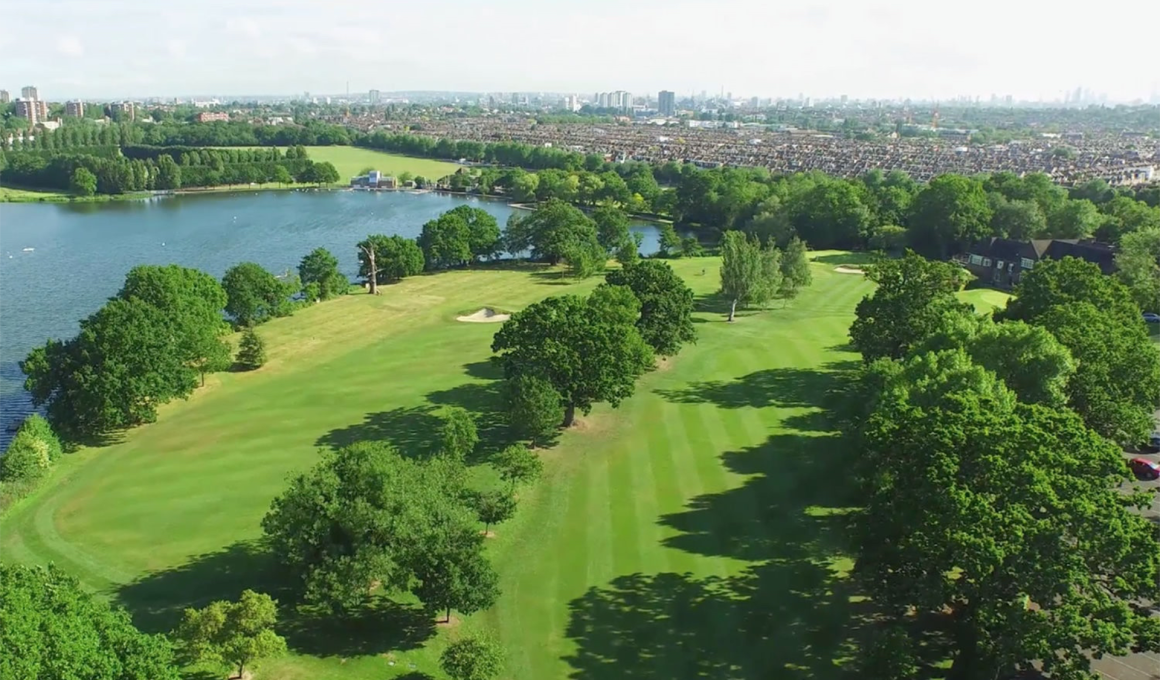
This week, Richard Rees stood up in St Mark’s Church in Wimbledon and told 150 supporters of the Save Wimbledon Park movement what he thought of the All England Club’s approved plans to expand the world’s most famous tennis tournament.
He was not polite.
Rees is not a campaigner or a local resident. He is what is termed a “master planner”. And it was in that role that he designed the Wimbledon tournament’s first big step into the world of modern tennis in the 1990s; the one that shaped Wimbledon as it exists today. His team coined the phrase that has became Wimbledon’s defining identity: ‘Tennis in an English garden.’
Rees has gone on to design Olympic tennis venues at Sydney, Athens, Beijing and Rio. He planned the regeneration of Liverpool city centre and worked on the Hong Kong waterfront. He is, in short, precisely the person whose opinion on a Wimbledon master plan you would most want to hear.
Two years ago, a friend suggested he look at the All England’s approved expansion scheme. He had not seen it. He looked. What he found troubled him so much that he has spent the past year designing an alternative.
“Frankly, I was confused and disappointed,” he told attendees who had come to hear him on Wednesday evening, the day after Parliament had stripped another layer of legal protection from Wimbledon Park without a vote. The championships had been run on 22 to 23 courts for years. The approved scheme proposes 38 additional courts on the extended site, taking the total to 71. “I think it was a push just to see how much we could do, slam it on,” he said. “It’s an inadequate master plan. I’m sorry. But I’m allowed to criticise — I’ve done it myself.” He knew what an inadequate master plan looked like.
Twenty-one courts, a lake, and a different idea entirely
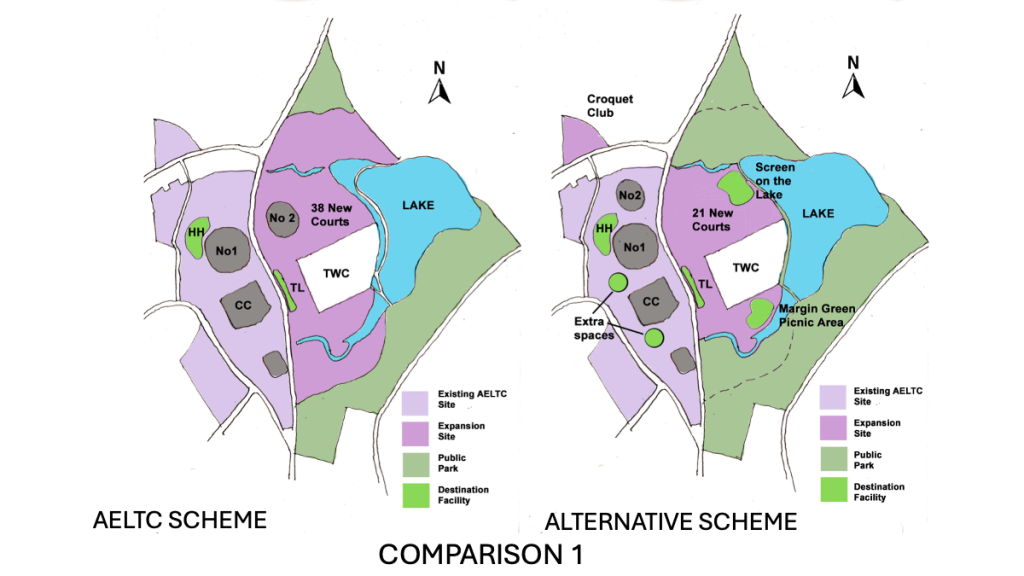
The scheme Rees designed with local architect Ken McFarlane starts from a simple challenge to the approved plan’s central premise: why 38 courts?
The stated reason for the whole expansion is to bring the qualifying tournament on-site, currently held off-site at Roehampton. That requires 18 courts, not 38. You can use qualifying courts as practice courts once the main championship begins, he notes. Junior and wheelchair competitions share facilities. The Aorangi Croquet Club off Bathgate Road can hold six more practice courts. The All England used to use it. It could do so again.
With this obvious reuse of courts, 38 courts become 21. The extended land footprint shrinks from 46 acres to 26. Forty-six acres of public park remain, and they can be linked permanently by a lakeside path.
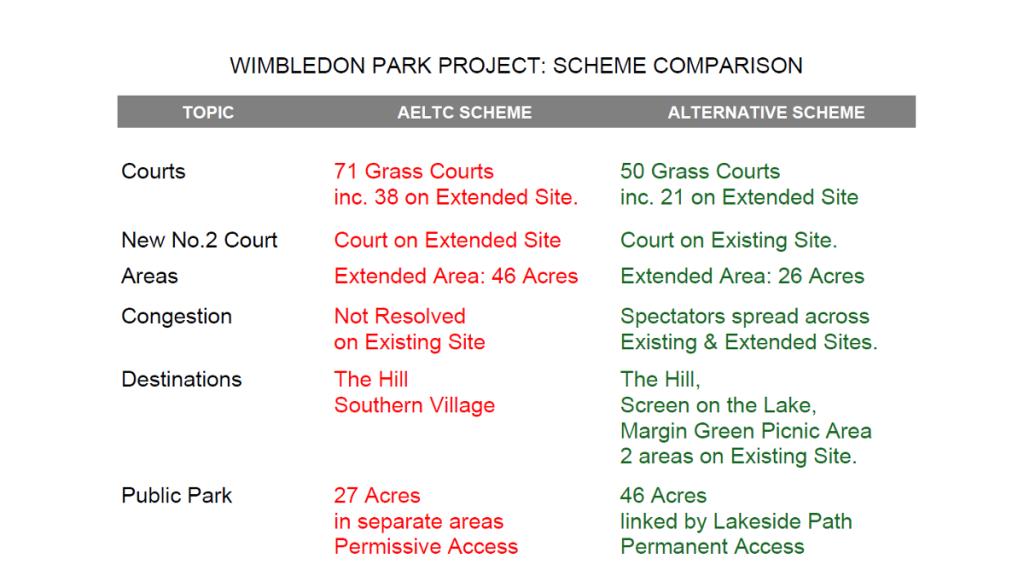
The proposed No. 2 Court is where the alternative most sharply departs from the approved scheme. AELTC proposes an 8,000-seat covered stadium on the protected golf course land. Rees accepts the principle: a covered court, the ability to play regardless of weather, is genuinely what Wimbledon needs. But he rejects the scale and the location entirely.
“Yes, get a covered court,” he told the meeting, “but we’re suggesting a much smaller idea for that.”
In conversation after the meeting he was more direct: the roof matters more than the seat count, and a smaller covered court on the north end of the existing site solves the operational problem without planting a stadium on protected parkland.
How that proposed court compares with the equivalent courts at other Grand Slams is shown in the graphic above. The US Open Grandstand also has no roof – but then New York in August is not Wimbledon in June.
The debate is not really about whether Wimbledon needs a covered No. 2. It does. The debate is about what a replacement is actually solving. Rees’s answer is blunt.
“Wimbledon will always be the premier Grand Slam because it was the first, it’s the only one on grass,” he said.
In fact, when he was tasked with redesigning Wimbledon’s master plan, he was given the New York comparison explicitly as a warning. “Don’t go to New York,” they told him. “It’s horrible.” The brief, he noted, appears to have changed without anyone asking whether it should.
Tennis in an English garden
Rees’s team coined the phrase that has driven the look-and-feel of the Wimbledon tournament for over 30 years. He told us after the meeting that he probably still has the original documents.
The phrase has stuck. It appears in the brief given to Grimshaw architects when they designed the 2013 master plan for the existing grounds, framed as Wimbledon’s unique setting to be preserved. It is the stated ethos of Grant Associates, who designed the landscape strategy for that same plan. And just this past June, ahead of the 2025 tournament, Wimbledon’s head gardener Martin Falconer was still using the same words. ‘For us it’s more actually about the feel of being in an English garden,’ he told AFP. The year before, he had been more direct still: ‘Our ethos is tennis in an English garden,’ he told ABC News.
What does it actually mean? Not merely flowers and strawberries. Wimbledon uses 10,000 individual petunia plants around the grounds each year, timed to bloom for the fortnight. It means something more structural: that the setting in which the tennis takes place is itself part of the experience. The grass. The scale. The sense that you are somewhere particular, somewhere that could not exist in New York or Melbourne or Paris. The intimacy between spectator and sport that disappears when courts seat 23,000 people and you cannot see the ball from the back row.
Wimbledon was started on four acres of meadowland in 1868, with 200 spectators at its first championship in 1877. Last year, 548,770 people passed through the gates across the fortnight, a new record. The growth is extraordinary and it brings commercial pressure with it. Wimbledon has the lowest attendance of any Grand Slam: roughly half the US Open’s 957,000 and barely more than half the Australian Open’s one million. The financial argument for expansion is real. The new land is an opportunity to grow.
But here is the thing. Every master plan the All England Club has commissioned for the past thirty years has invoked the same principle: Rees's original, Grimshaw's 2013 redesign, Grant Associates' landscape strategy. Each time the club has grown, it has promised that growth would be guided by this vision. Each time, as Rees noted quietly on Wednesday, something has been lost. Courts were reconfigured. Trees came out. Glass and steel replaced them. Grimshaw's 2013 plan was itself an attempt to ease the congestion that had already made the existing site uncomfortable. It moved courts north of No. 1 to release space at the centre. That was ten years ago. The problem has got worse, not better.
The approved expansion scheme was designed by Allies and Morrison, appointed in 2019 after AELTC paid £65 million for the golf course land. Their public materials, unlike every previous Wimbledon master plan, do not appear to invoke the phrase at all. The vision that has guided Wimbledon's development for thirty years is absent from the documents that would govern its most significant expansion in its history.
There is a reason for that absence, and Rees stated it plainly at Wednesday’s meeting. “It was not properly examined by a technical tennis masterplanner, like a masterplanner like myself,” he said.
“There are five or six people I could mention around the world who could have looked at this and given a very detailed description of what is wrong with it.”
Every previous Wimbledon masterplanner had gone back to that founding design ethos. Without one this time, the brief shifted. Capacity became the goal. The vision was lost.
Richard Rees noticed. So did everyone who has been to Wimbledon in recent years.
The problem nobody seems to have solved
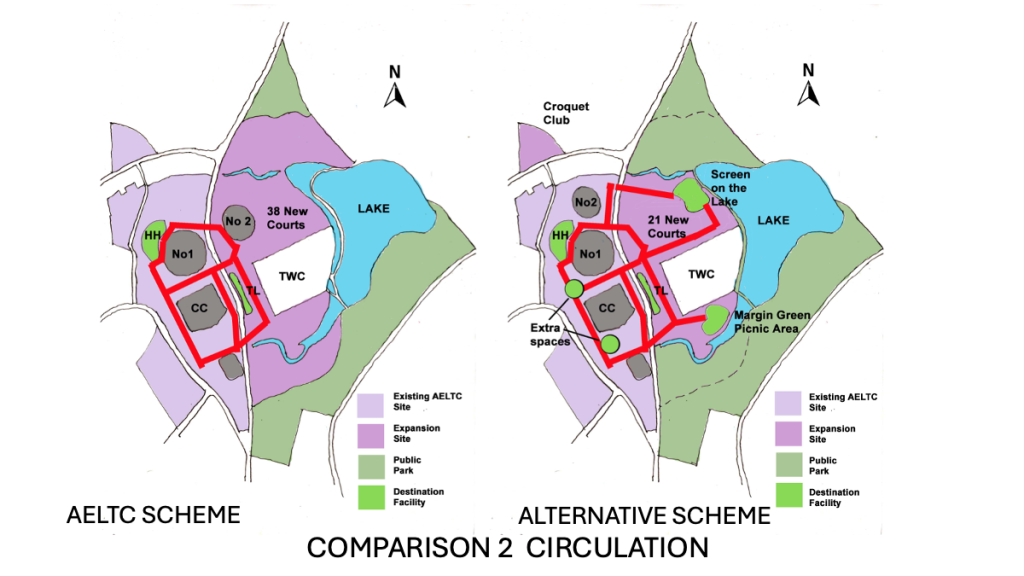
The deeper argument is about congestion. It is the argument the approved scheme, in Rees's view, simply does not address.
Go to Wimbledon during the championships. At peak times it can now take half an hour to cross from one end of the existing site to the other. The complex was designed for 30,000 to 35,000 visitors. It now receives 42,000. The approved scheme would bring that to 50,000, and it would concentrate the new facilities directly alongside the courts that are already at capacity.
"It's dangerously overcrowded," Rees told the meeting. He should know: when he designed the original Wimbledon master plan, the Hillsborough disaster was foremost in his mind. On 15 April 1989, 97 Liverpool supporters had died in a crush at Hillsborough stadium in Sheffield, the deadliest disaster in British sporting history, caused by overcrowding in pens that police failed to control. The Taylor Report that followed changed how public sports venues across Britain were designed and managed. Three years on, Rees moved the original No. 1 Court to ease congestion and create space between courts. That principle, he said, has been ignored in the current plans.
Rees's solution draws on the principle he applied when he planned Liverpool city centre: without destinations at both ends, people do not distribute. They crowd in the middle. The alternative places attractions on the far side of the new land: a Screen on the Lake, a big-screen viewing area beside Wimbledon Park's historic lake, and a Margin Green Picnic Area with temporary showcase courts to the south.
"You've got a lake for goodness sake," he told the meeting, "and you're turning your back on it."

"Good master plans only need simple principles," he said. "The principle here is: equalise the two halves." In ten years, he added, "you should be able to say: Wimbledon is still tennis in an English garden."
There is a further critique, quieter but pointed. Rees has been back to the existing Wimbledon site in recent years and does not entirely like what he has found. The hedges went. The trees went. Glass buildings replaced them. "It looks a bit like an office block," he said.
The alternative plan is partly about restoring what made the existing site Wimbledon, not just constraining what happens on the new land. You could start putting trees back into the courts that were removed, he suggested. The right kind - not anything that would shade play. But enough to transform the atmosphere. Tennis in an English garden. Still achievable. Still worth fighting for.
Why the alternative changes the legal picture
The alternative scheme is not just a design argument. It is also a legal one. As explained in our coverage yesterday, the 1993 covenants on the golf course land require it to be kept as open space, free of permanent buildings.
Lawyer and SWP director Jeremy Hudson told the meeting that the approved scheme breaches those covenants, as the All England Club itself acknowledges. The alternative scheme, in his view, would likely fall within them: courts as concrete rings at ground level, hospitality on temporary structures. No permanent buildings on the protected land.
"Would I rather there is no development?" Hudson said, when asked whether the alternative amounted to giving in. "Yes. Do I think the alternative plan represents a much better solution than the All England's? Yes. It is a compromise. It represents a reasonable middle way between the polarised positions."
The All England's response
Something interesting happened at Southfields the previous Wednesday. For the first time at any SWP public meeting, after nearly a dozen invitations, the All England Club sent representatives. Their chair, Debbie Jevans, was among them. They heard the alternative scheme. They listened. At the end of the evening, Coombe was assured they "would like to keep talking."
They were invited to Wednesday's meeting at St Mark's, where the plans were presented in full. They did not come. Coombe told the room they had replied to his invitation saying they were "not really interested in discussing it, all very difficult."
Richard Rees was measured about what he hoped the alternative might achieve. He knows Debbie Jevans. She was director of women's tennis at the International Tennis Federation when he designed the original master plan.
At Southfields she heard his two central arguments: that the approved scheme fails to solve the congestion on the existing site, and that it turns its back on the lake and the park that make Wimbledon what it is. Rees expressed hope that having heard those arguments from the man who designed Wimbledon in the first place, she might look at the existing plans with fresh eyes. "It's been planted," he said. "In her brain."
Save Wimbledon Park has been to the High Court twice, fought in the House of Lords and the House of Commons, and is fully prepared to go to the Supreme Court. It has also, in parallel, produced this alternative master plan. All of it voluntary. All of it without pay. Against a club with vast resources and, as Tuesday's parliamentary vote demonstrated, friends in high places.
It's still not clear why the All England Club has set itself against its neighbours, or why it continues to underestimate both them and their love of the area. While fighting them in the courts, the hope is that the private club will recognise the value of compromise, pulled to the realisation by hearing its own words played back to it: Tennis in an English garden.
Paul Kohler, the Wimbledon MP, was in the audience on Wednesday. "What I've seen looks fantastic," he said. "It respects the covenants. It does maintain the All England as a world-leading place without going back on the promises made 30, 40 years ago."
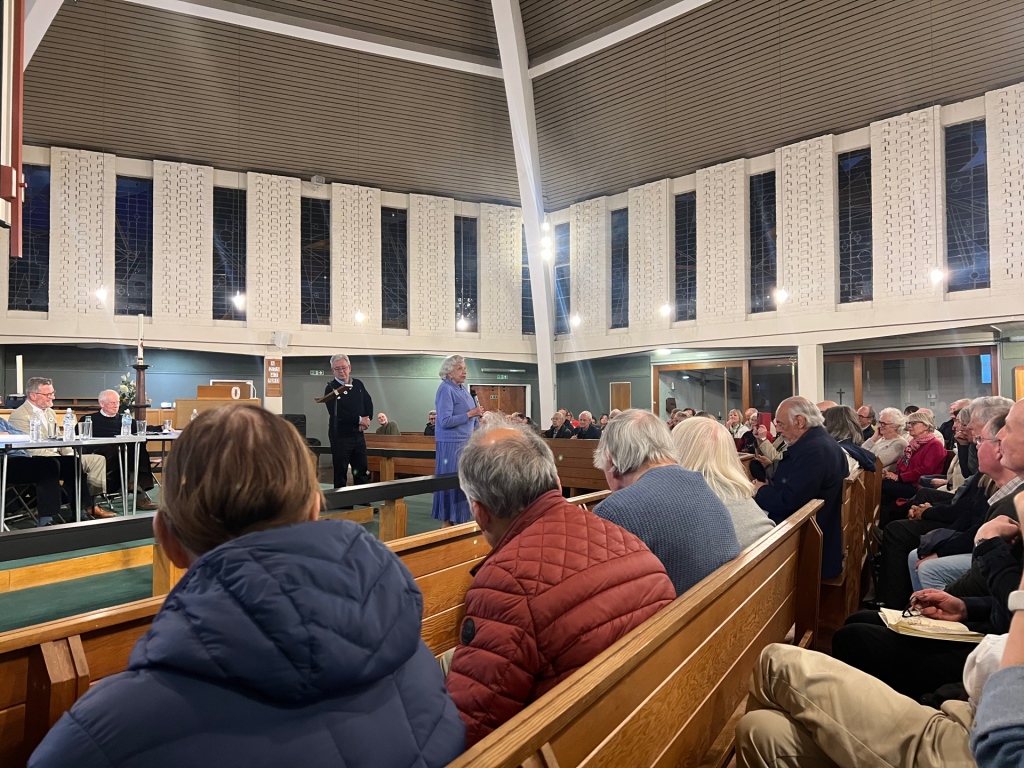
At the close of the meeting, actress Thelma Ruby, 101, who overlooks the park from her flat, addressed the room. For years, she said, the approved plan had given her "the most terrible nightmares." The alternative meant something she had not expected to feel. "There could be a chance."
Putney.news has followed the battle to save Wimbledon Park for some time. Our full coverage includes the five questions that will decide the future of Wimbledon Park, Tuesday's passing of the Banner amendment, and yesterday's full account of the legal and political background to this dispute.



While I appreciate the effort that has gone into producing this alternative plan, I think it is a mistake to offer AELTC any opening to develop on the existing parkland, for three principal reasons: firstly, the assumption that it must grow to compete with other tournaments is questionable: it already attracts full spectator attendance and world-ranking players. Secondly, there has to be a limit to the burden that the tournament is allowed to impose on the residents and the proposed increase in numbers would surely surpass it. Lastly, and arguably the most important, given AELTC’s arrogance and huge financial resources, there is a real danger that any permitted development would be used by the club in the future to justify further expansion, regardless of whatever constraints are imposed now.